


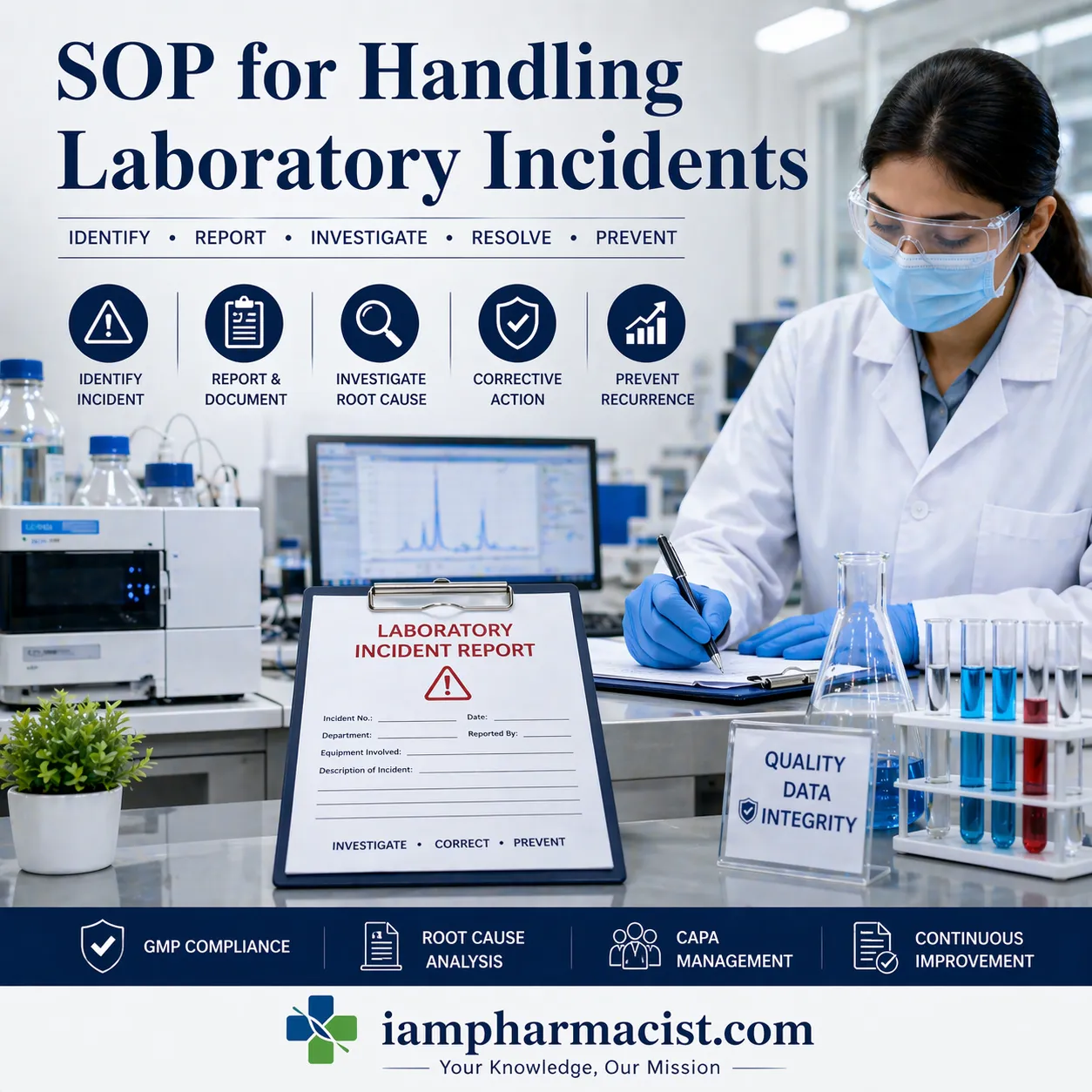

Learn SOP for handling laboratory incidents in pharmaceutical QC including investigation, reporting, CAPA, and GMP compliance procedures.
Introduction
In pharmaceutical quality control laboratories, even minor errors or unexpected observations can significantly impact data integrity and product quality. Laboratory incidents—whether analytical errors, equipment issues, or environmental factors—must be handled systematically to ensure compliance with GMP standards.
A well-defined SOP for laboratory incident handling ensures timely identification, proper investigation, corrective actions, and documentation. This guide provides a structured and audit-ready approach to managing laboratory incidents effectively.
Definition
Laboratory incident in QC refers to any unexpected event, error, deviation, or abnormal observation during testing that may affect the accuracy, reliability, or integrity of analytical results.
| Category | Examples |
|---|---|
| General | Calculation errors, contamination, wrong parameters |
| Chromatography | Carryover, RT shift, peak splitting |
| Spectroscopy | Extra peaks, low correlation |
| Microbiology | OOT results, media errors |
| Documentation | Missing logbook entries |
Step-by-Step Process
- Identify incident
- Stop analysis immediately
- Inform supervisor
- Record incident in logbook
- Assign incident number
- Investigate root cause
- Implement CAPA
- Approve and close incident
1.0 OBJECTIVE
To lay down the procedure for handling laboratory incidents in Quality Control.
2.0 SCOPE
Applicable to all Quality Control laboratory activities.
3.0 RESPONSIBILITY
- Officer / Sr. Officer: Perform and report incidents
- Executive / Manager: Review and verify
4.0 ACCOUNTABILITY
Head of Department
5.0 PROCEDURE
5.1 Identification of Laboratory Incidents
General Incidents
- Borderline results
- Incorrect parameter testing
- Calculation/reporting errors
- Sample contamination
- Use of uncalibrated instruments
- Weighing/dilution errors
- Wrong method parameters
- Improper sample handling
- Glassware breakage
- Power interruptions
- Sample spillage
- System suitability failure
Chromatographic Incidents
- Injection carryover
- Unknown impurities
- Retention time shift (>10%)
- Peak splitting / poor shape
- Baseline drift
- Standard failure
Spectroscopy Incidents
- Extra peaks
- Poor correlation
Microbiology Incidents
- OOT/borderline results
- TOC noise
- Incorrect media preparation
Documentation Issues
- Missing logbook entries
5.2 Immediate Actions (Operation)
- Stop analysis immediately
- Inform supervisor
- Preserve sample and data
- Do not discard evidence
- Document initial observation
5.3 Incident Reporting
- Record incident in logbook
- Assign incident number:
QCI/YY/XXX
Example:
- QCI = Quality Control Incident
- YY = Year
- XXX = Serial number
5.4 Investigation Procedure
- Analyst documents incident details
- Attach:
- Raw data
- Chromatograms
- Calculations
- Perform checklist (HPLC/GC if applicable)
Root Cause Analysis
- Instrument issue
- Analyst error
- Method issue
- Environmental factor
5.5 CAPA (Corrective & Preventive Action)
- QC Manager reviews investigation
- Propose corrective actions
- Define preventive measures
- Monitor effectiveness
5.6 Approval and Closure
- QA Manager approves report
- Close within 30 working days
- Document any extension
5.7 Training Requirement
- Ensure trained personnel handle incidents
- Maintain training records
5.8 Documentation & Record Retention
- Maintain incident report forms
- Attach supporting data
- Ensure traceability
5.9 Calibration / Compliance
- Verify instrument calibration
- Check system suitability
- Ensure compliance with STP
5.10 Cleaning / Data Integrity
- Maintain clean documentation
- Follow ALCOA+ principles
- Avoid overwriting
6.0 ABBREVIATIONS
- SOP – Standard Operating Procedure
- STP – Standard Testing Procedure
- QC – Quality Control
- QA – Quality Assurance
- HPLC – High Performance Liquid Chromatography
- GC – Gas Chromatography
- TOC – Total Organic Carbon
Annexure: Incident Report Format
- Product Name
- Batch No / AR No
- Equipment
- Incident No
- Test & Date
- Analyst Details
- Description of Incident
- Investigation
- Corrective Action
- Preventive Action
- Signatures (QC & QA)
Technical Insight: Why Incident Handling Matters
Proper incident handling ensures data integrity, regulatory compliance, and product quality. It also helps identify systemic issues and prevent recurrence through CAPA.
FAQs
1. What is laboratory incident in QC?
Any deviation or unexpected event during analysis.
2. What is incident number format?
QCI/YY/XXX.
3. Who reports incidents?
QC analyst.
4. What is CAPA?
Corrective and preventive action.
5. How fast should incident be logged?
Within one working day.
6. What is closure timeline?
Within 30 working days.
7. What is ALCOA+?
Data integrity principles.
8. What if investigation delays?
Reason must be documented.
9. Which instruments require checklist?
HPLC and GC.
10. Who approves incident report?
QA Manager.