


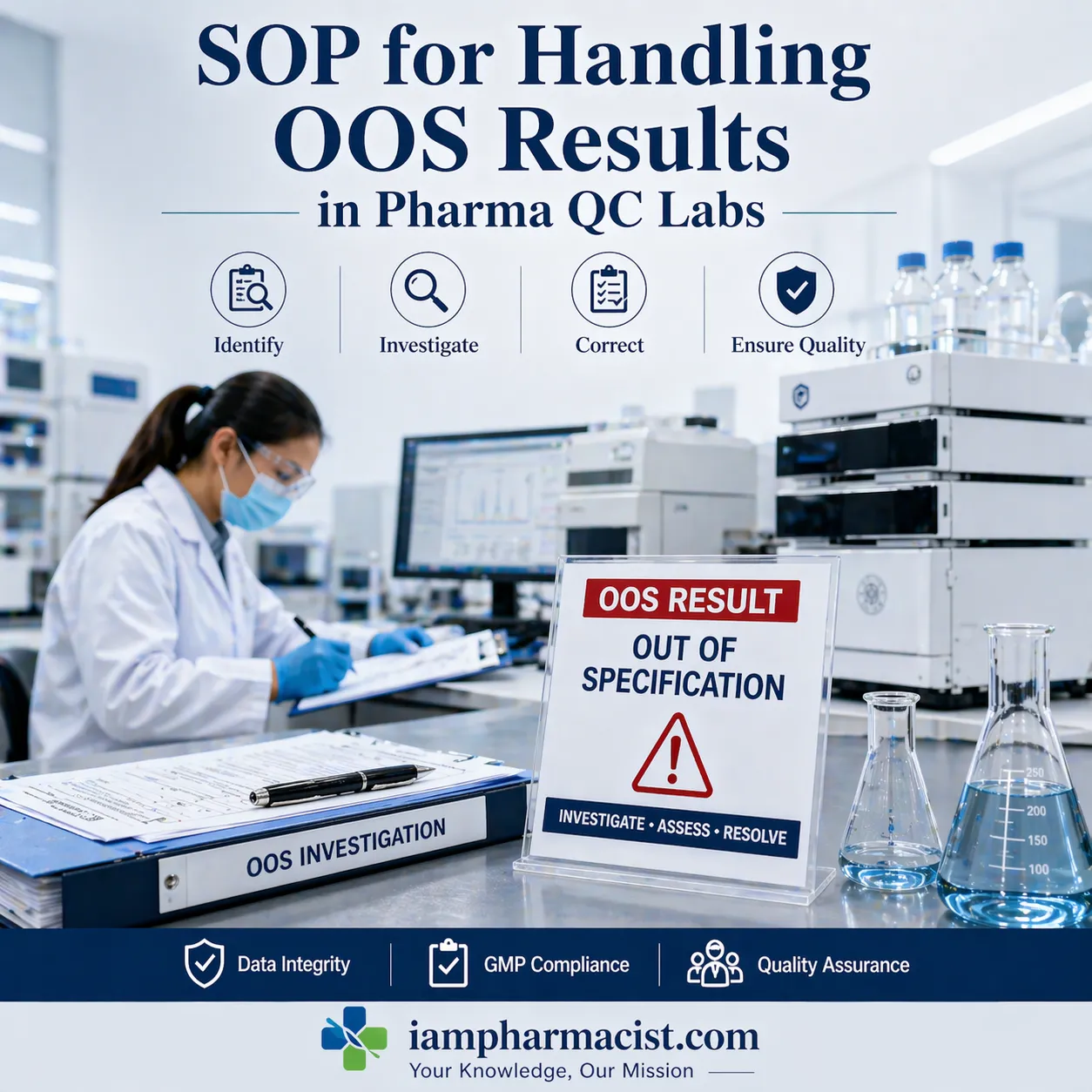

Learn SOP for handling Out of Specification (OOS) results in pharma QC labs with stepwise investigation, reanalysis, and GMP compliance.
Introduction
In pharmaceutical quality control, accurate analytical results are critical for ensuring product safety, efficacy, and compliance. However, deviations such as Out of Specification (OOS) results can occur during testing.
A robust SOP for handling OOS results ensures systematic investigation, identification of root causes, and regulatory compliance. This document provides a detailed GMP-aligned procedure for managing OOS results, including multi-stage investigation and decision-making processes.
Definition
Out of Specification (OOS) refers to test results that fall outside predefined acceptance criteria or specifications during analysis of pharmaceutical materials, including raw materials, packaging materials, and finished products.
| Stage | Description |
|---|---|
| Stage A | Initial laboratory investigation |
| Stage B | Repeat analysis by another analyst |
| Stage C | Re-sampling and comparative analysis |
| Final Conclusion | Approval or rejection decision |
Step-by-Step Process
- Identify OOS result
- Record in OOS logbook
- Perform Stage A investigation
- Conduct repeat analysis (Stage B)
- Perform re-sampling if required (Stage C)
- Evaluate results
- Approve or reject material
1.0 PURPOSE
To describe the procedure for handling Out of Specification (OOS) results obtained during analysis.
2.0 SCOPE
Applicable to OOS results obtained in QC laboratory for raw materials, packaging materials, and finished products (release parameters only).
3.0 RESPONSIBILITY
- QC Analyst
- Report OOS results to QC In-charge
- QC In-charge
- Issue OOS form and log entry
- Conduct investigation
4.0 ACCOUNTABILITY
- Quality Head
- Review investigation
- Approve final decision
5.0 PROCEDURE
5.1 OOS Handling Workflow
- Analyst reports OOS result
- QC In-charge logs entry and issues investigation form
- Investigation begins (Stage A)
5.2 Stage A: Initial Investigation
- Check:
- Sample condition
- Instrument calibration
- Balance calibration
- Reagents validity
- Analytical calculations
- Chromatograms and records
- Glassware accuracy
Outcome:
- If error found → correct and reanalyze
- If passes → release material & retrain analyst
- If satisfactory → proceed to Stage B
5.3 Stage B: Repeat Analysis
- Assign analysis to another analyst
- Evaluate results
Outcome:
- If passes → reanalyze by original analyst
- Investigate analyst performance
- If satisfactory → release material
- If fails → proceed to Stage C
5.4 Stage C: Re-sampling Investigation
- Authorized by Quality Head
- Analyze:
- New sample
- Previously approved batch
Outcome:
- If current fails & reference passes → reject material
- If both pass → re-investigate Stage B
- If no previous batch available → reject material
5.5 Final Decision
- Document all findings
- Attach:
- Stage A, B, C reports
- Analytical records
- Quality Head gives final approval/rejection
5.6 Documentation & Record Keeping
- Maintain OOS logbookhttps://iampharmacist.com/non-conformance-in-pharmaceuticals/
- Attach all chromatograms and reports
- Cross-reference analytical reports
- Maintain traceability
5.7 Cleaning / Compliance (Data Integrity)
- Ensure clean documentation practices
- Avoid overwriting data
- Follow ALCOA+ principles
5.8 Calibration / Verification
- Verify instruments before analysis
- Ensure calibration status is valid
- Maintain calibration logshttps://www.scribd.com/document/862952640/QC-040-00-Preparation-of-Mobile-phases
6.0 ABBREVIATIONS
- SOP – Standard Operating Procedure
- OOS – Out of Specification
Technical Insight: Why OOS Investigation is Critical
OOS handling ensures product quality and regulatory compliance. It helps identify root causes such as analytical errors, instrument failure, or actual product defects—preventing release of substandard products.
FAQs
1. What is OOS in pharma?
Out of Specification result outside predefined limits.
2. What are OOS stages?
Stage A, B, and C investigation.
3. Who handles OOS?
QC analyst, QC in-charge, and Quality Head.
4. What is Stage A?
Initial investigation of lab errors.
5. What is Stage B?
Repeat testing by another analyst.
6. What is Stage C?
Re-sampling and comparative analysis.
7. When is material rejected?
When results fail after investigation.
8. What is OOS logbook?
Record of all OOS events.
9. Why reanalysis is done?
To confirm results and rule out errors.
10. What guidelines apply?
GMP, WHO, and regulatory standards.