


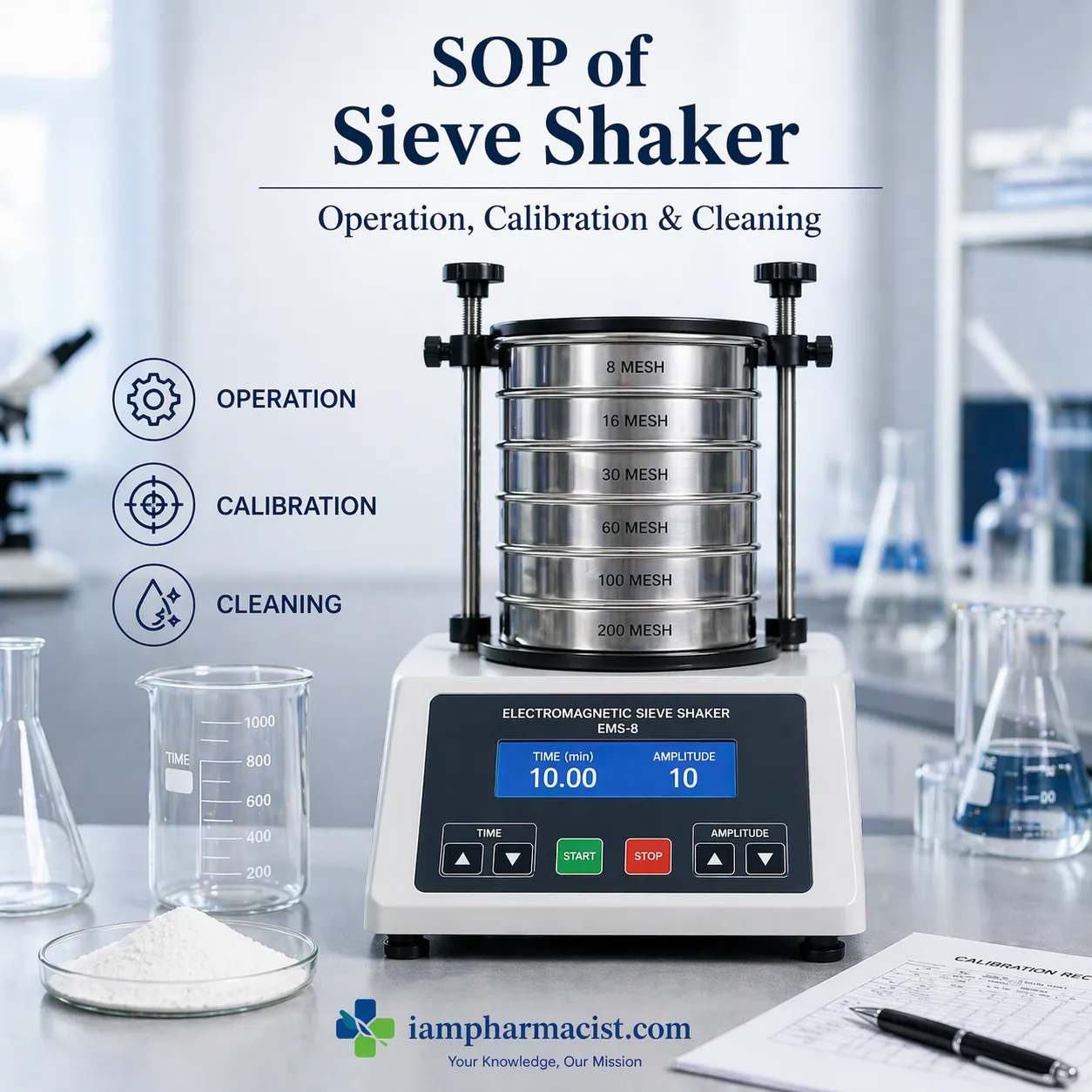

Learn the complete SOP of sieve shaker including operation, calibration, and cleaning for accurate particle size analysis of powders.
Introduction
Particle size distribution plays a crucial role in determining the quality, dissolution rate, and bioavailability of pharmaceutical products. The sieve shaker is a fundamental instrument used in quality control laboratories to analyze powder particle size accurately.
This SOP provides a detailed and practical guide for operating, calibrating, and cleaning a sieve shaker to ensure reliable, reproducible, and compliant results in laboratory environments.
Definition
Sieve shaker is a laboratory instrument used to separate and classify particles based on size by passing them through a stack of sieves with decreasing mesh sizes under controlled vibration.
| Parameter | Description |
|---|---|
| Sieve Size | Mesh opening size |
| Amplitude | Vibration intensity |
| Time Duration | Duration of shaking |
| Mode | Continuous or intermittent |
| Particle Size Range | Distribution of powder sizes |
| IP Standard | Compliance with pharmacopeial standards |
Step-by-Step Process
- Clean and prepare the instrument
- Arrange sieves in descending mesh size
- Load powder sample
- Set time and amplitude
- Select operation mode
- Start vibration
- Collect and analyze retained fractions
1.0 OBJECTIVE
To describe the procedure for operation and calibration of sieve shaker.
2.0 SCOPE
This SOP is applicable for operation and calibration of sieve shaker.
3.0 RESPONSIBILITY
Officer / Executive – Quality Control
4.0 ACCOUNTABILITY
Manager – Quality Control
5.0 PROCEDURE
5.1 Operation of the Instrument
- Ensure working bench and instrument are clean
- Switch ON the instrument
- Display shows:
ELECTROMAGNETIC SIEVE SHAKER EMS-8
Setup
- Use sieves with certified IP standard mesh sizes
- Arrange sieves in decreasing order of pore size
- Place sieves securely on shaker
- Set amplitude to lowest initially
Parameter Setting
- Set time (0–99 minutes) using ▲▼ keys
- Set amplitude (power level 5–20) using ▲▼ keys
5.2 Mode of Operation
- Continuous Mode
- Intermittent Mode
5.3 Control of Continuous Operation
- Press CONTINUOUS key
- Press START
- Shaker runs continuously for set time and amplitude
5.4 Control of Intermittent Operation
- Select INTERMITTENT mode
- Press START
- Shaker vibrates at intervals (~0.5 sec)
5.5 Cleaning of the Sieve
- Dismantle all sieves carefully
- Wash with soap and tap water using soft sponge
- Rinse with purified water
- Dry in oven at 105°C for 1 hour
- Store properly to avoid contamination
5.6 Calibration
- Calibration frequency: Monthly & after maintenance
Calibration Steps
- Verify timer using calibrated clock at:
- 10 min
- 20 min
- 50 min
- 70 min
- 90 min
- Acceptable tolerance: ±1 minute
- Record observations in calibration log
6.0 ABBREVIATIONS
- SOP – Standard Operating Procedure
- I.D No – Identification Number
Technical Insight: Importance of Particle Size Analysis
Particle size affects flowability, compressibility, and dissolution rate. Uniform particle size ensures consistent drug performance and manufacturing efficiency, making sieve analysis a critical QC test.
FAQs
1. What is a sieve shaker?
A device used to separate particles based on size using vibrating sieves.
2. Why is sieve analysis important?
It ensures uniform particle size for consistent product quality.https://www.webofpharma.com/2025/10/tablet-bulk-density-calculator.html
3. What are IP standard sieves?
Sieves that comply with Indian Pharmacopoeia standards.
4. What is amplitude in sieve shaker?
It is the vibration intensity controlling particle movement.
5. What is continuous mode?
Operation where vibration is constant.
6. What is intermittent mode?
Operation where vibration occurs at intervals.
7. How often should calibration be done?
Monthly or after maintenance.
8. What temperature is used for drying sieves?
105°C for 1 hour.
9. What happens if sieves are not cleaned properly?
It may affect accuracy of results.
10. What is acceptable calibration tolerance?
±1 minute.