


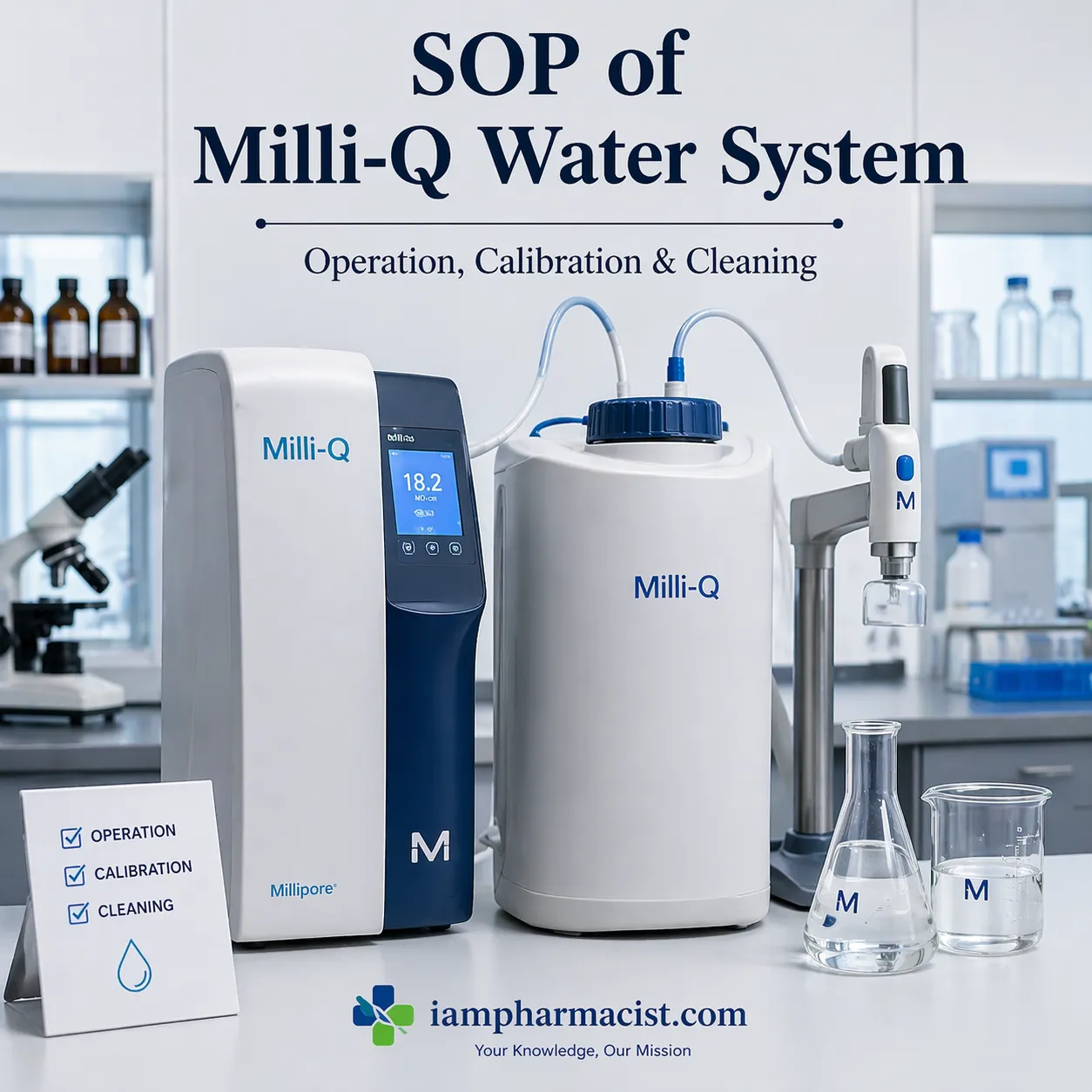

Learn the complete SOP of Milli-Q Water System including operation, calibration, and cleaning for high-purity laboratory water.
Introduction
In modern laboratories, water quality directly impacts analytical accuracy and experimental reproducibility. The Milli-Q Water System by Millipore is widely used to produce ultrapure water essential for pharmaceutical, chemical, and microbiological applications. This SOP provides a comprehensive and technically sound procedure for operating, calibrating, and maintaining the Milli-Q system to ensure consistent high-quality water output.
Definition
Milli-Q water system is a laboratory purification system that produces ultrapure water (Type I) by removing ions, organic compounds, particulates, and microorganisms using advanced filtration and deionization technologies.
| Component | Function |
|---|---|
| Elix System | Pre-treatment and purification |
| Reservoir | Storage of purified water |
| Milli-Q Unit | Final polishing to ultrapure water |
| Pressure Gauge | Monitors water flow pressure |
| Outlet | Dispensing ultrapure water |
Step-by-Step Process
- Ensure water supply and pressure
- Switch ON the system
- Activate Elix system
- Allow water collection in reservoir
- Run Milli-Q polishing unit
- Collect ultrapure water
- Set system to standby
1.0 OBJECTIVE
To describe a procedure for operation of Milli-Q water system from Millipore.
2.0 SCOPE
This SOP is applicable for operation of Milli-Q water system from Millipore.
3.0 RESPONSIBILITY
Officer / Executive – Quality Control
4.0 ACCOUNTABILITY
Manager – Quality Control
5.0 PROCEDURE
5.1 Operating Procedure
- Ensure the area is clean and clear.
- Verify continuous water supply.
- Check pressure gauge for circulation.
- Ensure pressure is greater than 1.5 kg/cm².
System Components
- Millipore Elix – Primary purification
- Millipore Reservoir – Storage
- Millipore Milli-Q – Final purification
Operation Steps
- Switch ON the main power supply.
- Indicator light confirms power.
- Press Operate/Standby on Elix → display shows “Pre Operate”.
- Water treated in Elix automatically collects in reservoir.
- Water is further purified through Milli-Q system.
- Press Operate/Standby on Milli-Q → display shows “Pre Operate”.
- Collect ultrapure water from outlet.
- Press standby key → display shows “Standby”.
- Do NOT switch OFF power supply.
5.2 Calibration Procedure
- Verify conductivity/resistivity using standard solutions
- Ensure resistivity is ~18.2 MΩ·cm (Type I water)
- Check system alarms and sensors
- Record calibration results in logbook
- Perform periodic validation as per SOP
5.3 Cleaning Procedure
- Clean external surfaces with lint-free cloth
- Sanitize reservoir periodically
- Replace filters and cartridges as per schedule
- Flush system after maintenance
- Maintain cleaning records
6.0 ABBREVIATIONS
- SOP – Standard Operating Procedure
- kg – Kilogram
Technical Insight: Importance of Ultrapure Water
Ultrapure water is essential in HPLC, spectroscopy, and microbiological testing. Even trace contaminants can interfere with analytical results, making Milli-Q systems critical in regulated laboratories.
FAQs
1. What is a Milli-Q water system?
A system that produces ultrapure laboratory-grade water.
2. What is the quality of Milli-Q water?
Type I water with resistivity up to 18.2 MΩ·cm.
3. Why is Milli-Q water used in laboratories?
For accurate analytical and experimental results.
4. What are main components of Milli-Q system?
Elix unit, reservoir, and Milli-Q polishing unit.
5. What pressure is required for operation?
Above 1.5 kg/cm².
6. How often should calibration be done?
As per SOP and regulatory requirements.
7. Can Milli-Q system be switched off?
No, it should remain powered for continuous operation.
8. What maintenance is required?
Filter replacement, cleaning, and sanitization.
9. What happens if water quality drops?
It may affect experimental accuracy.
10. What industries use Milli-Q systems?
Pharmaceutical, biotech, and research laboratories.