


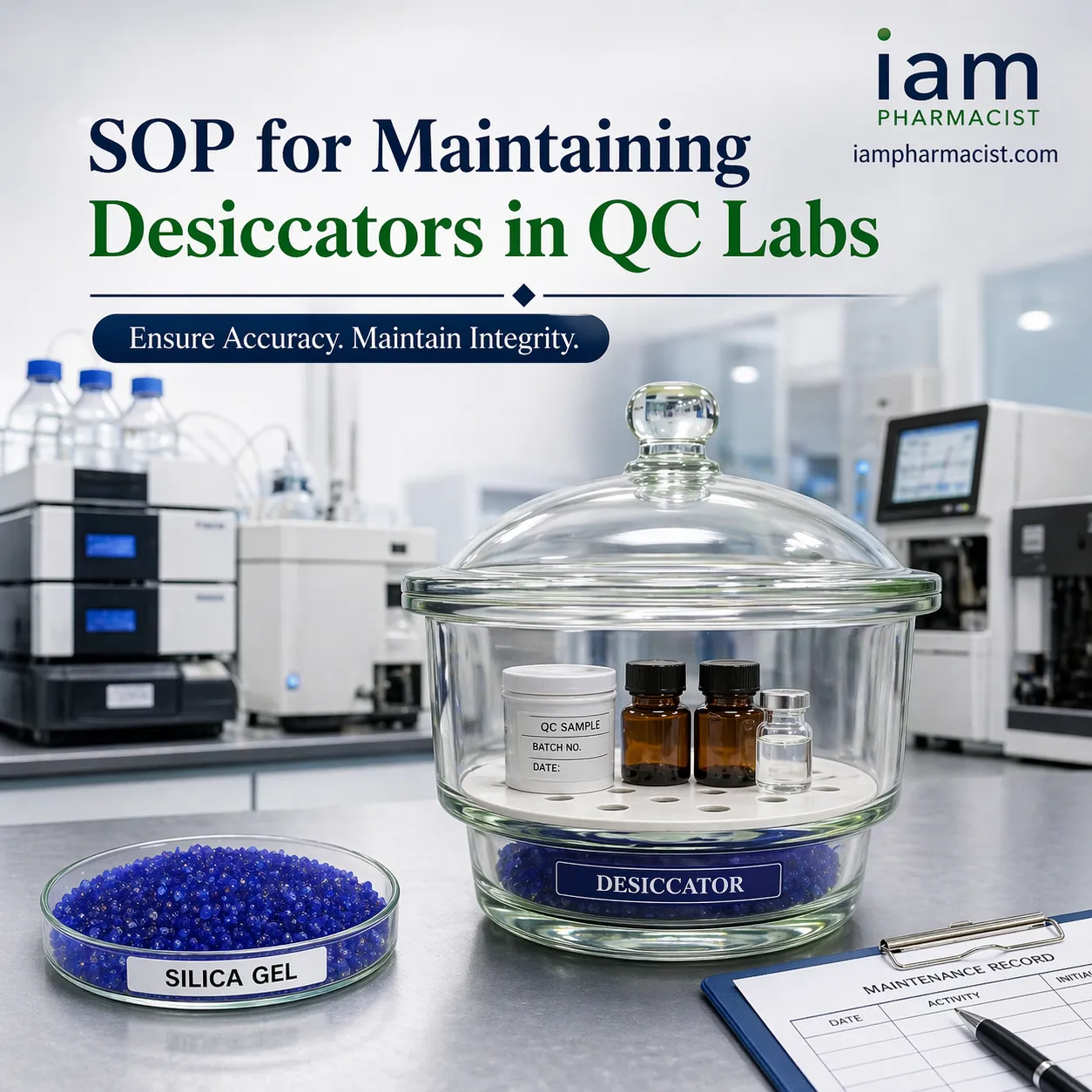

Step-by-step SOP for maintaining desiccators in QC labs, including cleaning, calibration, silica gel handling, and compliance best practices.
Definition
A desiccator maintenance SOP is a standardized procedure used in quality control laboratories to ensure proper cleaning, drying, silica gel replacement, and handling of desiccators to maintain a moisture-free environment for sensitive materials.
| Step | Activity | Frequency |
|---|---|---|
| 1 | Remove materials | Before cleaning |
| 2 | Remove silica gel | Every cleaning cycle |
| 3 | Wash & dry | Weekly/biweekly |
| 4 | Replace silica gel | Every 2 weeks |
| 5 | Dry silica gel (105°C) | Every 2 weeks |
| 6 | Label verification | Each use |
Step-by-Step SOP
- Remove all materials and transfer safely
- Remove silica gel
- Clean with soap solution and rinse
- Dry thoroughly
- Refill with dried silica gel
- Return labeled materials
- Replace silica gel fortnightly
- Regenerate silica gel at 105°C for 3 hours
Introduction
In quality control laboratories, maintaining controlled humidity is critical for ensuring accurate analytical results and preventing sample degradation. Desiccators play a vital role in moisture-sensitive processes. However, improper maintenance can compromise product quality, regulatory compliance, and data integrity.
This guide provides a fully structured SOP for desiccator maintenance, optimized for both operational efficiency and compliance with Good Laboratory Practices (GLP).
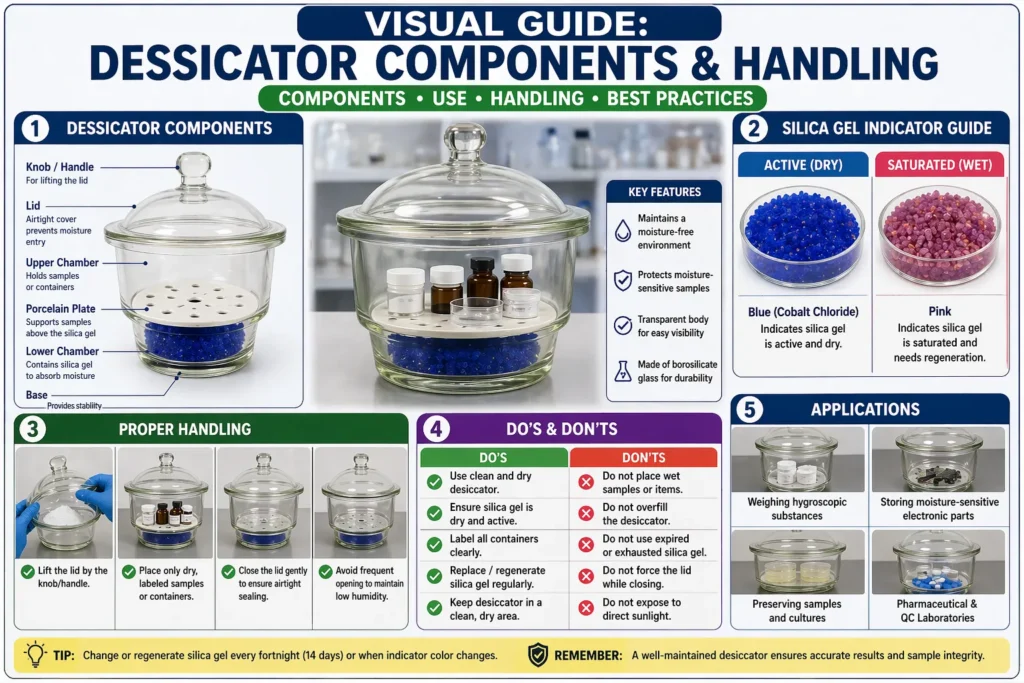
Visual Guide: Desiccator Components & Handling
1.0 OBJECTIVE
To establish a standardized procedure for the maintenance of desiccators to ensure effective moisture control and preservation of sample integrity.
2.0 SCOPE
This SOP applies to all desiccators used in Quality Control laboratories for storage of moisture-sensitive materials.
3.0 RESPONSIBILITY
Officer / Executive – Quality Control
- Perform cleaning, inspection, and silica gel replacement
- Ensure proper labeling and documentation
4.0 ACCOUNTABILITY
Manager – Quality Control
- Ensure SOP compliance
- Review maintenance records
5.0 PROCEDURE
5.1 Operation Procedure
- Remove all materials from the desiccator
- Transfer them to another functional desiccator
- Ensure no exposure to ambient humidity
5.2 Cleaning Procedure
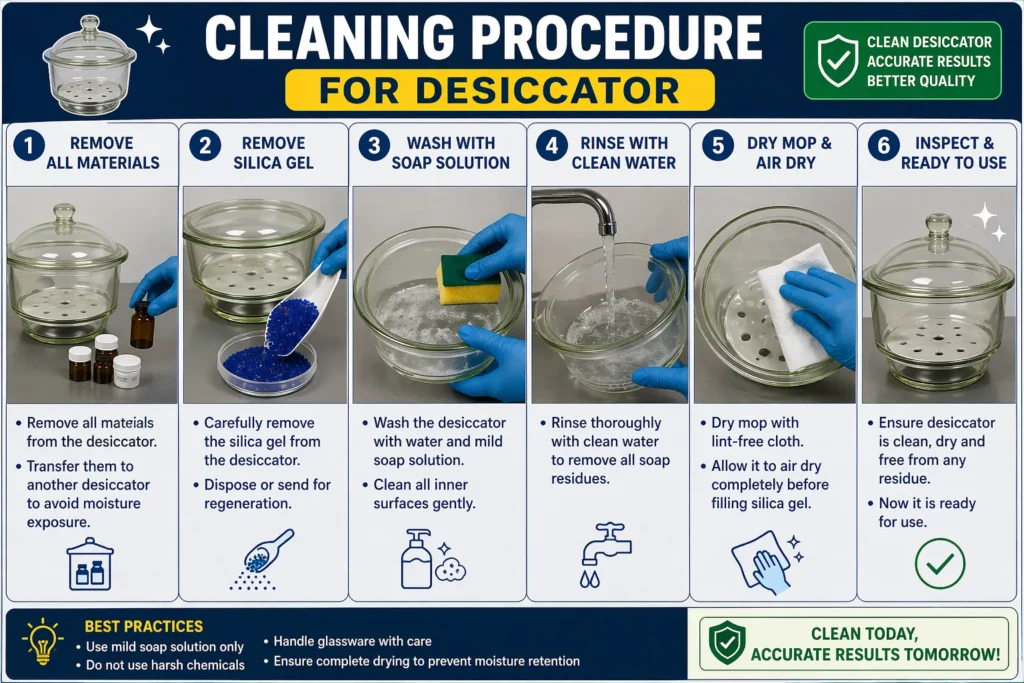
Remove silica gel carefully
Wash desiccator with water and mild soap solution
Rinse thoroughly with clean water
Dry using lint-free cloth (dry mop)
Allow complete air drying before reuse
5.3 Silica Gel Handling & Regeneration
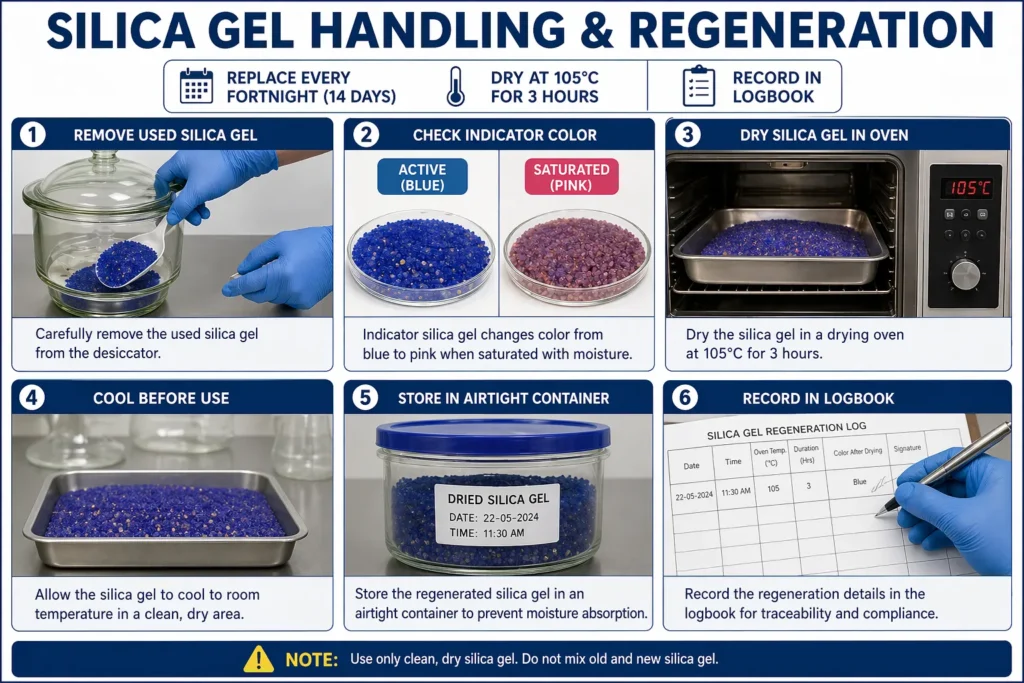
Replace silica gel every fortnight (2 weeks)
Dry used silica gel in oven at 105°C for 3 hours
Record regeneration details in logbook
Ensure silica gel is fully cooled before reuse
5.4 Reassembly & Verification
- Fill desiccator with regenerated silica gel
- Transfer materials back into the desiccator
- Verify all containers are properly labeled
- Ensure airtight sealing of lid
5.5 Calibration & Performance Check
- Check humidity control effectiveness periodically
- Inspect vacuum seal (if applicable)
- Replace gasket if leakage is observed
- Document performance verification
FAQs
1. What is a desiccator used for in QC labs?
To maintain a moisture-free environment for sensitive samples.
2. How often should silica gel be replaced?
Every two weeks or when indicator changes color.
3. What temperature is used for silica gel drying?
105°C for 3 hours.
4. Can desiccators be cleaned with detergents?
Yes, mild soap solution followed by thorough rinsing.
5. Why is labeling important in desiccators?
To ensure traceability and avoid sample mix-ups.
6. What happens if silica gel is not replaced?
Moisture buildup can compromise sample integrity.
7. How do you know silica gel is saturated?
Indicator color change (e.g., blue to pink or orange to green).
8. Is calibration required for desiccators?
Performance checks and seal integrity verification are recommended.
9. Can wet materials be placed in desiccators?
No, only dry materials should be stored.
10. What are signs of a faulty desiccator?
Condensation, poor sealing, or ineffective drying.