


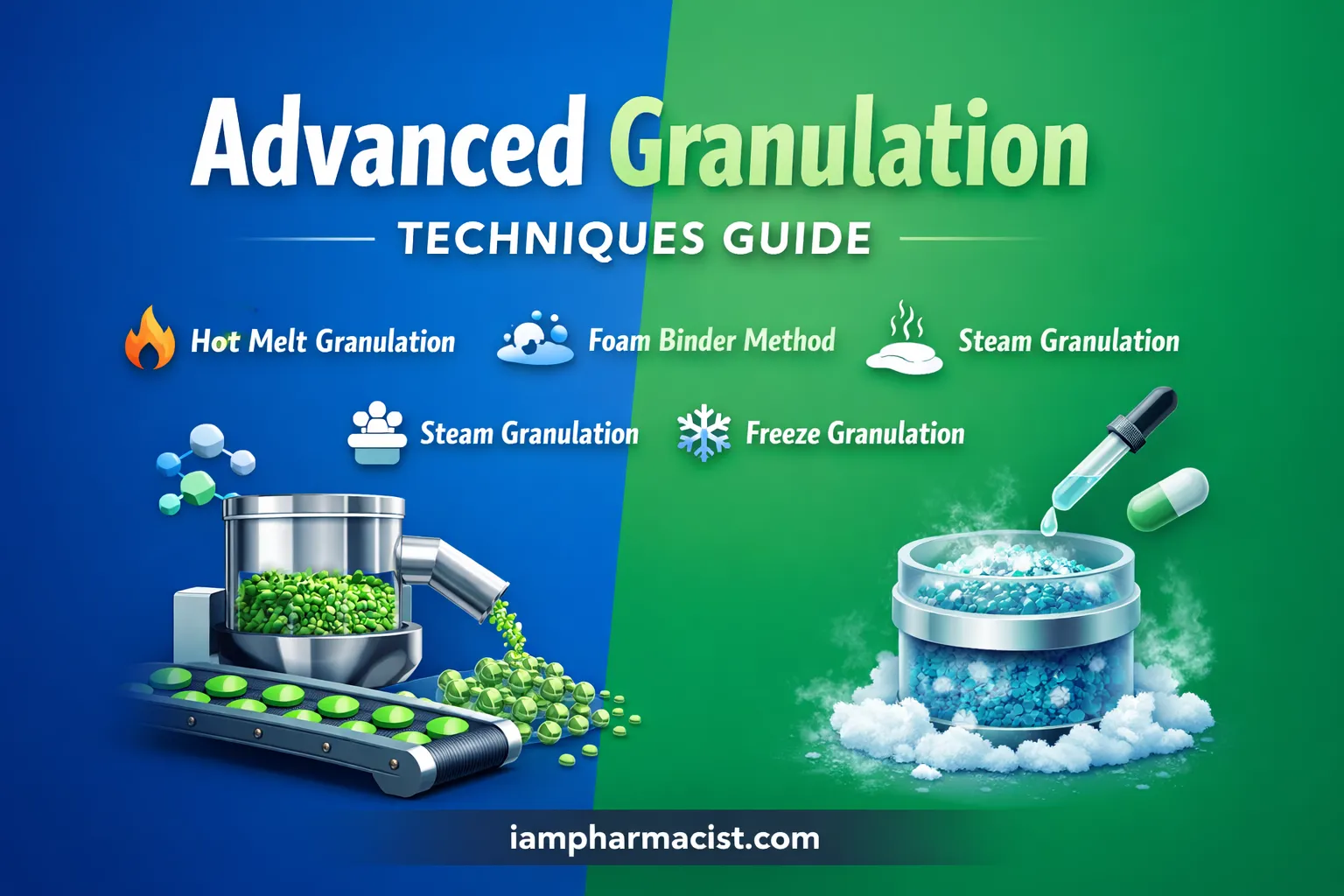

Explore advanced granulation techniques in pharma manufacturing, including hot melt, foam binder, steam, MADG, and more.
Advanced Granulation Techniques
Granulation is a critical process in pharmaceutical manufacturing, where fine powders are transformed into granules to improve flowability, compressibility, and uniformity in tablet production.
Traditionally, two main methods are used:
- Wet Granulation – involves adding a solvent or binder solution
- Dry Granulation – uses pressure without any liquid addition
However, with technological advancements, several Advanced Granulation Techniques have emerged to enhance efficiency, reduce processing time, and improve product quality.
This article explores the most important modern granulation methods used in the pharmaceutical industry.
Types of Advanced Granulation Techniques
1. Hot Melt Granulation Technique
Hot melt granulation eliminates the need for solvents and drying. Instead, a meltable binder (like Macrogol 6000) is used.
How It Works
- Binder melts at 40–90°C
- Melted binder binds powder particles into granules
- Cooling solidifies the granules
Process Steps
- Weighing
- Sieving
- Mixing
- Melting and mixing
- Cooling
- Screening
- Final blending
Key Advantages
- No drying required
- Faster processing
- Reduced moisture-related issues
2. Foam Binder Granulation Technique
This method is a modified version of wet granulation where the binder is applied as foam instead of liquid.
How It Works
- Binder solution is converted into foam using a foam generator
- Foam increases surface area and ensures uniform distribution
Process Steps
- Weighing
- Sieving
- Dry mixing
- Foam binder addition
- Wet sieving
- Drying
- Final sieving and blending
Key Benefits
- Uses less binder
- Prevents overwetting
- Improves uniformity
3. Steam Granulation Technique
Steam replaces water as the granulating fluid in this process.
How It Works
- Steam activates the binder
- Condensation forms moisture for granule formation
Process Steps
- Weighing
- Sieving
- Dry mixing
- Steam application
- Drying
- Sieving
- Final blending
Advantages
- Faster granulation
- Better distribution of moisture
- Improved granule strength
4. Moisture Activated Dry Granulation (MADG)
MADG is a hybrid method combining dry and wet granulation with minimal water usage.
How It Works
- Small amount of water (up to 5%) is added
- Moisture-absorbing excipients eliminate the need for drying
Process Steps
- Weighing
- Sieving and mixing
- Moisture activation
- Moisture absorption
- Final blending
Benefits
- No drying step
- Time-saving
- Energy-efficient
5. Freeze Granulation Technique
This technique involves freezing droplets of a suspension using liquid nitrogen.
How It Works
- Slurry is sprayed into liquid nitrogen
- Particles freeze instantly
- Ice is removed by sublimation (freeze drying)
Advantages
- Preserves particle structure
- Ideal for sensitive materials
6. Reverse Wet Granulation
Unlike conventional wet granulation, this method adds powder into the binder solution.
Process Steps
- Weighing, sieving, and mixing
- Binder solution preparation
- Addition of powders into binder
- Wet sieving
- Drying
- Dry sieving
- Final blending
Benefits
- Better control over granule formation
- Improved uniformity
7. Pneumatic Dry Granulation Technique (PDGT)
PDGT is an advanced form of dry granulation using air classification.
How It Works
- Powder is compacted into sheets
- Milled into granules
- Fine particles are separated and recycled using airflow
Advantages
- Minimizes fines
- Improves yield
- Continuous process
Conclusion
Advanced granulation techniques are transforming pharmaceutical manufacturing by improving efficiency, reducing processing time, and enhancing product quality. Selecting the right method depends on formulation requirements, equipment availability, and production goals.
Frequently Asked Questions (FAQs)
1. What are advanced granulation techniques?
They are modern methods used to convert powders into granules with improved efficiency and product quality.
2. Why is granulation important in pharmaceuticals?
It improves flowability, compressibility, and uniformity of powders for tablet manufacturing.
3. What is the difference between wet and dry granulation?
Wet granulation uses liquid binders, while dry granulation uses pressure without liquids.
4. What is hot melt granulation?
A solvent-free technique using heat to melt binders and form granules.
5. What are the benefits of foam binder granulation?
It reduces binder usage and prevents overwetting.
6. How does steam granulation work?
Steam activates the binder and forms granules through condensation.
7. What is MADG in pharmaceuticals?
Moisture Activated Dry Granulation uses minimal water and eliminates drying.
8. What is freeze granulation used for?
It is used for temperature-sensitive materials and preserves particle structure.
9. What is reverse wet granulation?
A method where powders are added into binder solution instead of the opposite.
10. What is PDGT?
Pneumatic Dry Granulation uses air systems to recycle fines and improve granule quality.