


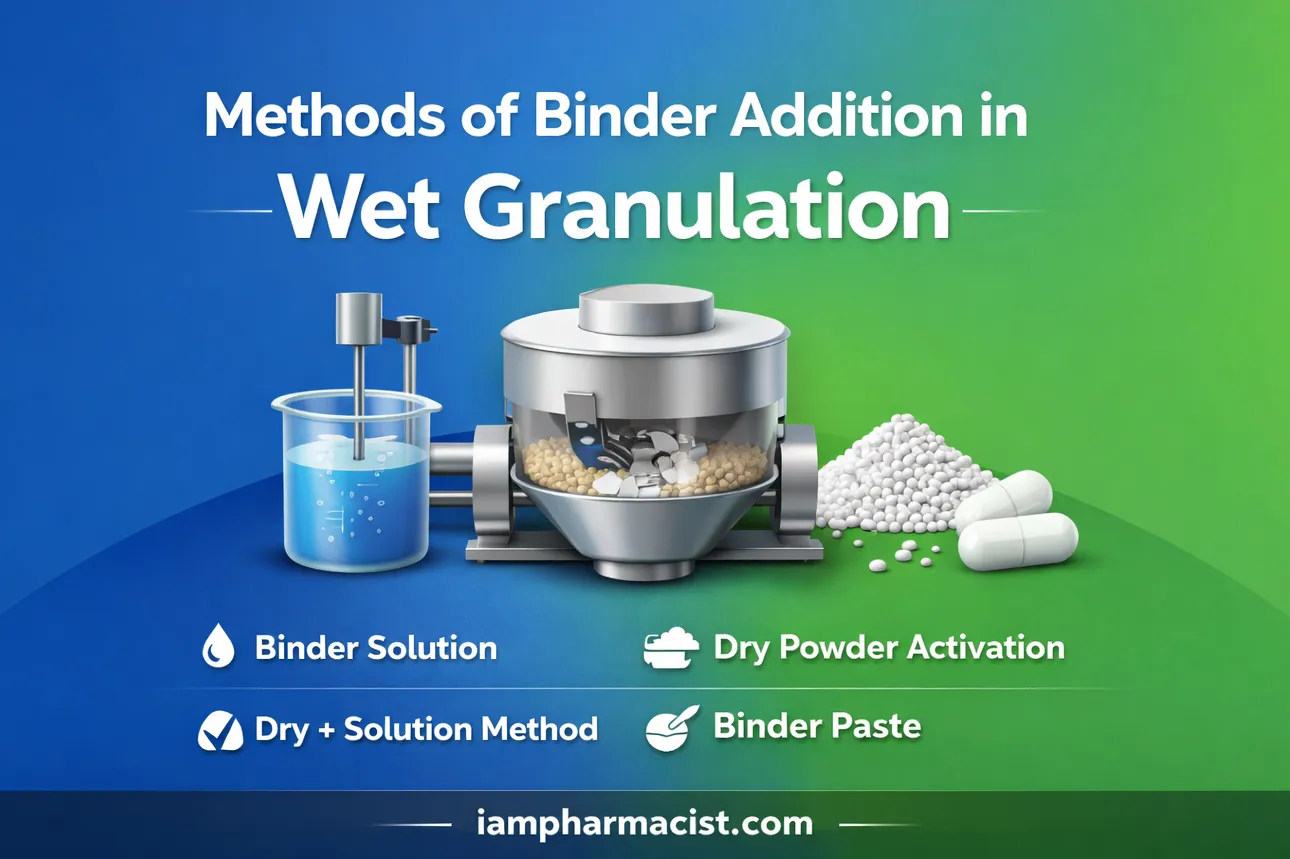

Learn methods of binder addition for wet granulation, including solution, dry activation, and paste techniques.
Methods of Binder Addition for Wet Granulation
Binders play a critical role in pharmaceutical manufacturing, especially in wet granulation. They help powder particles adhere together, forming granules that can be compressed into tablets or filled into capsules. Among all granulation techniques, wet granulation remains one of the most widely used due to its reliability and ability to improve powder flow and compressibility.
In this guide, we’ll explore the methods of binder addition for wet granulation, along with their preparation techniques, advantages, and practical considerations.
What is Wet Granulation?
Wet granulation is a process in which a liquid binder is added to a powder blend to form granules. This method enhances particle cohesion, reduces dust, and ensures uniform distribution of active pharmaceutical ingredients (API).
Methods of Binder Addition for Wet Granulation
There are several ways to incorporate binders into a formulation. Each method is selected based on formulation requirements, equipment, and desired granule properties.
1. Binder Solution or Suspension
This is the most commonly used method.
In this approach, binders in powder form are dissolved or dispersed in a suitable solvent (aqueous or organic), forming a solution or suspension.
Examples: Kollidon
Method of Preparation:
- Take the required binder quantity as per BMR (Batch Manufacturing Record)
- Sieve if necessary
- Measure solvent accurately
- Add binder slowly into the solvent using a mixer
- Mix until a lump-free solution or suspension is formed
- Add gradually to the powder premix
Key Tip: Adding too quickly can cause over-wetting or case hardening.
2. Dry Powder Activation
In this method, the binder is added directly in dry form to the powder blend and activated later by solvent addition.
Examples:
- Pregelatinized Starch
- HPMC
- HPC
Method of Addition:
- Sieve and mix binder with API and excipients
- Ensure uniform blending
- Add solvent gradually
- The solvent activates the binder, forming granules
Advantage: Reduces the risk of case hardening and improves distribution.
3. Dry Powder + Binder Solution/Suspension
This hybrid method combines dry binder addition with partial binder solution.
Why use it?
Sometimes, dissolving the entire binder amount creates a highly viscous solution that is difficult to handle.
Approach:
- Add part of the binder in solution form
- Add the remaining binder as dry powder in the premix
Benefit: Better control over viscosity and granule formation.
4. Binder Paste Method
Here, the binder is prepared as a paste before addition.
Example: Starch paste
Method of Preparation:
- Mix starch with water (insoluble in cold water)
- Heat the mixture to form a paste
- Cool before use
- Add to powder premix
Use Case: Ideal when stronger binding is required.
5. API in Solvent Method
In certain formulations, the API itself is dissolved in a solvent and added to the powder mix.
Purpose:
- Improves uniform distribution of API
- Enhances content uniformity
Application: Useful for low-dose formulations.
6. Solvent Alone Method
This method does not use any binder.
How it works:
- A suitable solvent is added directly to the powder blend
- The solvent activates inherent binding properties of the formulation
When to use:
- When excipients already possess binding capability
Choosing the Right Method
Selecting the appropriate method depends on:
- Nature of API
- Type of excipients
- Equipment used
- Desired granule properties
- Sensitivity to moisture or heat
Conclusion
Understanding the methods of binder addition for wet granulation is essential for developing robust pharmaceutical formulations. Each technique offers unique benefits and challenges, and the right choice ensures optimal granule quality, uniformity, and manufacturability.
Frequently Asked Questions (FAQs)
1. What is the purpose of binders in wet granulation?
Binders help particles stick together to form granules with good strength and flow properties.
2. Which is the most common binder addition method?
Binder solution or suspension is the most widely used method.
3. What is dry powder activation?
It involves adding binder in dry form and activating it with a solvent later.
4. Why is slow addition of binder solution important?
To prevent over-wetting and case hardening.
5. What is case hardening in wet granulation?
It occurs when the outer surface becomes too wet, forming a hard layer that prevents proper granulation.
6. Why use a combination of dry binder and solution?
To manage viscosity and improve process control.
7. When is starch paste used as a binder?
When strong binding and robust granules are required.
8. Can API act as a binder in wet granulation?
In some cases, yes—especially when dissolved in a solvent.
9. Is binder always required in wet granulation?
No, some formulations can form granules using solvent alone.
10. How do you choose the right binder method?
It depends on formulation properties, equipment, and desired granule characteristics.