


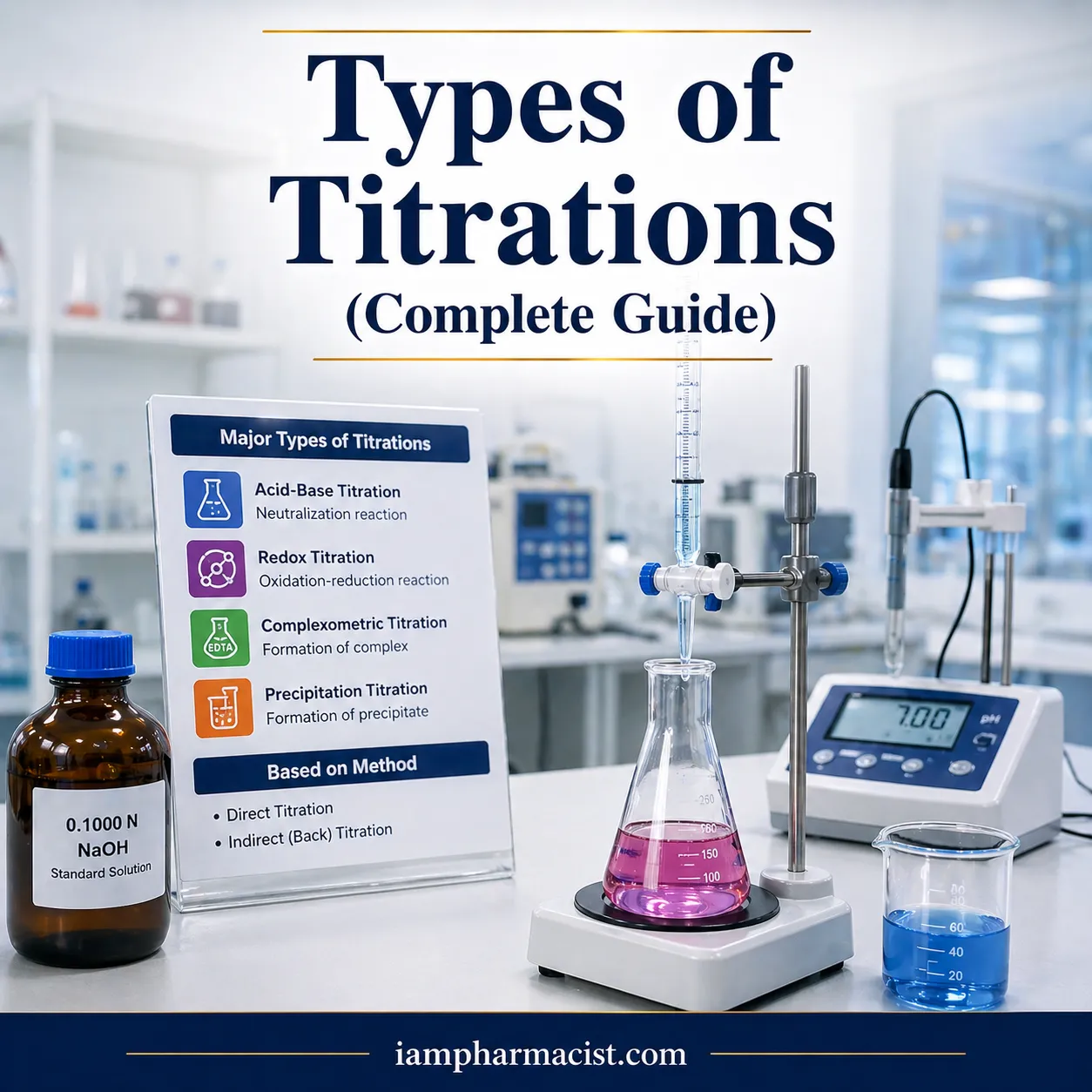

Explore different types of titrations with examples, principles, and uses in pharma labs. Learn acid-base, redox, complexometric, and more.
Definition
Titration is a quantitative analytical technique used to determine the concentration of an unknown substance by reacting it with a standard solution of known concentration until the endpoint is reached.
Introduction
Titration plays a critical role in pharmaceutical quality control laboratories for analyzing raw materials and finished products. It is a reliable and widely used method for both qualitative and quantitative estimation of chemical substances.
In pharmaceutical analysis, titrimetry ensures accuracy, precision, and compliance with regulatory standards. Based on methodology, chemical reaction, and reagent nature, titrations are classified into several important types.
Classification of Titrations
1. Based on Method
Direct Titration
- Most common method
- Titrant directly reacts with analyte
- Simple and widely used in routine QC
Indirect Titration (Back Titration)
- Excess reagent reacts with analyte
- Remaining reagent is titrated
- Useful when direct titration is not feasible
2. Based on Chemical Reaction
Acid-Base Titration
- Also called neutralization titration
- Acid reacts with base → forms salt + water
- Endpoint usually around pH 7
Redox Titration
- Based on oxidation-reduction reactions
- Involves transfer of electrons
- Common reagents: potassium permanganate, iodine
Complexometric Titration
- Formation of stable complex between analyte and titrant
- Commonly uses EDTA
- Widely used for metal ion analysis
Precipitation Titration
- Formation of insoluble precipitate
- Example: silver nitrate with chloride ionshttps://iampharmacist.com/ph-meter-2/
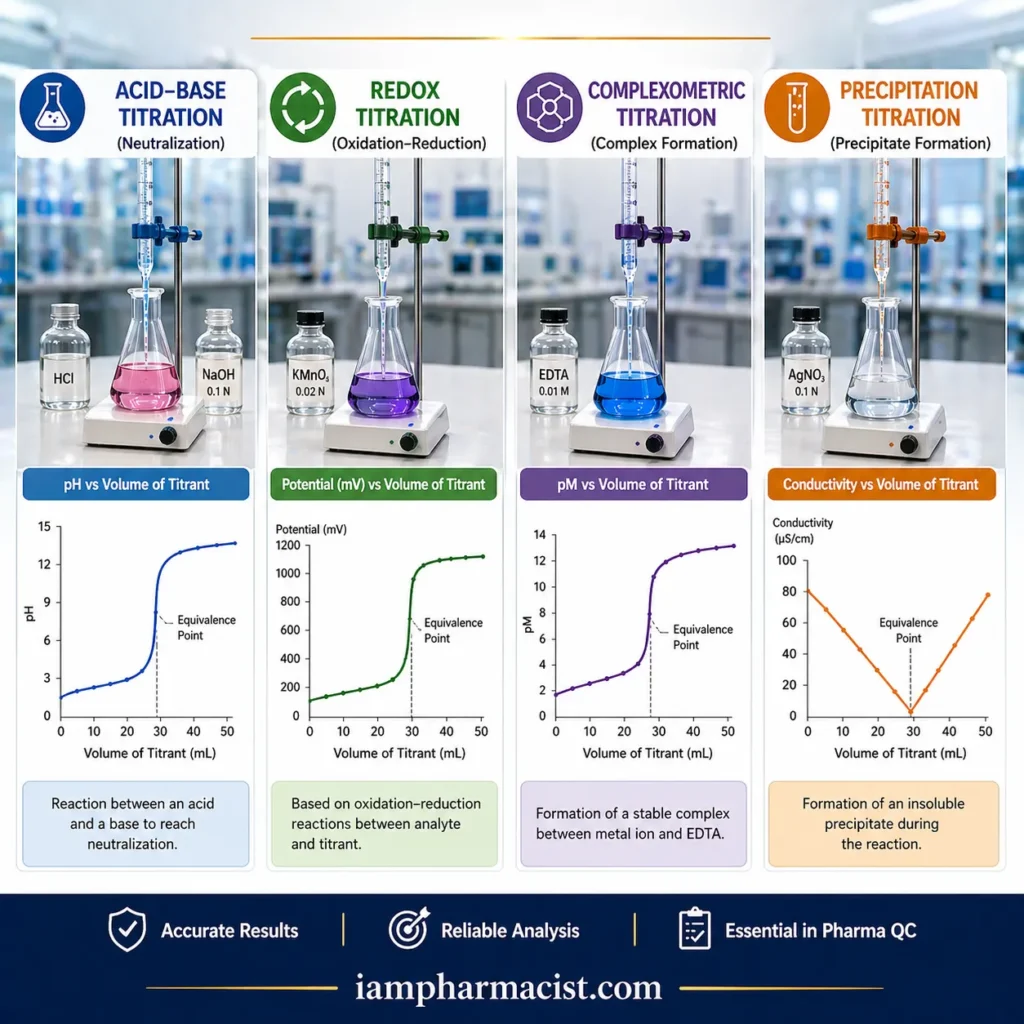
| Type | Graph Parameter | Detection Method |
|---|---|---|
| Acid–Base | pH vs Volume | Indicator / pH meter |
| Redox | Potential vs Volume | Electrode / indicator |
| Complexometric | pM vs Volume | Metal indicators |
| Precipitation | Turbidity/Conc. | Visual / indicators |
3. Based on Strength of Reagents
- Strong Acid vs Strong Base
- Strong Acid vs Weak Base
- Strong Base vs Weak Acid
- Weak Acid vs Weak Base
Each type affects the titration curve and endpoint detection.
Titration Types Overview (Table)
| Type | Principle | Example | Application |
|---|---|---|---|
| Acid-Base | Neutralization | HCl vs NaOH | pH determination |
| Redox | Electron transfer | KMnO₄ titration | Oxidation analysis |
| Complexometric | Complex formation | EDTA titration | Metal ion estimation |
| Precipitation | Insoluble precipitate | AgNO₃ vs Cl⁻ | Halide determination |
| Direct | Direct reaction | Simple titration | Routine analysis |
| Indirect (Back) | Excess reagent method | Back titration | Difficult analytes |
Step-by-Step Titration Procedure (HowTo)
- Prepare standard solution (titrant)
- Measure analyte accurately
- Add suitable indicator
- Fill burette with titrant
- Add titrant slowly to analyte
- Observe endpoint (color change)
- Record volume used
- Calculate concentration using formula
Importance in Pharmaceutical Industry
- Ensures drug quality and safety
- Used in assay of APIs
- Helps in impurity profiling
- Critical for regulatory compliance
FAQs
1. What are the main types of titrations?
Acid-base, redox, complexometric, and precipitation titrations are the main types.
2. What is direct titration?
A method where titrant directly reacts with analyte to determine concentration.
3. What is back titration?
An indirect method where excess reagent is used and then titrated.
4. Why is titration important in pharma?
It ensures accurate drug composition and quality control.
5. What is EDTA titration used for?
It is used for determining metal ions in solution.
6. What is the endpoint in titration?
The point where the reaction is complete, usually indicated by color change.
7. What is redox titration?
A titration based on oxidation-reduction reactions.
8. Which indicator is used in acid-base titration?
Common indicators include phenolphthalein and methyl orange.
9. What is precipitation titration?
A titration where an insoluble solid forms during reaction.
10. What are examples of titration in QC labs?
Assay of APIs, water hardness testing, and impurity analysis.
{ “@context”: “https://schema.org”, “@type”: “Article”, “headline”: “Types of Titrations in Chemistry (Complete Guide)”, “description”: “Explore different types of titrations with examples and applications in pharmaceutical analysis.”, “author”: { “@type”: “Person”, “name”: “Pharma Expert” }, “publisher”: { “@type”: “Organization”, “name”: “iampharmacist.com” } } { “@context”: “https://schema.org”, “@type”: “FAQPage”, “mainEntity”: [ { “@type”: “Question”, “name”: “What are the main types of titrations?”, “acceptedAnswer”: { “@type”: “Answer”, “text”: “Acid-base, redox, complexometric, and precipitation titrations.” } } ] } { “@context”: “https://schema.org”, “@type”: “HowTo”, “name”: “How to Perform Titration”, “step”: [ {“@type”: “HowToStep”,”text”: “Prepare standard solution”}, {“@type”: “HowToStep”,”text”: “Measure analyte”}, {“@type”: “HowToStep”,”text”: “Add indicator”}, {“@type”: “HowToStep”,”text”: “Perform titration”}, {“@type”: “HowToStep”,”text”: “Record endpoint”} ] }