


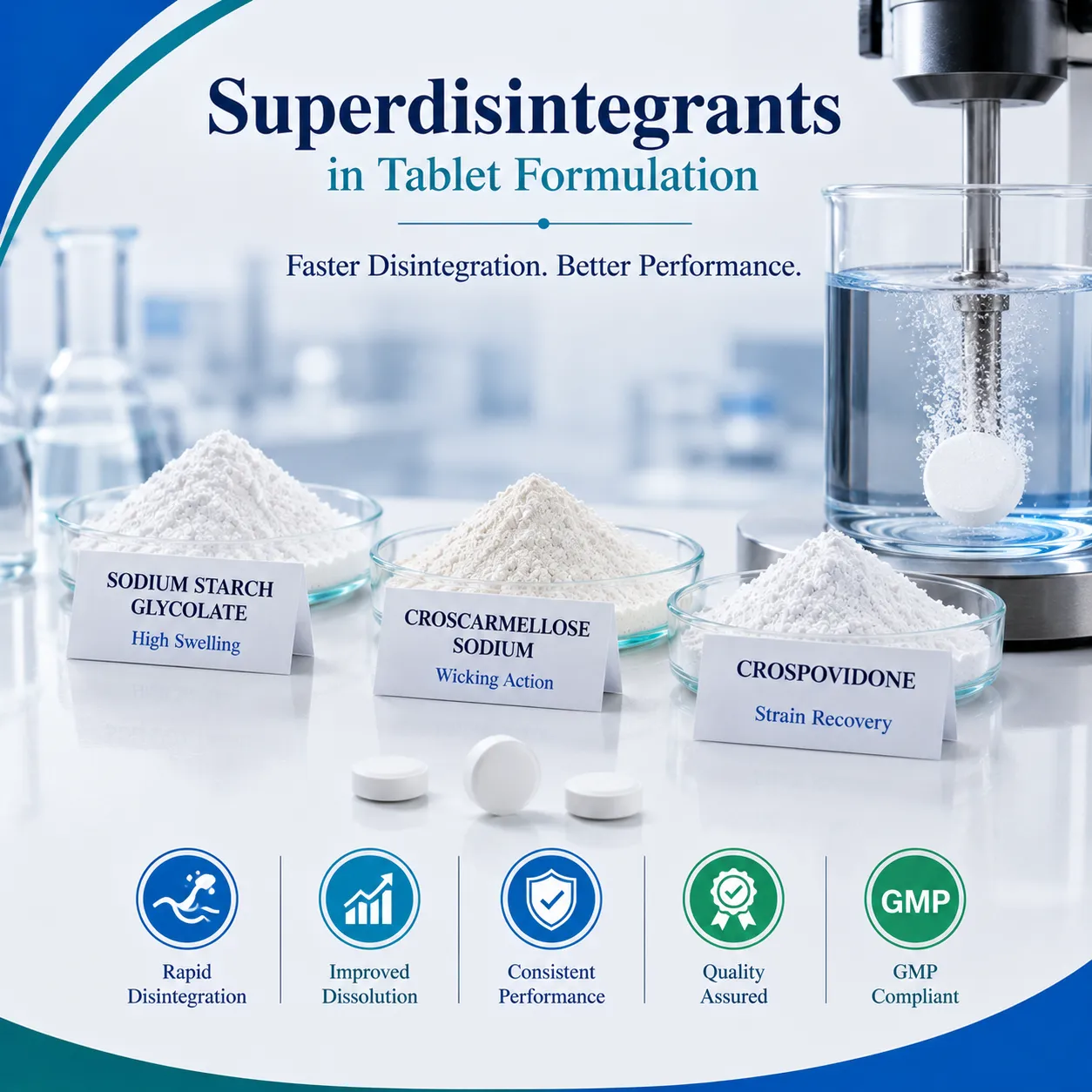

Learn superdisintegrants in tablet formulation, including types, mechanisms of action, performance comparison, selection criteria, GMP requirements, and regulatory insights.
Definition
Superdisintegrants are highly efficient pharmaceutical excipients used in tablet formulations to promote rapid disintegration upon contact with aqueous fluids. Common superdisintegrants include sodium starch glycolate (SSG), croscarmellose sodium (CCS), and crospovidone, which primarily act through swelling, wicking (capillary action), and deformation recovery mechanisms. They typically achieve rapid tablet breakup at low concentrations of 2–5% w/w.
Superdisintegrants in Tablet Formulation: Types, Mechanisms, and Performance Comparison
Introduction
Tablet disintegration is a critical quality attribute that directly influences drug dissolution, bioavailability, and therapeutic effectiveness. For immediate-release dosage forms, rapid disintegration is essential to ensure prompt drug release and absorption.
While traditional disintegrants have been used for decades, the introduction of superdisintegrants revolutionized tablet formulation by enabling significantly faster disintegration at much lower concentrations. Modern pharmaceutical development relies heavily on superdisintegrants such as sodium starch glycolate, croscarmellose sodium, and crospovidone to optimize product performance and manufacturing efficiency.
This guide explores the science behind superdisintegrants, their mechanisms of action, performance characteristics, selection criteria, and regulatory considerations.
What Are Superdisintegrants?
Superdisintegrants are specialized excipients designed to facilitate rapid tablet breakup when exposed to aqueous environments such as gastrointestinal fluids.
Their primary purpose is to:
- Accelerate tablet disintegration
- Improve dissolution rates
- Enhance drug availability
- Support immediate-release performance
- Reduce disintegration times at low concentrations
Compared to conventional disintegrants, superdisintegrants provide greater efficiency and functionality, typically at usage levels of 2–5% w/w.
Why Tablet Disintegration Matters
Disintegration is the process by which a tablet breaks into smaller particles after administration.
Importance of Disintegration
Proper disintegration:
- Increases surface area available for dissolution
- Enhances drug release
- Improves absorption
- Supports bioavailability
- Ensures therapeutic efficacy
Several formulation variables affect tablet disintegration, including:
- Disintegrant concentration
- Tablet hardness
- Porosity
- API properties
- Matrix solubility
- Compression force
These factors collectively determine how quickly and effectively a tablet disintegrates.
Mechanisms of Action of Superdisintegrants
Although multiple mechanisms have been proposed, three mechanisms are widely recognized as the most significant:
1. Swelling
How It Works
Swelling occurs when superdisintegrant particles absorb water and expand in multiple dimensions.
This expansion creates internal pressure within the tablet matrix until the adhesive forces holding the tablet together are overcome.
Key Characteristics
- Rapid water uptake
- Significant volume expansion
- Strong disruptive force
Impact of Tablet Porosity
Excessively porous tablets may reduce the effectiveness of swelling because particles have less resistance against which to exert pressure.
Conversely, very dense tablets may impede liquid penetration and delay disintegration.
2. Wicking (Capillary Action)
How It Works
Wicking involves drawing water into the tablet through capillary forces.
Hydrophilic disintegrant particles create pathways that facilitate fluid penetration into the tablet core.
Benefits
- Rapid liquid uptake
- Reduced interparticle bonding
- Efficient matrix disruption
Once water enters the porous structure, physical bonds between particles weaken and the tablet breaks apart.
3. Deformation (Strain Recovery)
How It Works
During compression, certain disintegrants undergo deformation.
When exposed to water, they attempt to recover their original shape, generating mechanical stress within the tablet.
Result
- Internal expansion pressure
- Matrix disruption
- Faster disintegration
Potato starch (Solani amylum) is a classic example of a disintegrant exhibiting strain recovery behavior.
Types of Pharmaceutical Disintegrants
Traditional Disintegrants
Examples include:
- Native starches
- Alginic acid
- Ion-exchange resins
- Microcrystalline cellulose
While effective, these materials often require higher concentrations compared with superdisintegrants.
Superdisintegrants
Modern tablet formulations primarily utilize:
- Sodium Starch Glycolate (SSG)
- Croscarmellose Sodium (CCS)
- Crospovidone
These materials deliver superior disintegration performance at significantly lower levels.
Sodium Starch Glycolate (SSG)
Overview
Sodium starch glycolate was among the first commercially available superdisintegrants.
Commercial example:
- Primojel®
Structure and Properties
SSG is produced through:
- Cross-linking starch molecules
- Carboxymethylation of hydroxyl groups
This structure enables extensive water uptake without gel formation.
Primary Mechanism
Swelling
SSG exhibits the highest swelling capacity among commonly used superdisintegrants.
Key Performance Characteristics
- Absorbs more than 20 times its weight in water
- Swells in three dimensions
- Produces rapid tablet breakup
Best Applications
Particularly effective in:
- Insoluble tablet matrices
- Immediate-release formulations
However, its performance may be reduced in highly soluble matrices because less structural resistance remains for swelling forces to act against.
Croscarmellose Sodium (CCS)
Overview
Croscarmellose sodium is a cross-linked carboxymethyl cellulose derivative.
Commercial example:
- Primellose®
Structure
Produced through:
- Cellulose carboxymethylation
- Internal cross-linking
This creates a porous fibrous structure.
Primary Mechanism
Wicking with Secondary Swelling
CCS acts predominantly through capillary action.
The fibrous particles draw water deep into the tablet matrix.
Advantages
- Rapid water penetration
- Effective in soluble matrices
- Excellent disintegration performance
Unlike SSG, CCS swells primarily in two dimensions.
Crospovidone
Overview
Crospovidone is a cross-linked polyvinylpolypyrrolidone polymer.
Commonly referred to as a:
- “Popcorn polymer”
due to its distinctive morphology.
Structure
Produced through polymerization of vinylpyrrolidone under conditions that create extensive cross-linking.
Mechanism of Action
Several mechanisms have been proposed:
- Wicking
- Secondary swelling
- Swelling pressure
- Strain recovery
While debate continues regarding the dominant mechanism, crospovidone is universally recognized as an effective superdisintegrant.
Potential Limitation
Crospovidone may contain trace levels of:
- Formaldehyde
- Peroxides
These impurities can present compatibility concerns with sensitive APIs.
Performance Comparison of Major Superdisintegrants
| Property | Sodium Starch Glycolate | Croscarmellose Sodium | Crospovidone |
|---|---|---|---|
| Main Mechanism | Swelling | Wicking + Swelling | Wicking + Recovery |
| Water Uptake | Very High | High | Moderate |
| Swelling Capacity | Highest | Moderate | Lower |
| Effective Concentration | 2–5% | 2–5% | 2–5% |
| Soluble Matrix Performance | Moderate | Excellent | Excellent |
| Insoluble Matrix Performance | Excellent | Good | Good |
| Flow Properties | Moderate | Moderate | Good |
| API Compatibility Concerns | Low | Low | Possible peroxide/formaldehyde traces |
Factors Affecting Superdisintegrant Performance
Formulation Factors
Tablet Hardness
Higher hardness may slow liquid penetration.
API Load
High-dose formulations may alter disintegration efficiency.
Matrix Solubility
Influences the effectiveness of swelling mechanisms.
Porosity
Impacts fluid penetration and capillary action.
Compression Force
Can affect strain recovery and particle deformation.
How to Select the Right Superdisintegrant
Step 1: Evaluate API Characteristics
Assess:
- Solubility
- Hygroscopicity
- Particle size
- Stability
Step 2: Understand the Matrix
Determine whether the formulation contains:
- Soluble fillers
- Insoluble fillers
- High binder levels
Step 3: Define Performance Goals
Target:
- Disintegration time
- Dissolution profile
- Bioavailability requirements
Step 4: Conduct Compatibility Studies
Perform:
- FTIR analysis
- DSC studies
- Stress testing
- Stability testing
Step 5: Optimize Concentration
Evaluate concentrations between:
- 2%
- 3%
- 4%
- 5%
to identify the optimal balance between performance and manufacturability.
Practical Example
Immediate-Release Paracetamol Tablet
Formulation Objective
Achieve rapid disintegration while maintaining tablet hardness.
Candidate Superdisintegrants
| Excipient | Expected Benefit |
|---|---|
| SSG | Maximum swelling |
| CCS | Fast wicking |
| Crospovidone | Rapid capillary action |
Selection Outcome
For a lactose-based soluble matrix, CCS often provides faster disintegration due to its superior wicking performance.
GMP and Regulatory Considerations
Pharmacopeial Compliance
Superdisintegrants should comply with applicable monographs in:
- USP-NF
- Ph. Eur.
- JP
- BP
- IP
Supplier Qualification
Manufacturers should evaluate:
- GMP compliance
- Change control systems
- Functional performance consistency
- Trace impurity profiles
https://www.ema.europa.eu/en/human-regulatory-overview/research-development/compliance-research-development/good-manufacturing-practice
Functionality-Related Characteristics (FRCs)
Critical attributes include:
- Particle size distribution
- Water uptake capacity
- Swelling index
- Flowability
- Compressibility
These characteristics significantly influence formulation performance.
Emerging Trends
Co-Processed Superdisintegrants
Designed to improve:
- Flow properties
- Compression behavior
- Manufacturing robustness
QbD-Based Excipient Selection
Modern formulation development increasingly evaluates:
- Critical Material Attributes (CMAs)
- Critical Quality Attributes (CQAs)
- Design Space Development
Fast-Disintegrating Technologies
Growing demand for:
- Orally disintegrating tablets (ODTs)
- Pediatric formulations
- Geriatric-friendly dosage forms
FAQs
1. What are superdisintegrants in tablet formulation?
Superdisintegrants are highly efficient excipients used to accelerate tablet disintegration in aqueous environments.
2. Which are the most common pharmaceutical superdisintegrants?
Sodium starch glycolate, croscarmellose sodium, and crospovidone are the most widely used superdisintegrants.
3. How do superdisintegrants work?
They function primarily through swelling, wicking (capillary action), and deformation recovery mechanisms.
4. What concentration of superdisintegrants is typically used?
Most superdisintegrants are effective at concentrations between 2–5% w/w.
5. Which superdisintegrant has the highest swelling capacity?
Sodium starch glycolate exhibits the highest swelling capacity among common superdisintegrants.
6. Why is tablet disintegration important?
It increases surface area for dissolution and promotes drug absorption and bioavailability.
7. What is the primary mechanism of croscarmellose sodium?
Its primary mechanism is wicking, supported by secondary swelling.
8. What are the advantages of crospovidone?
Crospovidone provides rapid disintegration, excellent capillary action, and effective performance at low concentrations.
9. Can superdisintegrants affect tablet hardness?
Yes. Superdisintegrant type and concentration can influence hardness, friability, and disintegration performance.
10. How are superdisintegrants selected during formulation development?
Selection is based on API characteristics, matrix composition, compatibility, disintegration goals, and manufacturing requirements.