


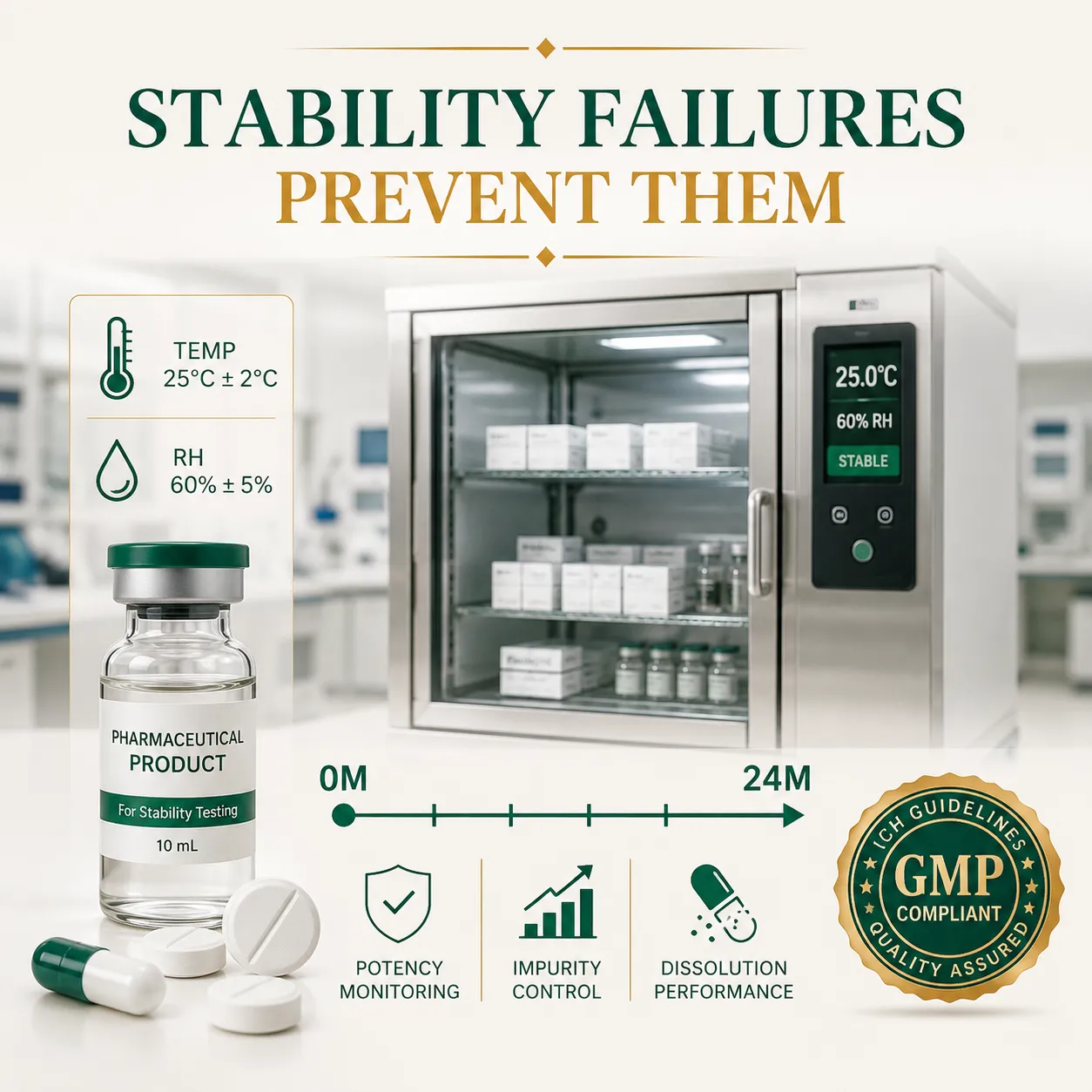

Learn the most common stability study failures in pharmaceuticals, their root causes, GMP impacts, and proven strategies to prevent OOS and recalls.
Definition
Common stability study failures in pharmaceuticals include assay reduction (potency loss), dissolution decline, impurity increases, microbiological contamination, and environmental or execution errors. These failures are typically caused by formulation instability, packaging deficiencies, environmental stress, or procedural deviations and can be prevented through robust formulation development, validated packaging systems, controlled storage conditions, and GMP-compliant stability programs.
Common Stability Study Failures and How to Prevent Them
Stability studies are among the most critical activities in pharmaceutical development and commercial manufacturing. They establish a product’s shelf life, storage conditions, packaging requirements, and regulatory compliance.
However, stability study failures remain a major challenge across the pharmaceutical industry. A failed stability study can delay product approvals, trigger investigations, increase manufacturing costs, cause market recalls, and damage brand reputation.
Whether the issue is potency loss, dissolution failure, impurity growth, microbial contamination, or stability chamber deviations, understanding the root causes is essential for preventing future failures.
This guide explains the most common stability study failures, their causes, regulatory implications, and proven preventive strategies aligned with ICH guidelines, GMP requirements, and industry best practices.
Why Stability Study Failures Matter
Stability testing demonstrates that a pharmaceutical product maintains its:
- Identity
- Strength (assay)
- Quality
- Purity
- Safety
- Performance
throughout its shelf life.
Failure in stability testing can lead to:
| Impact Area | Consequence |
|---|---|
| Regulatory Approval | Delayed product registration |
| Product Quality | Reduced efficacy or safety concerns |
| Supply Chain | Shelf-life reduction |
| Financial | Product recalls and investigation costs |
| Compliance | FDA, EMA, MHRA observations |
| Brand Reputation | Loss of customer confidence |
Overview of Common Stability Study Failures
| Failure Type | Typical Observation | Risk Level |
|---|---|---|
| Assay Loss | Potency decreases below specification | High |
| Impurity Increase | Related substances exceed limits | High |
| Dissolution Failure | Slower drug release | High |
| Appearance Changes | Discoloration, caking, brittleness | Medium |
| Microbial Failure | Increased microbial counts | High |
| Chamber Deviations | Incorrect storage conditions | High |
| Sample Management Errors | Missing or mixed-up samples | Medium |
1. Chemical Stability Failures (Assay Loss and Impurity Growth)
What Happens?
The active pharmaceutical ingredient (API) gradually degrades over time, leading to:
- Reduced potency
- Increased degradation products
- Out-of-specification (OOS) results
- Shelf-life reduction
Common Symptoms
- Assay below specification
- Increased related substances
- Unknown impurities
- Changes in pH
Root Causes
| Cause | Mechanism |
|---|---|
| Oxidation | Exposure to oxygen |
| Hydrolysis | Moisture-driven degradation |
| Photodegradation | Light-induced breakdown |
| Drug-Excipient Incompatibility | Chemical interaction with excipients |
| High Temperature | Accelerated degradation |
Prevention Strategies
Conduct Forced Degradation Studies
Forced degradation identifies degradation pathways before commercialization.
Evaluate effects of:
- Heat
- Light
- Oxidation
- Acid/base stress
- Humidity
Optimize Formulation
Consider:
- Antioxidants
- Chelating agents
- Buffer systems
- Protective coatings
Implement ICH Q1B Photostability Testing
Photostability studies help determine:
- Packaging requirements
- Light protection statements
- Storage recommendations
Practical Example
A vitamin-containing tablet showed assay reduction after six months.
Investigation Findings:
- API oxidation due to oxygen permeation through packaging.
Corrective Action:
- Switched to aluminum-aluminum blister packaging.
- Added antioxidant to formulation.
Result:
- Shelf life extended from 12 to 24 months.
2. Physical Stability Failures (Dissolution and Appearance Changes)
What Happens?
The product remains chemically stable but loses physical performance characteristics.
Examples include:
- Dissolution failure
- Tablet hardness changes
- Capsule brittleness
- Caking
- Color changes
Root Causes
| Cause | Impact |
|---|---|
| Moisture Uptake | Slower dissolution |
| Compression Variability | Hardness changes |
| Poor Coating Process | Appearance defects |
| Packaging Failure | Environmental exposure |
| Crystal Form Changes | Reduced bioavailability |
Prevention Strategies
Evaluate Moisture Sensitivity
Perform studies under:
- ICH long-term conditions
- Accelerated conditions
- High humidity stress conditions
Improve Packaging Design
Use:
- Moisture-resistant bottles
- High-barrier blisters
- Appropriate desiccants
Strengthen Manufacturing Controls
Monitor:
- Granulation moisture
- Compression force
- Coating parameters
- Drying conditions
Practical Example
A tablet passed assay testing but failed dissolution after nine months.
Root Cause:
Excess moisture absorption caused tablet hardening.
Solution:
- Upgraded to high-barrier blister packaging.
- Added desiccant protection.
Outcome:
Dissolution remained within specifications throughout shelf life.
3. Microbiological Stability Failures
What Happens?
Products fail microbiological specifications during storage.
Common in:
- Oral liquids
- Topical products
- Ophthalmics
- Sterile products
Common Findings
- Elevated microbial counts
- Preservative efficacy failure
- Sterility failure
- Microbial ingress
Root Causes
| Cause | Effect |
|---|---|
| Preservative Degradation | Loss of antimicrobial protection |
| Packaging Defects | Microbial ingress |
| Inadequate Sterilization | Initial contamination |
| Temperature Excursions | Microbial growth |
Prevention Strategies
Conduct Preservative Efficacy Testing (PET)
Evaluate preservative performance:
- Initial
- Mid-point
- Shelf-life endpoint
Verify Package Integrity
Perform:
- Container Closure Integrity Testing (CCIT)
- Seal integrity studies
- Transportation simulation studies
Strengthen Environmental Controls
Ensure:
- Controlled manufacturing environments
- Routine environmental monitoring
- Personnel hygiene compliance
Practical Example
An oral suspension failed PET testing at 18 months.
Investigation:
Preservative concentration decreased due to chemical degradation.
CAPA:
- Reformulated preservative system.
- Introduced pH optimization.
Outcome:
Microbiological stability restored.
4. Stability Study Execution and Environmental Failures
What Happens?
The product itself may be stable, but study integrity is compromised.
These failures often result in:
- Invalid data
- Regulatory observations
- Repeat studies
Common Causes
| Failure | Example |
|---|---|
| Chamber Excursions | Temperature outside specification |
| Missed Pull Points | Samples not tested on schedule |
| Sample Mix-Ups | Incorrect labeling |
| Data Integrity Issues | Missing records |
| Equipment Failure | Monitoring system malfunction |
Prevention Strategies
Utilize Advanced Stability Chambers
Features should include:
- Redundant temperature sensors
- Secondary alarms
- Backup power systems
- Continuous monitoring
Implement 21 CFR Part 11 Compliance
Systems should support:
- Audit trails
- Electronic signatures
- Controlled access
- Secure data storage
Improve Sample Management
Maintain:
- Barcode tracking
- Electronic inventory
- Backup sample storage
Practical Example
A stability chamber experienced a temperature excursion for 18 hours.
Investigation Outcome:
Alarm notification failed due to software configuration error.
Corrective Action:
- Dual alarm system installed.
- Escalation procedures updated.
Result:
No recurrence during subsequent studies.
Step-by-Step Guide to Prevent Stability Study Failures
Step 1: Perform Comprehensive Risk Assessment
Evaluate:
- API degradation pathways
- Moisture sensitivity
- Packaging risks
- Transportation risks
Step 2: Design Scientifically Sound Stability Protocols
Ensure alignment with:
- ICH Q1A(R2)
- ICH Q1B
- WHO Stability Guidelines
- Regional regulatory requirements
Step 3: Validate Stability Chambers
Verify:
- Temperature mapping
- Humidity mapping
- Alarm functionality
- Backup systems
Step 4: Implement Robust Packaging Qualification
Assess:
- Moisture protection
- Oxygen barrier performance
- Light protection
- Seal integrity
Step 5: Establish Ongoing Monitoring
Track trends for:
- Assay
- Dissolution
- Impurities
- Microbial counts
Step 6: Conduct Routine GMP Audits
Review:
- Stability data
- Chamber performance
- SOP compliance
- Documentation practices
GMP and Regulatory Expectations
Key Regulatory References
| Guideline | Focus Area |
|---|---|
| ICH Q1A(R2) | Stability testing requirements |
| ICH Q1B | Photostability testing |
| ICH Q1D | Bracketing and matrixing |
| ICH Q1E | Stability data evaluation |
| FDA 21 CFR Part 211 | GMP requirements |
| 21 CFR Part 11 | Electronic records and signatures |
| EU GMP Annex 11 | Computerized systems |
What Inspectors Commonly Review
Regulators frequently assess:
- Stability protocols
- Chamber qualification records
- Temperature excursion investigations
- Trend analyses
- OOS investigations
- CAPA effectiveness
- Data integrity controls
Best Practices Checklist
| Best Practice | Status |
|---|---|
| Conduct forced degradation studies | ✓ |
| Qualify stability chambers | ✓ |
| Perform photostability testing | ✓ |
| Verify container closure integrity | ✓ |
| Trend stability data routinely | ✓ |
| Conduct periodic GMP audits | ✓ |
| Maintain Part 11 compliance | ✓ |
| Implement CAPA program | ✓ |
FAQs
1. What are the most common stability study failures?
The most common failures include assay loss, impurity increases, dissolution failures, microbiological contamination, appearance changes, and stability chamber deviations.
2. What causes assay failure during stability testing?
Assay failures are usually caused by API degradation due to oxidation, hydrolysis, temperature exposure, or drug-excipient incompatibility.
3. Why do impurities increase during stability studies?
Impurities increase as degradation products form over time due to environmental stress or chemical instability.
4. How can dissolution failures be prevented?
Dissolution failures can be prevented through moisture control, optimized manufacturing parameters, and appropriate packaging systems.
5. What is the role of photostability testing?
Photostability testing evaluates the impact of light exposure and helps determine packaging and labeling requirements.
6. How important is packaging in stability studies?
Packaging protects products from moisture, oxygen, and light, making it a critical factor in maintaining stability.
7. What are stability chamber excursions?
These are deviations where temperature or humidity exceed approved limits and may affect study validity.
8. What GMP regulations apply to stability testing?
Key regulations include ICH Q1A(R2), ICH Q1B, FDA 21 CFR Part 211, 21 CFR Part 11, and EU GMP requirements.
9. What is preservative efficacy testing (PET)?
PET evaluates whether antimicrobial preservatives remain effective throughout the product’s shelf life.
10. How can pharmaceutical companies reduce stability study failures?
Companies can reduce failures through robust formulation development, qualified packaging, validated chambers, routine audits, trend analysis, and effective CAPA programs.