


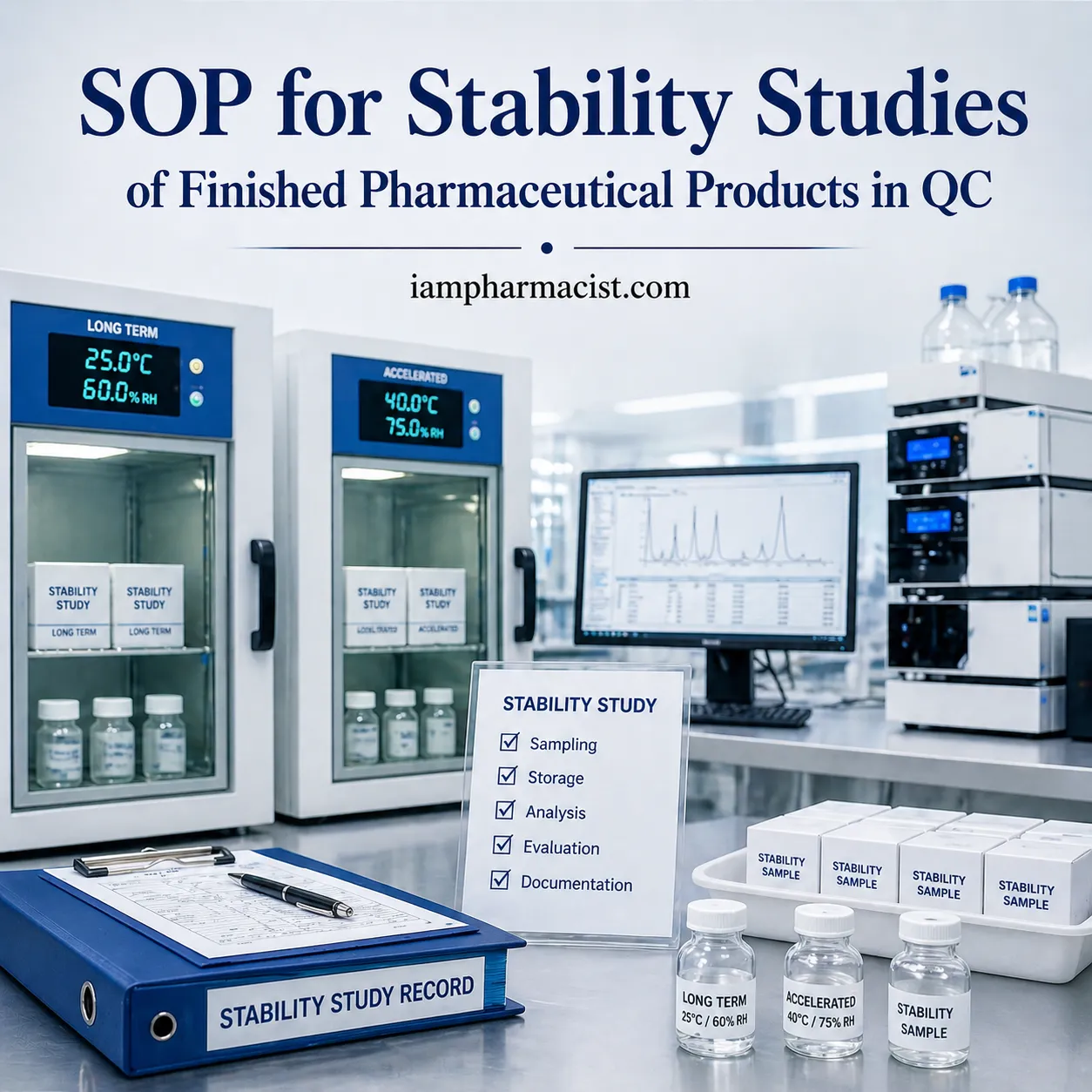

Learn a complete SOP for stability studies of finished pharmaceutical products in QC, including sampling, storage, testing, and evaluation steps.
Definition
A stability study SOP in pharmaceutical quality control is a documented procedure that defines how finished product samples are collected, stored, tested, and evaluated over time to ensure product quality, safety, and efficacy throughout its shelf life.
| Parameter | Accelerated Testing | Long-Term Testing |
|---|---|---|
| Temperature | 40 ±2°C | 25 ±2°C |
| Humidity | 75 ±5% RH | 60 ±5% RH |
| Time Points | 0,1,2,3,6 months | 0–60 months |
| Purpose | Predict stability | Confirm shelf-life |
Introduction
Stability studies are a cornerstone of pharmaceutical quality assurance, ensuring that finished products maintain their identity, strength, quality, and purity over time. A well-defined Standard Operating Procedure (SOP) in the Quality Control (QC) department ensures consistency, compliance with regulatory guidelines, and reliable data generation.
This guide provides a comprehensive SOP for analyzing finished products in stability studies, covering sampling, storage, testing, and evaluation.
1.0 Objective
To establish a standardized procedure for the collection, storage, and analysis of stability samples of finished pharmaceutical products.
2.0 Scope
Applicable to the Quality Control Department for all finished products undergoing stability studies.
3.0 Responsibility
- QC Supervisor
4.0 Accountability
- Senior Manager – Quality Assurance
5.0 Procedure
5.1 General Overview
All activities related to stability studies—including collection, storage, testing, and evaluation—must follow an approved stability program and flow chart.
5.2 Collection of Samples
- First three consecutive batches of new products must be tested under accelerated conditions.
- At least one batch per year must undergo long-term stability testing.
- Samples are collected by QA as per the approved stability schedule.
5.3 Sample Size
- Samples must be collected in intact marketed packs.
- Quantity should be sufficient for all stability-indicating tests.
5.4 Storage Conditions
- Long-term stability:
- 25 ±2°C / 60 ±5% RH
- Accelerated stability:
- 40 ±2°C / 75 ±5% RH
5.5 Testing Parameters & Periodicity
Initial Testing
- Based on Certificate of Analysis (CoA) if within one month of batch release.
- Otherwise, fresh analysis is required.
Testing Schedule
Accelerated Testing:
- 0, 1, 2, 3, 6 months
Long-Term Testing:
- 0, 3, 6, 9, 12, 18, 24, 36, 48, 60 months
Important Notes
- Long-term studies continue until product expiry.
- Analysis timelines:
- Accelerated: ±5 days
- Long-term: ±7 days
- Annual stability schedule must be prepared every December.
- All entries must be recorded in the stability register.
5.6 Evaluation of Stability Data
- Annual evaluation is mandatory.
- Any failure or deviation must be reported immediately.
Critical Parameters to Monitor
- Physical appearance
- pH
- Assay
- Dissolution
- Content uniformity
Action in Case of Failure
- Investigate affected and related batches
- Review raw materials, process parameters, and analytical data
- Decision on recall taken by technical management
SOP Operational Sections
Operation
- Follow approved stability program
- Ensure correct sampling and labeling
- Maintain testing timelines and documentation
Calibration
- Analytical instruments must be calibrated before testing
- Calibration records must be documented and verified
Cleaning
- Equipment and glassware must be cleaned as per SOP
- Prevent cross-contamination
- Maintain cleaning logs
Step-by-Step Stability Testing Process
- Collect samples from approved batches
- Store under defined stability conditions
- Perform initial testing (T0)
- Conduct periodic analysis as per schedule
- Record results in stability register
- Evaluate trends and deviations
- Report findings and recommend actions
Abbreviations
- SOP: Standard Operating Procedure
- QA: Quality Assurance
- QC: Quality Control
FAQs
1. What is stability testing in pharmaceuticals?
It evaluates how product quality changes over time under environmental conditions.
2. Why is stability SOP important?
It ensures consistency, compliance, and reliable results. https://www.fda.gov/drugs/pharmaceutical-quality-resources/search-pharmaceutical-quality-documents
3. What are accelerated stability conditions?
Typically 40°C and 75% RH to predict long-term stability.
4. How often are stability samples tested?
At predefined intervals such as 0, 3, 6, 12 months, etc.
5. What is long-term stability testing?
Testing under normal storage conditions to confirm shelf life.
6. Who is responsible for stability studies?
QC and QA departments share responsibilities.
7. What happens if stability fails?
Investigation and possible product recall.
8. What is initial analysis in stability studies?
Baseline testing at time zero (T0).
9. What is a stability register?
A logbook for recording all stability data.
10. How long are stability studies conducted?
Up to the product’s expiry period.
{ “@context”: “https://schema.org”, “@type”: “Article”, “headline”: “Stability Study SOP for Finished Products”, “description”: “Complete SOP for stability testing of finished pharmaceutical products in QC.”, “author”: { “@type”: “Organization”, “name”: “iampharmacist.com” } } { “@context”: “https://schema.org”, “@type”: “FAQPage”, “mainEntity”: [ { “@type”: “Question”, “name”: “What is stability testing?”, “acceptedAnswer”: { “@type”: “Answer”, “text”: “It evaluates product quality over time.” } } ] } { “@context”: “https://schema.org”, “@type”: “HowTo”, “name”: “Stability Testing Procedure”, “step”: [ {“@type”: “HowToStep”,”text”: “Collect samples”}, {“@type”: “HowToStep”,”text”: “Store samples”}, {“@type”: “HowToStep”,”text”: “Analyze periodically”}, {“@type”: “HowToStep”,”text”: “Evaluate results”} ] }