


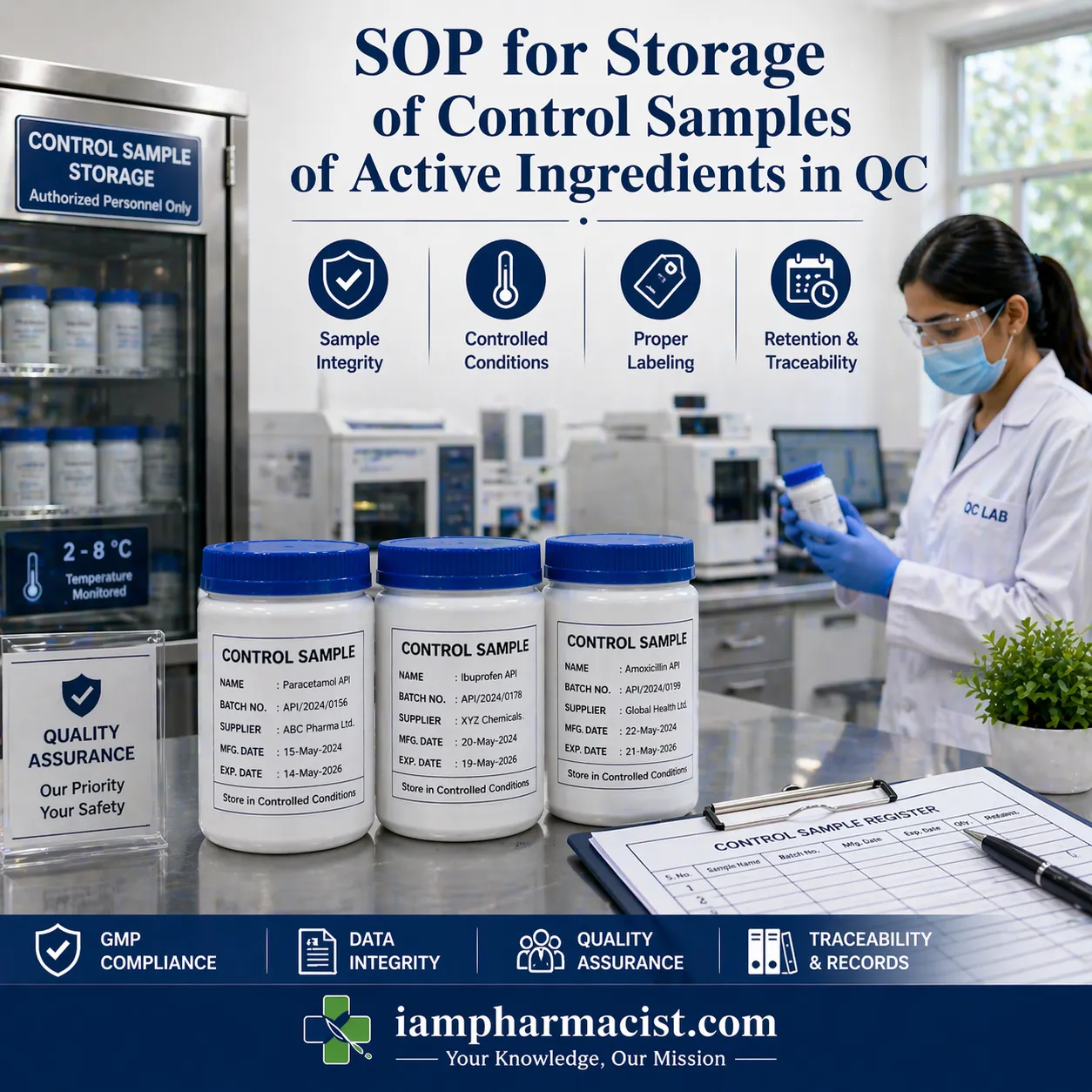

Learn SOP for storage of control samples of active ingredients in QC lab with GMP guidelines, labeling, and retention policy.
Introduction
In pharmaceutical quality control, maintaining control samples of active ingredients is essential for traceability, re-analysis, and regulatory compliance. These samples serve as reference points for product quality throughout the lifecycle of a drug.
A well-defined SOP ensures that control samples are stored under controlled conditions, properly labeled, and retained for the required duration. This document provides a GMP-compliant procedure for storing and maintaining control samples of active materials in QC laboratories.
Definition
Control samples of active materials are retained samples of active pharmaceutical ingredients (APIs) stored under controlled conditions to allow future testing, verification, and investigation throughout the product lifecycle.
| Parameter | Requirement |
|---|---|
| Sample Quantity | Sufficient for at least 2 analyses |
| Storage Location | Chemical store / QC storage area |
| Label Details | Name, batch no., supplier, MFG/EXP |
| Retention Period | 1 year after expiry of last batch |
| Traceability | Linked with BMR records |
| Disposal | As per SOP |
Step-by-Step Process
- Collect control sample
- Label with complete details
- Store in designated area
- Ensure sufficient quantity
- Maintain records and traceability
- Retain for defined period
- Dispose as per SOP
1.0 OBJECTIVE
To lay down the procedure for preservation of control samples of active ingredients.
2.0 SCOPE
This SOP is applicable to Quality Control Department.
3.0 RESPONSIBILITY
Quality Control Supervisor
4.0 ACCOUNTABILITY
Sr. Manager – Quality Assurance
5.0 PROCEDURE
5.1 Operation (Storage & Handling)
- Retain control samples of all active ingredients used in drug products
- Ensure sufficient quantity for at least two complete analyses
Labeling Requirements
- Paste label with:
- Sample name
- Batch number
- Supplier name
- Manufacturing date
- Expiry date
Storage Conditions
- Store samples in Chemical Stores / QC storage area
- Maintain controlled environmental conditions
5.2 Sample Retention
- Control samples must be retained for:
1 year after expiry of the last batch/lot in which the API is used
5.3 Traceability
- Maintain record of:
- Lot number / batch number
- Retrieve details from Batch Manufacturing Record (BMR)
5.4 Disposal Procedure (Cleaning Aspect)
- Dispose control samples after retention period
- Follow approved SOP for destruction
- Record disposal details
5.5 Calibration / Compliance
- Ensure storage area conditions are monitored
- Verify temperature/humidity logs
- Maintain compliance with GMP guidelines
5.6 Documentation
- Maintain sample register
- Record:
- Storage details
- Retention period
- Disposal records
6.0 ABBREVIATIONS
- SOP – Standard Operating Procedure
- QA – Quality Assurance
- QC – Quality Control
- Dept. – Department
Technical Insight: Why Control Samples Matter
Control samples ensure traceability and allow re-testing during investigations such as OOS, deviations, or stability failures. They are critical for regulatory audits and product quality assurance.
FAQs
1. What is control sample in pharma?
A retained sample for future testing and verification.
2. Why control samples are stored?
For traceability and re-analysis.
3. What is minimum quantity required?
Enough for two complete analyses.
4. Where are control samples stored?
Chemical store or QC storage area.
5. What is retention period?
1 year after expiry of last batch.
6. What details are on label?
Name, batch, supplier, dates.
7. What is BMR?
Batch Manufacturing Record.
8. Who is responsible?
QC Supervisor.
9. What happens after retention period?
Samples are destroyed as per SOP.
10. Which guidelines apply?
GMP and QA procedures.