


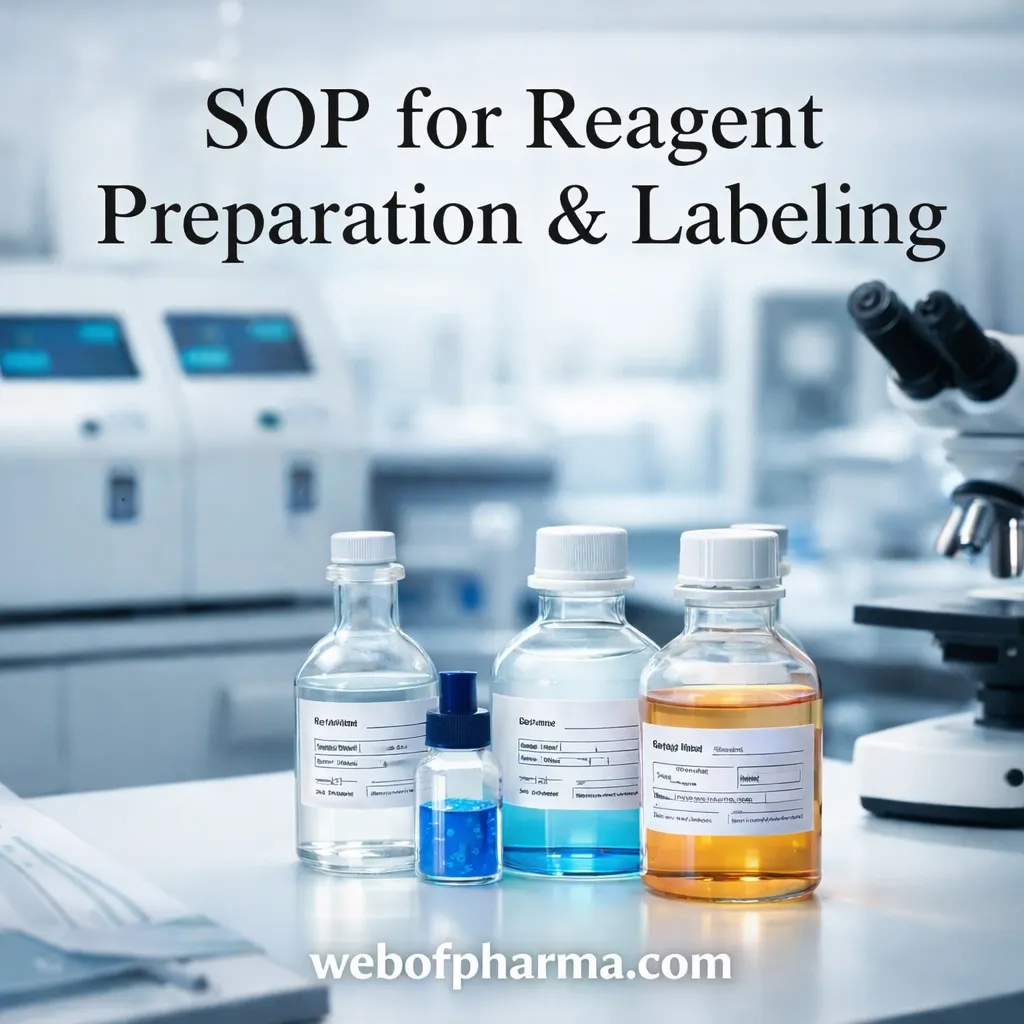

Learn SOP for preparation, identification, and labeling of reagents used in raw materials, in-process, and finished product analysis.
1.0 OBJECTIVE
To establish a standardized procedure for the preparation, identification, labeling, and documentation of reagents used during analysis.
2.0 SCOPE
This SOP applies to all reagents used in:
- Raw material analysis
- In-process sample testing
- Finished product evaluation
3.0 RESPONSIBILITY
- 3.1 Doing: Technical Assistant
- 3.2 Checking: Executive / Manager
4.0 ACCOUNTABILITY
- Head of the Department
Definition
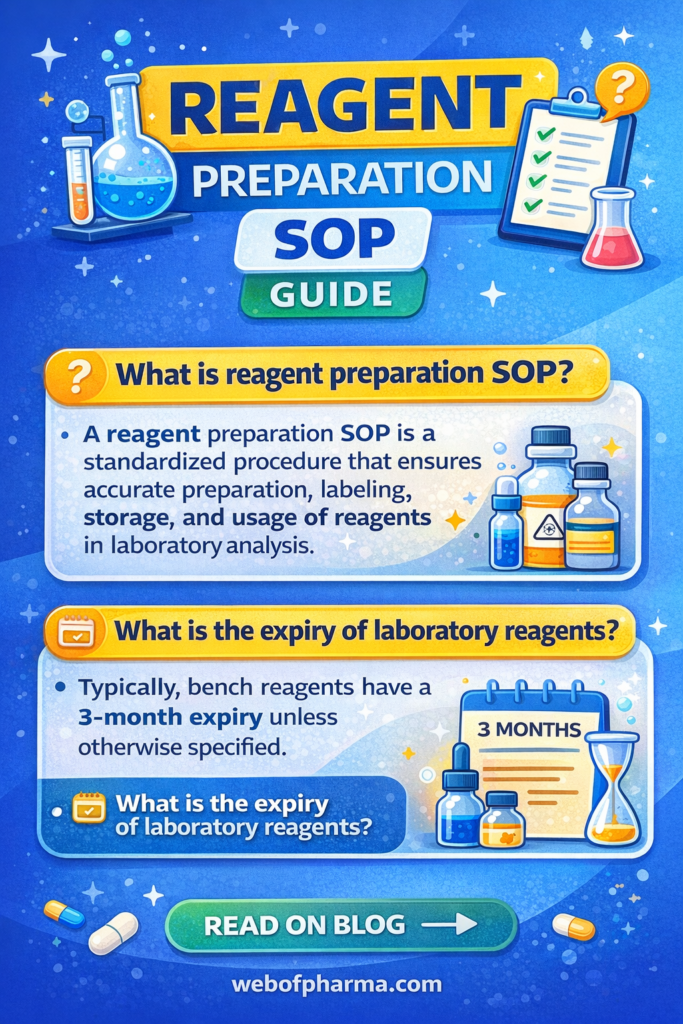
A Standard Operating Procedure (SOP) for reagent preparation is a documented guideline that ensures reagents used in laboratory analysis are prepared, labeled, stored, and monitored consistently to maintain accuracy, safety, and regulatory compliance.
Introduction
In pharmaceutical quality control, even a minor deviation in reagent preparation can compromise entire analytical results. A well-defined SOP for reagent preparation ensures consistency, traceability, and compliance with pharmacopoeial standards. This guide delivers a complete, audit-ready SOP for reagent preparation, identification, and documentation across QC laboratories.https://www.scribd.com/document/591653174/Determination-of-Shelf-life-of-Solutions-in-Laboratory
Semantic Content Layer
Reagent preparation in pharmaceutical analysis involves standardized processes aligned with pharmacopoeial methods such as IP, BP, and USP. Proper reagent identification, labeling, and storage are critical components of laboratory quality systems. This SOP ensures analytical accuracy, prevents contamination, and supports regulatory compliance under GMP guidelines.
5.0 PROCEDURE
Reagent Preparation
5.1 Preparation
- Prepare reagents strictly as per respective pharmacopoeia.
- Use calibrated instruments and approved raw materials.
5.2 Filling
- Transfer prepared reagent into clean, dry reagent bottles.
5.3 Labeling
- Label each reagent bottle with required details (Label I & II).
5.4 Expiry Assignment
- Assign 3 months expiry unless otherwise specified.
5.5 Pre-use Verification
- Check clarity and expiry before use.
- Discard hazy or expired reagents.
5.6 Documentation
- Record all details in annexure/logbook.
5.7 Reference Number Allocation
- Assign unique reference numbers as per reagent category.
5.3 Labeling Details
| Label Type | Information Required |
|---|---|
| Label I | Name of reagent, Strength, Method, Solvent, Ref. No. |
| Label II | Date of preparation, Strength, Signature, Use before, Checked by |
5.7 Reference Number System
General QC Laboratory
- Limit Test Solution → L-(01)
- Primary Colour Solution → P-(01)
- Indicator → I-(01)
- Table Reagent → TR-(01)
Bulk Drug API QC
- Limit Test → AL-(01)
- Primary Colour → AP-(01)
- Indicator → AI-(01)
- Table Reagent → ATR-(01)
Microbiology Laboratory
- Table Reagent → MTR-(01)
- Indicator → MI-(01)
6.0 ABBREVIATIONS
- Ref. No. = Reference Number
Step-by-Step SOP Sections
Operation
- Follow pharmacopoeial method strictly
- Use approved chemicals and solvents
- Maintain controlled environmental conditions
- Ensure traceability via reference numbers
Calibration
- Use calibrated weighing balances and volumetric glassware
- Verify calibration status before preparation
- Record calibration details in logbook
Cleaning
- Use clean, dried reagent bottles
- Ensure no cross-contamination
- Follow laboratory cleaning SOP
FAQs
1. What is SOP for reagent preparation?
It defines standardized steps for preparing and managing reagents in QC labs.
2. Why is reagent labeling important?
It ensures traceability, prevents errors, and maintains compliance.https://iampharmacist.com/concurrent-validation-in-pharma/
3. What is the standard expiry for reagents?
Generally 3 months unless specified otherwise.
4. What should be checked before using a reagent?
Expiry date and clarity of solution.
5. What happens if a reagent becomes hazy?
It must be discarded and freshly prepared.
6. Who is responsible for reagent preparation?
Technical Assistant prepares; Manager verifies.
7. What is a reference number in reagent SOP?
A unique identifier assigned to each reagent.
8. Which pharmacopoeia is followed?
IP, BP, USP depending on requirement.
9. How are reagents documented?
Through annexures and logbooks.
10. What ensures compliance in reagent preparation?
Proper SOP adherence, labeling, and documentation.
{ “@context”: “https://schema.org”, “@type”: “Article”, “headline”: “SOP for Reagent Preparation & Identification in QC”, “description”: “Standard operating procedure for preparation, identification, and labeling of reagents used in pharmaceutical analysis.”, “author”: { “@type”: “Organization”, “name”: “Pharma QC Expert” }, “publisher”: { “@type”: “Organization”, “name”: “Pharma Knowledge Hub” }, “mainEntityOfPage”: { “@type”: “WebPage”, “@id”: “https://example.com/sop-reagent-preparation-identification-qc” } } { “@context”: “https://schema.org”, “@type”: “FAQPage”, “mainEntity”: [ { “@type”: “Question”, “name”: “What is SOP for reagent preparation?”, “acceptedAnswer”: { “@type”: “Answer”, “text”: “It is a standardized procedure for preparing and managing laboratory reagents.” } } ] } { “@context”: “https://schema.org”, “@type”: “HowTo”, “name”: “How to Prepare Laboratory Reagents”, “step”: [ {“@type”: “HowToStep”,”text”: “Prepare reagent as per pharmacopoeia”}, {“@type”: “HowToStep”,”text”: “Transfer into clean bottle”}, {“@type”: “HowToStep”,”text”: “Label appropriately”}, {“@type”: “HowToStep”,”text”: “Assign expiry and reference number”}, {“@type”: “HowToStep”,”text”: “Verify before use”} ] }