


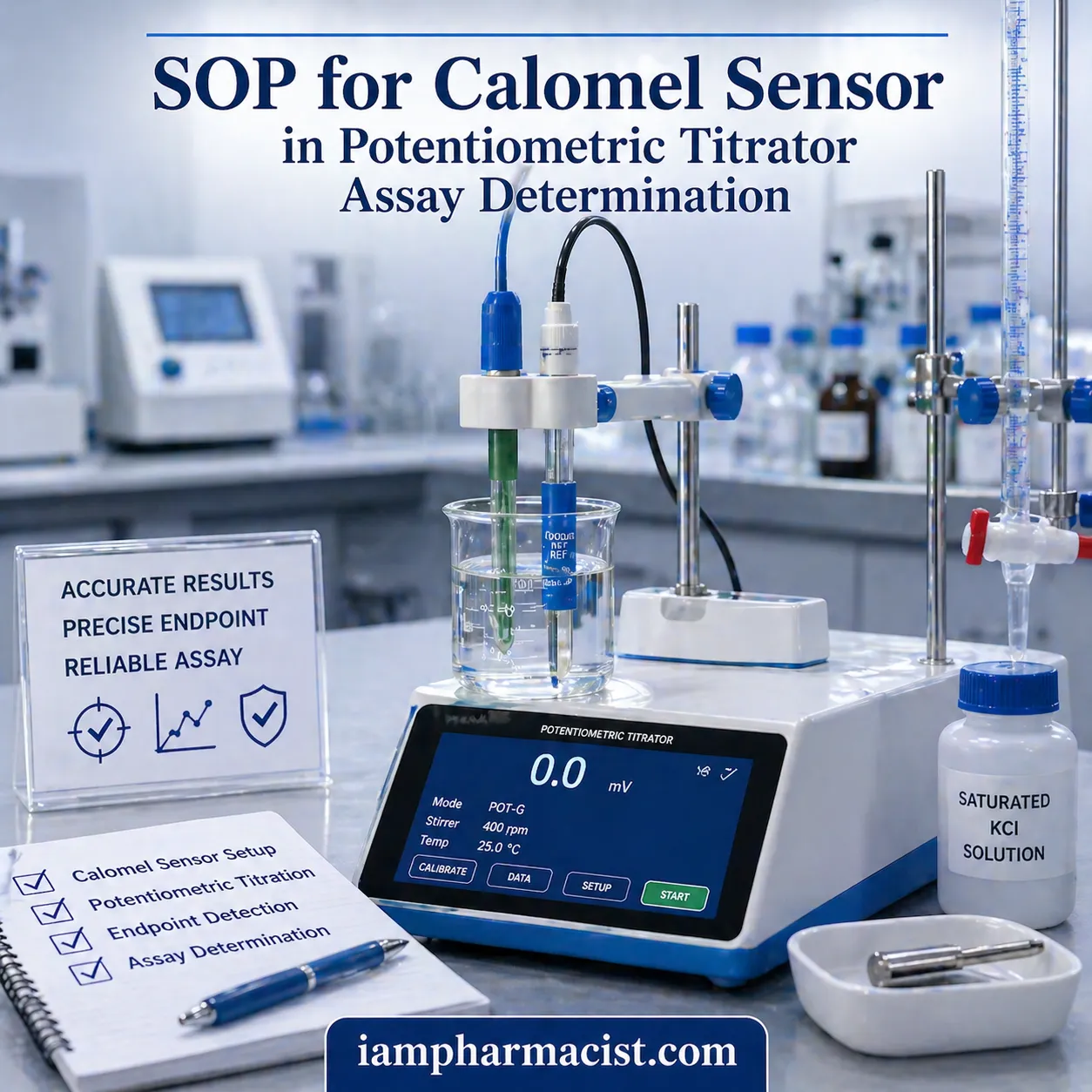

Learn SOP for calomel sensor (operating, calibrating, and maintaining) in potentiometric titrator for accurate assay determination in QC labs.
Definition
A calomel sensor SOP is a standardized procedure describing the correct method for operating, calibrating, and maintaining the calomel electrode used in potentiometric titration to ensure accurate assay determination in pharmaceutical quality control. https://iampharmacist.com/friability-test-apparatus-2/
| Parameter | Requirement |
|---|---|
| Power Supply | 230V, 50 Hz |
| Sensor Type | Calomel + Glass/Metal |
| Medium | Saturated KCl |
| Endpoint Detection | Maximum mV change |
| Selector Modes | POT-G / POT-M / O-R |
Step-by-Step List
Basic Operating Steps:
- Set controls to default position
- Connect power supply
- Attach calomel sensor
- Immerse electrodes in solution
- Adjust display to 0 mV
- Add titrant stepwise
- Record mV changes
- Identify endpoint
Introduction
Potentiometric titration is a highly accurate analytical technique used in pharmaceutical quality control for assay determination. The calomel sensor (reference electrode) plays a crucial role in measuring potential differences during titration. https://iampharmacist.com/bulk-density-apparatus/
This SOP ensures precision, reproducibility, and compliance with GMP standards, minimizing analytical errors and maintaining instrument integrity.
1.0 OBJECTIVE
To establish a standardized procedure for operation of potentiometric titration apparatus using calomel sensor.
2.0 SCOPE
Applicable to Quality Control Department.
3.0 RESPONSIBILITY
Supervisor Quality Control
4.0 ACCOUNTABILITY
Sr. Manager Quality Assurance (QA)
5.0 PROCEDURE
5.1 Operation of the Apparatus
Initial Setup
- Set selector switch to ‘O’
- Set stirrer to minimum (OFF position)
- Adjust set pointer to mid-range
Instrument Start-Up
- Connect power supply (230V, 50 Hz)
- Switch ON mains → display shows ~0 mV
- Adjust stirrer speed
Sensor Setup
- Connect:
- Calomel electrode → black socket
- Glass/Metal electrode → respective connector
- Immerse sensor tips in solution
- Ensure tips do not touch rotating stirrer
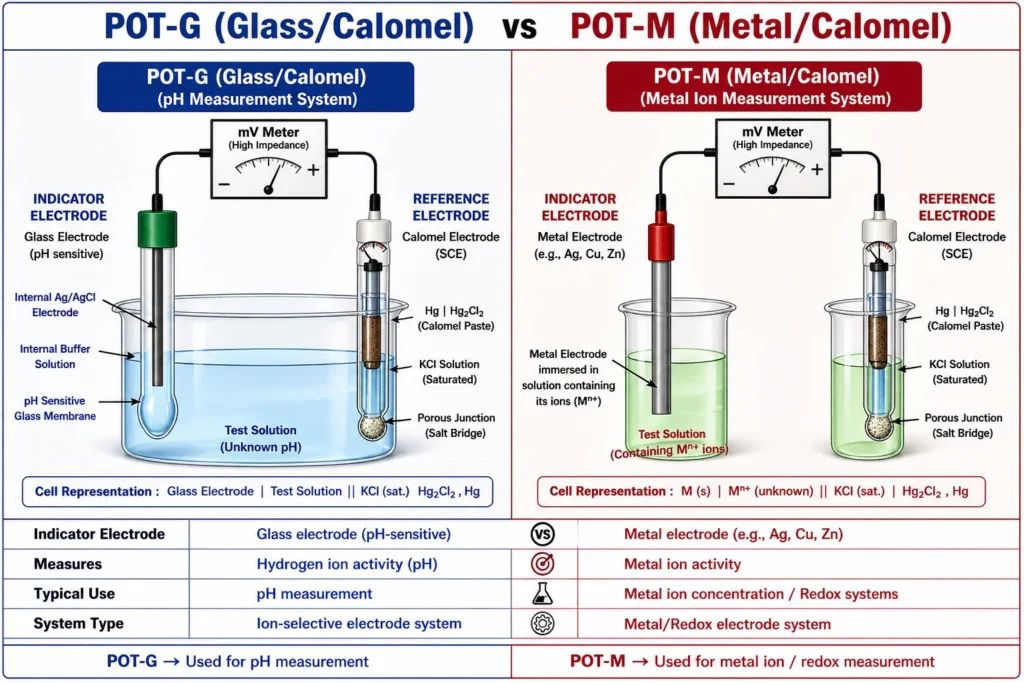
Measurement Process
- Set selector to:
- POT-G (Glass/Calomel)
- POT-M (Metal/Calomel)
- Adjust reading to 0 mV using coarse/fine controls
- Add titrant incrementally (e.g., 0.1–1 ml)
- Record change in millivolts after each addition
Endpoint Detection
- Endpoint = maximum change in mV
- After endpoint:
- mV changes decrease
- Graph plotting (mV vs volume) improves accuracy
5.2 Precautions
- Always keep selector in ‘O’ position when not in use
- Avoid damaging sensor tips
- Do not apply force on controls
5.3 Procedure Using Glass/Calomel Sensors
- Set selector to ‘O’
- Mount electrodes properly
- Add Glacial Acetic Acid (~60 ml)
- Fill burette with 0.1N Perchloric Acid
- Start stirrer
- Neutralize solution
- Add sample (~100 mg)
- Continue titration with fixed increments
- Record mV changes
- Determine endpoint
5.4 Oxidation/Reduction Titrations
- Use Calomel + Metal (Platinum) sensor
- Set selector to ‘O-R’
- Endpoint indicated by sharp polarity change (± mV)
5.5 Charging the Calomel Sensor
Procedure
- Prepare saturated KCl solution
- Add KCl crystals to reservoir
- Fill reservoir halfway with KCl solution
- Allow sensor to stand for 24 hours
5.6 Care and Maintenance
- Keep instrument clean and covered
- Avoid force on controls
- Clean metal sensors:
- Soft emery paper
- Dilute nitric acid + distilled water
- Maintain saturated KCl level
- Do not allow unauthorized repairs
Importance of Calomel Sensor in Assay
- Provides stable reference potential
- Ensures accurate endpoint detection
- Improves analytical precisionhttps://iampharmacist.com/tablet-disintegration-apparatus/
- Supports regulatory compliancehttps://www.webofpharma.com/2026/04/dissolution-apparatus-2-paddle-guide.html
6.0 ABBREVIATIONS
- SOP: Standard Operating Procedure
- Hz: Hertz
- mV: Millivolts
- Dept.: Department
FAQs
1. What is a calomel sensor?
A reference electrode used in potentiometric titration.
2. Why is KCl used in calomel electrode?
To maintain stable reference potential.
3. What is endpoint in potentiometric titration?
Maximum change in millivolts.
4. What is POT-G mode?
Glass electrode with calomel sensor.
5. What is POT-M mode?
Metal electrode with calomel sensor.
6. Why keep selector at ‘O’ position?
To prevent damage when not in use.
7. How to improve endpoint accuracy?
Plot mV vs volume graph.
8. How to clean metal sensors?
Using soft emery paper or dilute acid.
9. What happens if KCl is not saturated?
Sensor performance decreases.
10. What standards apply?
GMP and pharmacopeial guidelines.https://www.who.int/docs/default-source/medicines/norms-and-standards/guidelines/quality-control/trs957-annex1-goodpractices-harmaceuticalqualitycontrol-laboratories.pdf
{ “@context”: “https://schema.org”, “@type”: “Article”, “headline”: “Calomel Sensor SOP for Potentiometric Titration”, “description”: “Complete SOP for operation and maintenance of calomel electrode used in potentiometric titration.”, “author”: { “@type”: “Person”, “name”: “Pharma QA Expert” }, “publisher”: { “@type”: “Organization”, “name”: “iampharmacist.com” } } { “@context”: “https://schema.org”, “@type”: “FAQPage”, “mainEntity”: [ { “@type”: “Question”, “name”: “What is calomel sensor used for?”, “acceptedAnswer”: { “@type”: “Answer”, “text”: “It is used as a reference electrode in potentiometric titration.” } } ] } { “@context”: “https://schema.org”, “@type”: “HowTo”, “name”: “How to Use Calomel Sensor”, “step”: [ {“@type”: “HowToStep”,”text”: “Set controls”}, {“@type”: “HowToStep”,”text”: “Connect sensor”}, {“@type”: “HowToStep”,”text”: “Start titration”}, {“@type”: “HowToStep”,”text”: “Record mV”}, {“@type”: “HowToStep”,”text”: “Determine endpoint”} ] }