


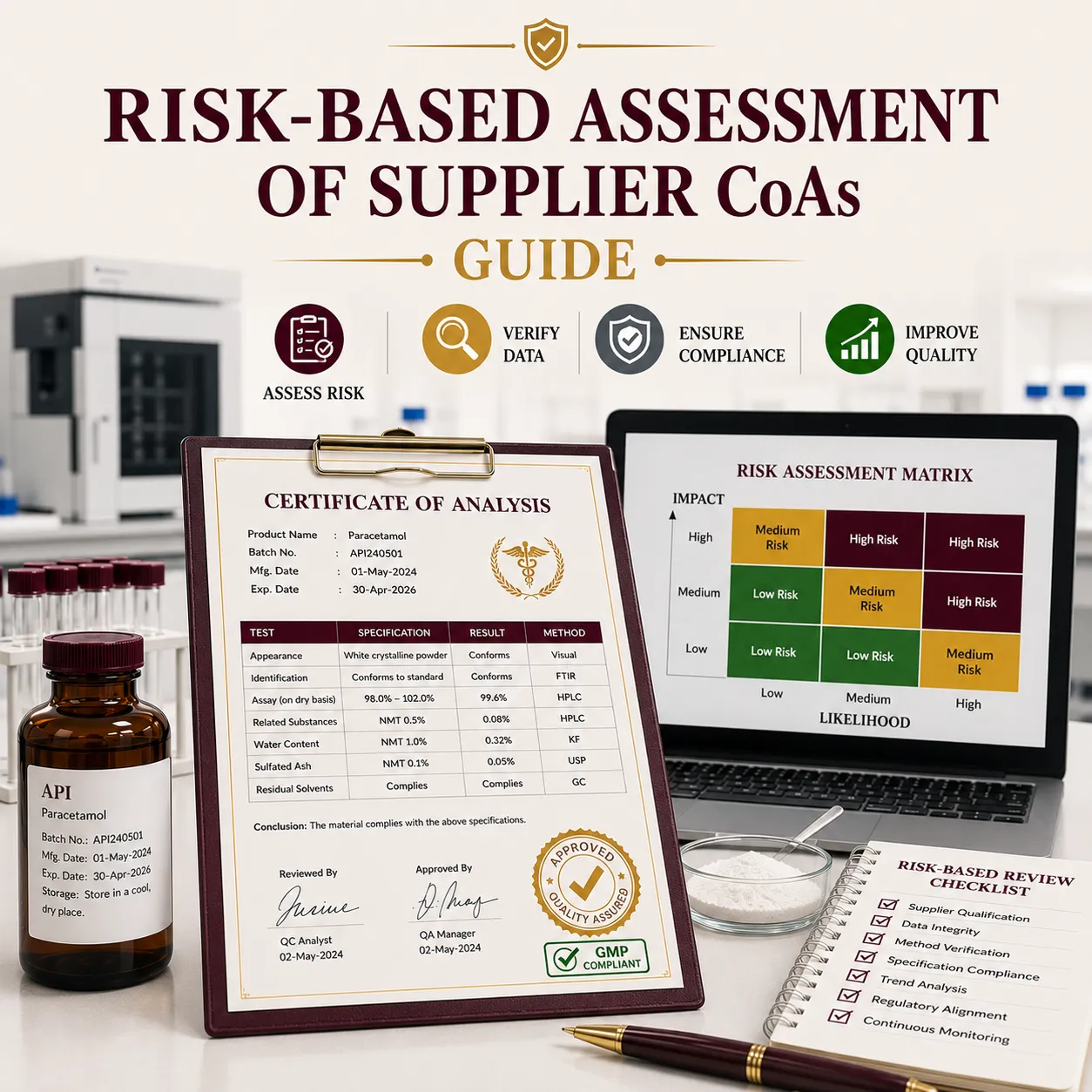

Learn how to perform risk-based assessment of supplier CoAs to ensure GMP compliance, supplier reliability, and material quality.
Definition
A risk-based assessment of supplier Certificates of Analysis (CoAs) is a quality management approach that evaluates supplier reliability, material criticality, historical performance, and regulatory compliance to determine the appropriate level of incoming material verification. This strategy helps pharmaceutical companies maintain GMP compliance while optimizing testing resources and supplier oversight.
Pharmaceutical manufacturers receive thousands of raw material batches every year, each accompanied by a Certificate of Analysis (CoA). While testing every incoming lot for every specification may seem like the safest approach, it is often inefficient, costly, and unnecessary when robust supplier qualification programs are in place.
Modern pharmaceutical quality systems increasingly rely on risk-based assessment of supplier Certificates of Analysis to balance patient safety, regulatory compliance, operational efficiency, and supplier quality assurance.
By applying risk management principles, QA and Compliance teams can determine when supplier CoAs may be trusted, when additional verification testing is required, and how supplier performance should be continuously monitored.
This article explores industry best practices for implementing a scientifically justified, risk-based CoA assessment program.
Why Use a Risk-Based Approach to Supplier CoA Assessment?
A risk-based strategy helps organizations:
- Reduce unnecessary testing costs
- Improve laboratory efficiency
- Strengthen supplier oversight
- Maintain GMP compliance
- Support supplier qualification programs
- Detect quality risks earlier
- Focus resources on high-risk materials
The approach aligns closely with:
- ICH Q9 Quality Risk Management
- ICH Q10 Pharmaceutical Quality System
- FDA cGMP requirements
- EU GMP expectations
- WHO GMP guidelines
Regulatory Expectations for Supplier CoA Reliance
Regulators do not permit manufacturers to blindly trust supplier CoAs.
FDA Requirement
Under 21 CFR 211.84(d)(1):
At least one specific identity test must be conducted on every incoming lot of raw material.
Manufacturers may reduce testing of other attributes only after establishing supplier reliability through qualification and verification activities.
Risk Tiering and Supplier Qualification
One of the most effective approaches is to classify suppliers based on risk.
Supplier Risk Categories
| Supplier Tier | Material Type | Risk Level | Verification Requirement |
|---|---|---|---|
| Critical | APIs, sterile materials, critical excipients | High | Full qualification + enhanced testing |
| Major | Functional excipients, processing aids | Medium | Periodic verification testing |
| Minor | Packaging, non-functional materials | Low | Documentation review |
This approach allows QA teams to allocate resources where they provide the greatest quality benefit.
Critical Suppliers
Examples include:
- Active Pharmaceutical Ingredients (APIs)
- Sterile components
- High-risk excipients
- Materials affecting patient safety
Recommended Controls
- Comprehensive supplier audits
- Quality Technical Agreements
- N+1 lot verification
- Periodic full-panel testing
- Annual performance review
Major Suppliers
Examples:
- Functional excipients
- Coating materials
- Process additives
Recommended Controls
- Routine documentation review
- Reduced testing programs
- Periodic supplier audits
- Trending of analytical results
Minor Suppliers
Examples:
- Secondary packaging
- Commodity materials
- Office supplies
Recommended Controls
- Vendor approval process
- Certificate of Conformance review
- Periodic supplier evaluation
Core CoA Validation Elements
A risk-based assessment begins with validating the integrity of the supplier CoA itself.
1. Traceability Verification
Every CoA should include:
- Product name
- Batch/Lot number
- Manufacturing date
- Expiry or retest date
- Supplier identification
Traceability Checklist
| Requirement | Present |
|---|---|
| Batch Number | ✓ |
| Manufacturing Date | ✓ |
| Expiry Date | ✓ |
| Product Identification | ✓ |
Missing traceability information should trigger further investigation.
2. Quantitative Analytical Results
QA teams should review actual numerical values rather than generic statements.
Preferred
✔ Assay = 99.4%
✔ Water Content = 0.32%
✔ Impurity A = 0.05%
Not Preferred
❌ Meets Specification
❌ Pass
❌ Conforms
Numerical data support meaningful quality assessments and trend analysis.
3. Method Verification
Verify that analytical methods are clearly identified.
Example
| Test | Method |
|---|---|
| Assay | USP HPLC |
| Identification | FTIR |
| Water Content | Karl Fischer |
| Residual Solvents | GC |
Methods should align with:
- USP
- EP
- BP
- JP
- Validated in-house procedures
4. Authorization Verification
A compliant CoA should include:
- Authorized signature
- Approval date
- Reviewer identification
- Electronic authentication (if applicable)
Quality Agreements and Supplier Responsibilities
For critical suppliers, formal Quality Technical Agreements (QTAs) are essential.
Topics Covered by QTAs
- Testing responsibilities
- Reporting requirements
- Change notification procedures
- OOS management
- CAPA responsibilities
- Regulatory communication
Well-defined agreements reduce ambiguity and strengthen supplier accountability.
Supplier Reliability Validation
Supplier CoA reliance must be justified through objective evidence.
Initial Qualification
Before reduced testing can be implemented:
- Supplier audit completed
- Quality systems evaluated
- Historical data reviewed
- Verification testing performed
N+1 Verification Strategy
A common approach is:
- Test the first lot completely
- Test the next lot completely
- Compare results against supplier CoAs
Consistent agreement supports supplier reliability.
Ongoing Monitoring and Best Practices
Supplier assessment is not a one-time activity.
Continuous monitoring is essential.
Statistical Process Control (SPC)
Trend supplier data over time.
Example
| Batch | Assay (%) |
|---|---|
| Batch 1 | 99.7 |
| Batch 2 | 99.6 |
| Batch 3 | 99.5 |
| Batch 4 | 98.8 |
A downward trend may indicate process drift.
Annual Verification Testing
Best practice includes periodic testing of randomly selected lots using:
- Internal laboratories
- Third-party ISO 17025 laboratories
Objective
Verify continued alignment between:
- Supplier CoA results
- Independent analytical results
OOS and CAPA Monitoring
QA should regularly review:
- OOS investigations
- Deviations
- CAPAs
- Complaints
- Recall history
These indicators provide valuable insight into supplier reliability.
Automation and Digital Supplier Quality Management
Many organizations are replacing manual reviews with automated systems.
Benefits of Supplier Quality Management (SQM) Software
| Feature | Benefit |
|---|---|
| Automated CoA Review | Faster verification |
| Missing Data Alerts | Improved compliance |
| Supplier Dashboards | Performance visibility |
| Expiry Notifications | Reduced risk |
| Audit Tracking | Better oversight |
Automation reduces manual errors and improves review consistency.
Step-by-Step Risk-Based Supplier CoA Assessment Process
Step 1
Classify suppliers according to risk.
Step 2
Verify supplier qualification status.
Step 3
Review CoA traceability information.
Step 4
Confirm numerical analytical results.
Step 5
Verify analytical methods and references.
Step 6
Assess Quality Agreement compliance.
Step 7
Review historical supplier performance.
Step 8
Perform verification testing when required.
Step 9
Trend supplier analytical data.
Step 10
Document risk assessment and approval decision.
Practical Example
Scenario
A manufacturer receives an API from a qualified supplier.
Assessment
| Evaluation Area | Status |
|---|---|
| Supplier Tier | Critical |
| Audit Completed | Yes |
| QTA Active | Yes |
| CoA Traceability | Complete |
| Verification Testing | Passed |
| Historical Performance | Acceptable |
Decision
Reduced Testing Program Approved
Supplier CoA accepted with periodic verification testing.
Common Mistakes in Risk-Based CoA Assessment
| Mistake | Risk |
|---|---|
| Blindly trusting supplier CoAs | Quality failures |
| No supplier tiering system | Inefficient resource use |
| Lack of data trending | Missed process drift |
| Missing verification testing | Unsupported reliance |
| Poor QTA management | Compliance gaps |
| Failure to review OOS history | Supplier risk overlooked |
GMP and Regulatory Insights
FDA
Requires identity testing for every incoming lot under 21 CFR 211.84.
ICH Q9
Supports scientifically justified risk-based decisions.
ICH Q10
Promotes lifecycle management of supplier quality systems.
EU GMP
Requires ongoing supplier qualification and material verification programs.
FAQs
1. What is a risk-based assessment of supplier CoAs?
A structured process that evaluates supplier reliability and material risk to determine the required level of verification testing.
2. Why is supplier risk tiering important?
It helps allocate quality resources based on material criticality and patient safety impact.
3. Can manufacturers rely entirely on supplier CoAs?
No. Identity testing and supplier reliability verification are still required.
4. What is N+1 verification testing?
Testing multiple initial lots to compare supplier results with independent laboratory data.
5. What regulations support risk-based CoA assessment?
FDA 21 CFR 211.84, ICH Q9, ICH Q10, EU GMP, and WHO GMP.
6. What information should every supplier CoA contain?
Batch traceability, analytical results, test methods, and authorization details.
7. Why are Quality Technical Agreements important?
They define responsibilities, testing requirements, and change notification expectations.
8. What is SPC in supplier monitoring?
Statistical Process Control used to identify trends and process drift.
9. How often should supplier performance be reviewed?
At least annually, with continuous monitoring for critical suppliers.
10. What is the benefit of automated CoA review systems?
They improve consistency, compliance, and review efficiency while reducing manual errors.