


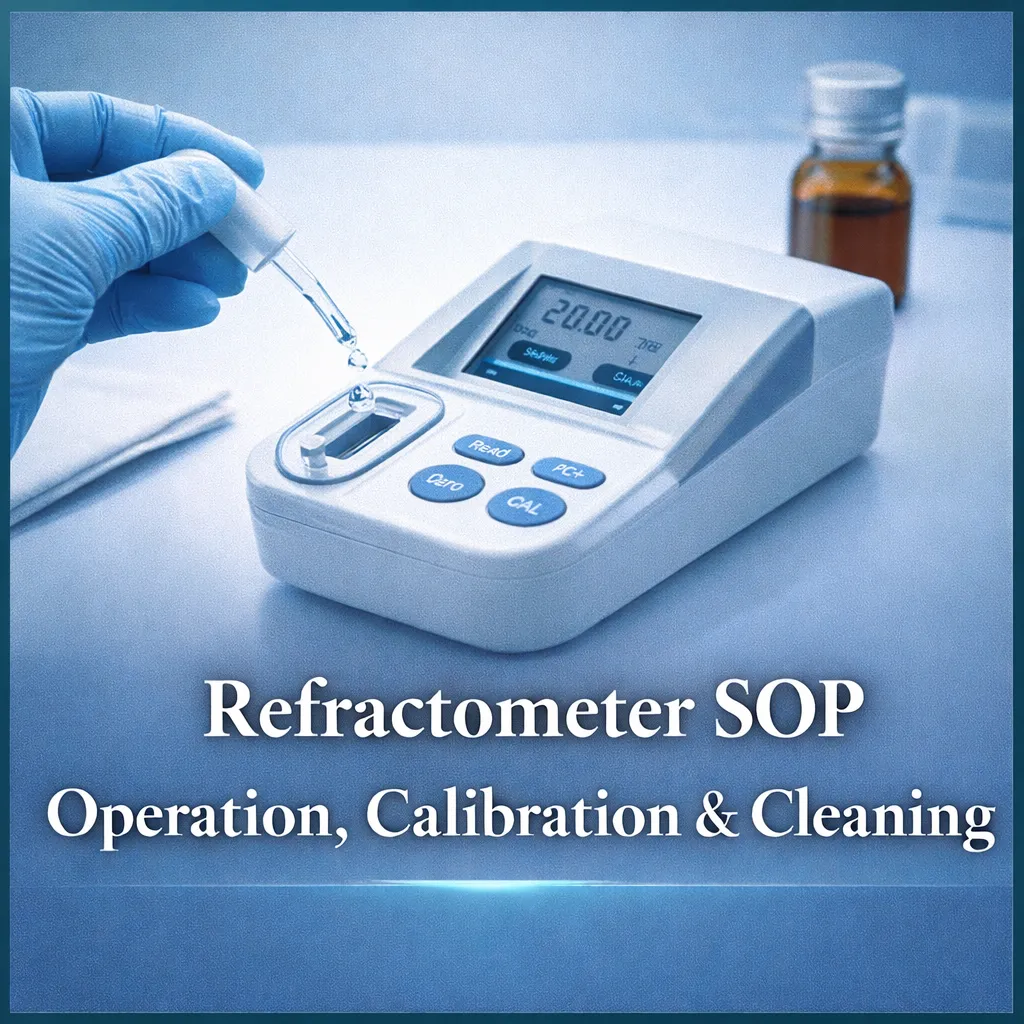

Learn refractometer SOP for operation, calibration, and cleaning in QC labs to ensure accurate refractive index measurement.
Introduction
A refractometer is an essential analytical instrument in pharmaceutical quality control laboratories, used to measure the refractive index of substances. Accurate readings depend on proper operation, regular calibration, and thorough cleaning of the prism and optical components.
This SOP provides a comprehensive guide for operating, calibrating, and cleaning the refractometer to ensure precision, reliability, and compliance with quality standards.
1.0 Objective
To define a standardized procedure for the operation, calibration, and cleaning of the refractometer.
2.0 Scope
This SOP applies to the refractometer installed in the Quality Control (QC) laboratory.
3.0 Responsibility
- Doing: Technical Assistant / Executive
- Checking: Executive / Manager
4.0 Accountability
- Head of the Department
5.0 Step-by-Step SOP for Refractometer
5.1 Operation of Refractometer
5.1.1 Pre-Operation Checks
- Ensure prism surface is clean and dry
- Verify calibration status
- Check light source and optical clarity
5.1.2 Sample Application
- Place a few drops of sample on prism
- Close the cover plate gently
5.1.3 Measurement
- Adjust focus and light
- Read refractive index from scale/display
5.1.4 Completion
- Record readings in logbook/system
- Remove sample from prism
5.2 Calibration of Refractometer
5.2.1 Standard Calibration
- Use distilled water or certified reference liquid
- Compare observed value with standard
5.2.2 Adjustment
- Adjust calibration knob if deviation observed
5.2.3 Frequency
- Perform calibration daily or as per SOP
5.2.4 Documentation
- Record calibration details in logbook
5.3 Cleaning Procedure
5.3.1 Cleaning Frequency
- Clean after each use
5.3.2 Prism Cleaning
- Clean prism with xylene
- Wipe with tissue paper
5.3.3 Optical Components
- Clean mirror and eyepiece with isopropyl alcohol (IPA)
- Wipe with tissue paper
5.3.4 External Cleaning
- Clean instrument body with cotton cloth
5.3.5 Documentation
- Record cleaning in instrument log card
6.0 Abbreviations
- SOP: Standard Operating Procedure
Safety Precautions
- Handle solvents (xylene, IPA) carefully
- Avoid direct contact with prism surface
- Use PPE (gloves, lab coat)
- Ensure proper ventilation
- Prevent scratches on optical components
Common Mistakes to Avoid
- Not cleaning prism after use
- Using contaminated samples
- Skipping calibration
- Scratching optical surfaces
- Incorrect reading due to poor focusing
Best Practices
- Clean immediately after every use
- Use lint-free tissue for wiping
- Calibrate regularly
- Maintain proper documentation
- Train staff on instrument handling
FAQs (Frequently Asked Questions)
1. What is a refractometer used for?
To measure refractive index of liquids or solids.
2. Why is cleaning important?
To avoid contamination and ensure accurate readings.
3. What solvent is used for prism cleaning?
Xylene is commonly used.
4. What is used for optical cleaning?
Isopropyl alcohol (IPA).
5. How often should calibration be done?
Daily or as per SOP.
6. What happens if prism is dirty?
It leads to inaccurate results.
7. Who is responsible for operation?
Technical staff performs; Manager verifies.
8. Why use distilled water for calibration?
It provides a known reference value.
9. Is documentation required?
Yes, for compliance and traceability.
10. What PPE is required?
Gloves and lab coat.