


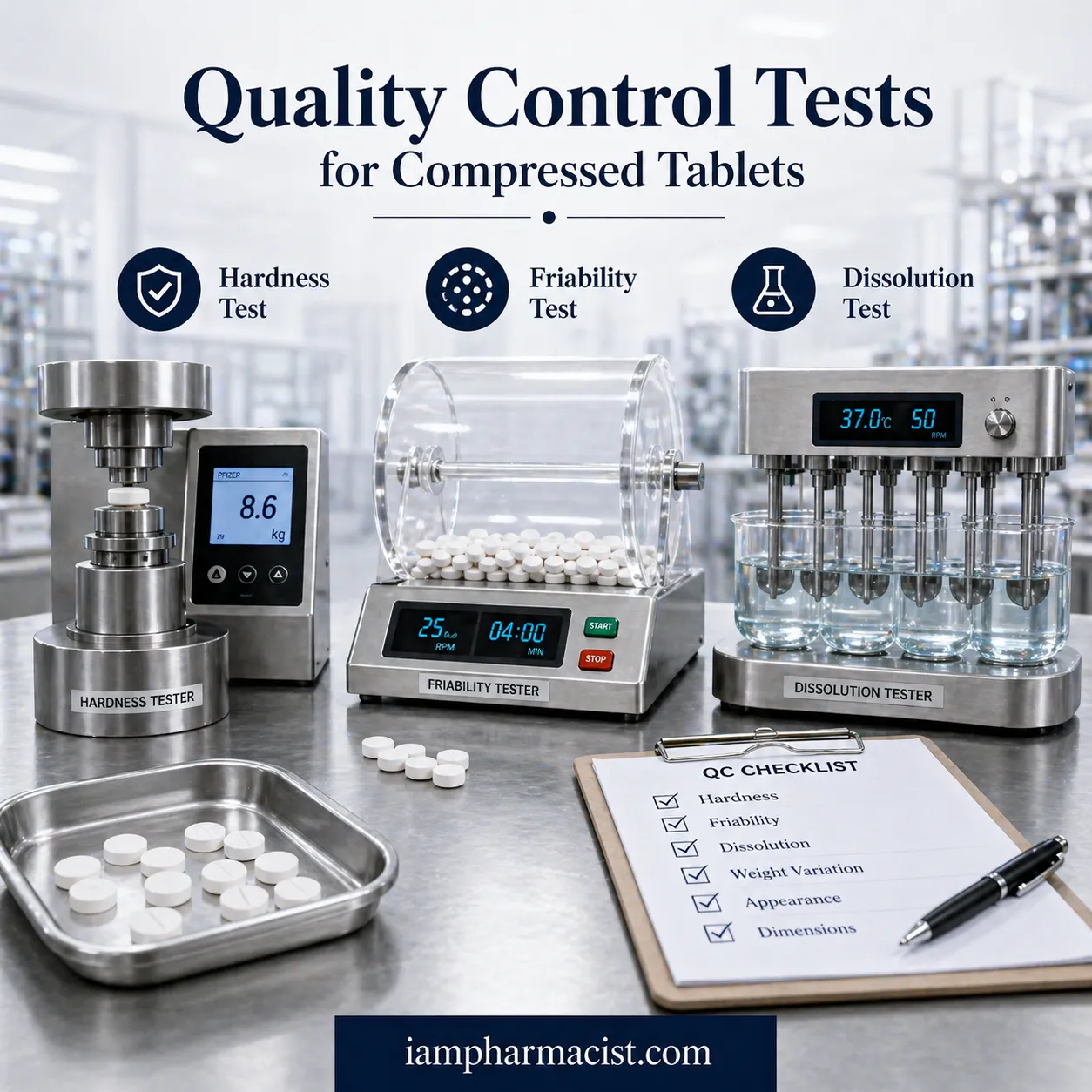

Tablet quality control tests are analytical procedures used to evaluate the physical, mechanical, and release properties of tablets to ensure they meet pharmacopeial standards for safety, efficacy, and consistency.
Introduction
Compressed tablets may look simple—but ensuring their quality requires rigorous testing.
Each tablet must meet strict standards for:
- Strength
- Stability
- Drug release
Without proper testing, tablets may fail in:
❌ Dissolution
❌ Handling
❌ Therapeutic effectiveness
That’s why pharmaceutical industries rely on hardness, friability, and dissolution tests as core quality control measures.
Key Quality Control Tests Overview
| Test | Purpose | Importance |
|---|---|---|
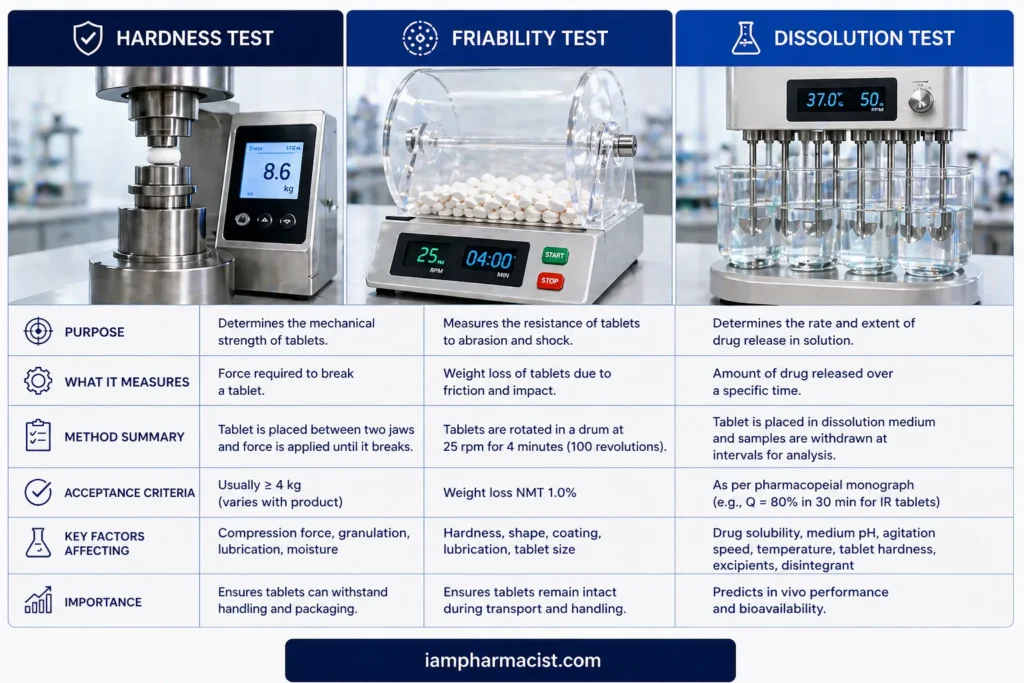
| Hardness | Measures tablet strength | Prevents breakage |
| Friability | Tests resistance to abrasion | Ensures durability |
| Dissolution | Measures drug release | Predicts bioavailability |
1. Tablet Hardness (Crushing Strength Test)
What It Measures
The force required to break a tablet.
Why It Matters
- Too hard → poor dissolution
- Too soft → breakage
Standard Insight
- Minimum hardness: ~4 kg for acceptable tablets
Equipment Used
- Monsanto tester
- Pfizer tester
- Digital hardness testers
How to Perform Hardness Test
- Select 10 tablets
- Place each tablet in hardness tester
- Apply force until tablet breaks
- Record values
- Calculate average
2. Friability Test
What It Measures
Resistance of tablets to abrasion and shock.
Why It Matters
Simulates real-world handling:
- Packaging
- Transport
- Storage
Acceptance Criteria
- Weight loss ≤ 1% is acceptable
How to Perform Friability Test
- Weigh 20 tablets (initial weight)
- Place in Roche friabilator
- Rotate for specified time
- Remove and dedust
- Reweigh tablets
- Calculate % weight loss
3. Dissolution Test
What It Measures
The rate and extent of drug release into solution.
Why It Matters
- Predicts bioavailability
- Ensures therapeutic effectiveness
Common Apparatus
- Rotating basket
- Rotating paddle
- Flow-through cell
👉 Paddle method is often more sensitive for detecting formulation differences
Test Conditions
- Temperature: 37 ± 1°C
- Medium: Depends on drug (acidic, alkaline, or water)
- Sampling at specific intervals
How to Perform Dissolution Test
- Place tablet in dissolution medium
- Maintain controlled temperature
- Rotate paddle/basket
- Withdraw samples at intervals
- Analyze drug concentration
- Plot release profile
Factors Affecting Tablet Quality
1. Drug Properties
- Particle size
- Solubility
- Polymorphism
2. Manufacturing Factors
- Compression force
- Granulation method
- Binder and disintegrant levels
3. Testing Conditions
- pH of medium
- Temperature
- Agitation speed
Additional Quality Tests
- Thickness measurement
- Weight variation
- Tensile strength
- Porosity
👉 These ensure consistency across batches. https://iampharmacist.com/maintenance-and-troubleshooting/
In-Process vs Final Quality Control
| Type | When Performed | Purpose |
|---|---|---|
| In-process | During production | Prevent defects early |
| Final testing | After production | Batch approval |
FAQs
1. What are tablet quality control tests?
Tests to ensure tablets meet safety and performance standards. https://iampharmacist.com/automation-in-tablet-compression/
2. What is hardness test?
It measures the force needed to break a tablet.
3. What is friability?
It measures tablet resistance to abrasion.
4. What is dissolution test?
It evaluates drug release in solution.
5. What is acceptable friability limit?
Usually ≤ 1%.
6. Why is dissolution important?
It predicts drug bioavailability.
7. What affects tablet hardness?
Compression force and formulation.
8. How many tablets are tested in friability?
Typically 20 tablets. https://www.webofpharma.com/2025/05/in-process-checks-and-failure-handling.html
9. What temperature is used in dissolution test?
37 ± 1°C.
10. Are these tests mandatory?
Yes, for regulatory compliance.
{ “@context”: “https://schema.org”, “@type”: “Article”, “headline”: “Quality Control Tests for Compressed Tablets”, “description”: “Learn hardness, friability, and dissolution tests used in tablet quality control.”, “author”: { “@type”: “Organization”, “name”: “iampharmacist.com” }, “mainEntityOfPage”: { “@type”: “WebPage”, “@id”: “https://iampharmacist.com/tablet-quality-control-tests-hardness-friability-dissolution” } } { “@context”: “https://schema.org”, “@type”: “HowTo”, “name”: “How to Perform Tablet Quality Tests”, “step”: [ {“@type”: “HowToStep”,”text”: “Measure tablet hardness”}, {“@type”: “HowToStep”,”text”: “Conduct friability test”}, {“@type”: “HowToStep”,”text”: “Perform dissolution test”}, {“@type”: “HowToStep”,”text”: “Analyze results”}, {“@type”: “HowToStep”,”text”: “Compare with standards”}, {“@type”: “HowToStep”,”text”: “Approve or reject batch”} ] } { “@context”: “https://schema.org”, “@type”: “FAQPage”, “mainEntity”: [ {“@type”: “Question”,”name”: “What are tablet quality control tests?”,”acceptedAnswer”:{“@type”:”Answer”,”text”:”Tests to ensure tablets meet safety and performance standards.”}}, {“@type”: “Question”,”name”: “What is friability limit?”,”acceptedAnswer”:{“@type”:”Answer”,”text”:”Usually not more than 1% weight loss.”}} ] }