


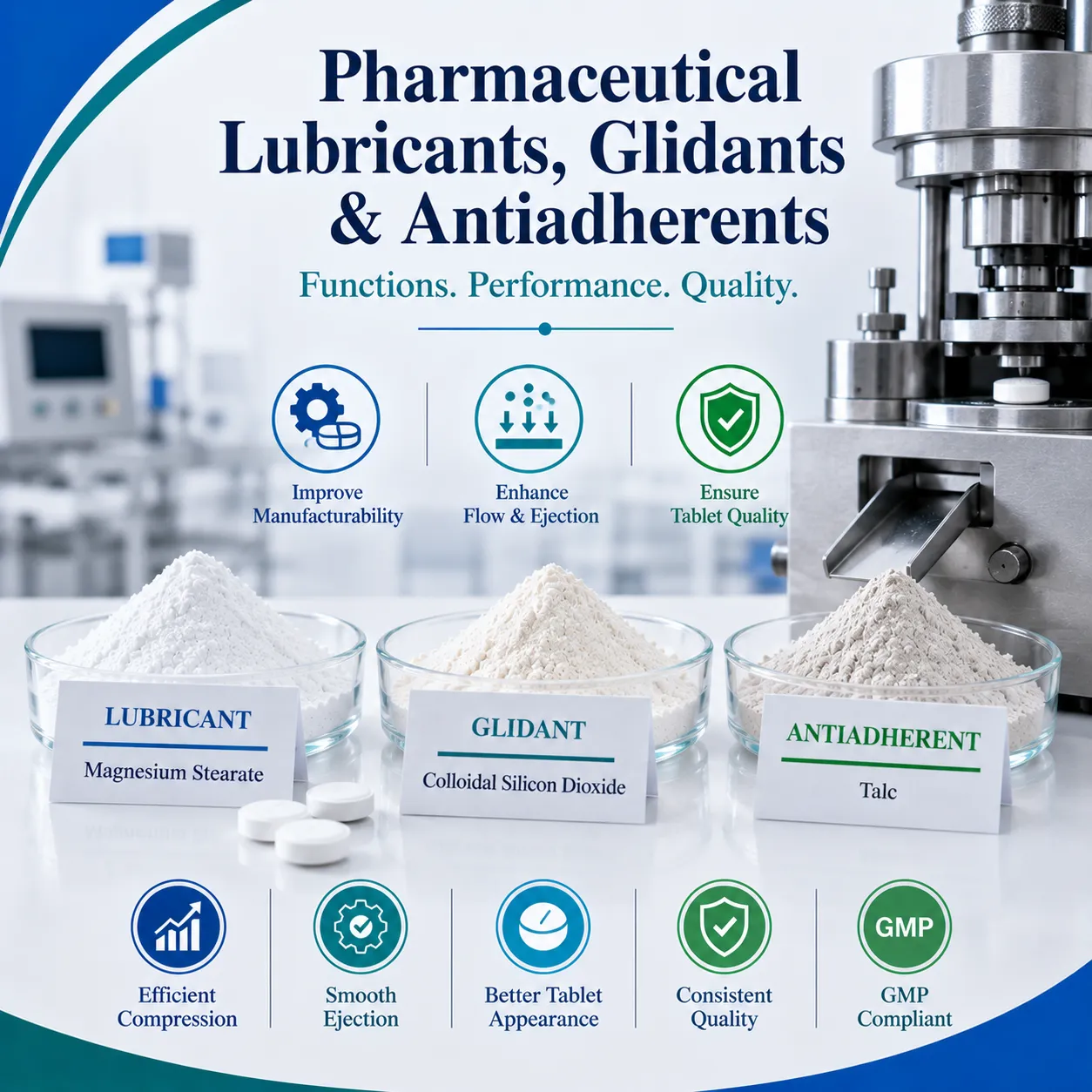

Learn Pharmaceutical Lubricants, Glidants & Antiadherents, including functions, selection criteria, GMP requirements, formulation impact, and performance comparison.
Definition
Pharmaceutical lubricants, glidants, and antiadherents are functional excipients used during tablet and capsule manufacturing to improve powder flow, reduce friction, prevent sticking, and ensure smooth compression and ejection. Common examples include magnesium stearate, stearic acid, talc, and colloidal silicon dioxide. Their proper selection directly impacts manufacturing efficiency, tablet quality, dissolution, and regulatory compliance.
Pharmaceutical Lubricants, Glidants, and Antiadherents: Functions and Selection Guide
Introduction
Tablet and capsule manufacturing involves complex mechanical processes that subject powders and granules to high pressures, friction, and equipment contact. Without appropriate excipients to facilitate processing, manufacturers frequently encounter problems such as sticking, picking, poor flow, high ejection forces, weight variation, and equipment wear.
To overcome these challenges, formulators use three critical classes of processing excipients:
- Lubricants
- Glidants
- Antiadherents
Although these excipients are often discussed together, each performs a distinct function during pharmaceutical manufacturing. Understanding their mechanisms, advantages, limitations, and selection criteria is essential for producing robust, GMP-compliant pharmaceutical products.
Why Lubricants, Glidants, and Antiadherents Matter
These excipients directly influence:
- Powder flowability
- Tablet compressibility
- Ejection efficiency
- Equipment wear
- Tablet appearance
- Dissolution performance
- Manufacturing productivity
Improper selection can lead to:
- Capping
- Lamination
- Sticking
- Picking
- Weight variation
- Slow dissolution
- Increased downtime
Understanding Pharmaceutical Lubricants
What Are Lubricants?
Lubricants are excipients that reduce friction between powder particles and metal surfaces during tablet compression and ejection.
They create a thin film layer between:
- Powder particles
- Die walls
- Punch surfaces
- Compression equipment
This barrier minimizes direct contact and facilitates smooth tablet production.
Functions of Lubricants
Reduce Die Wall Friction
Facilitate tablet ejection.
Minimize Punch Wear
Protect tooling during high-speed production.
Improve Compression Efficiency
Allow consistent force distribution.
Reduce Manufacturing Downtime
Prevent excessive equipment stress.
Common Pharmaceutical Lubricants
| Lubricant | Typical Concentration | Key Features |
|---|---|---|
| Magnesium Stearate | 0.25–1.0% | Excellent lubrication |
| Stearic Acid | 0.5–2.0% | Suitable for moisture-sensitive formulations |
| Sodium Stearyl Fumarate | 0.5–1.0% | Minimal dissolution impact |
| Hydrogenated Castor Oil | 1.0–3.0% | Suitable for natural formulations |
Magnesium Stearate: The Industry Standard
Advantages
- Superior lubrication efficiency
- Widely accepted globally
- Cost-effective
- Excellent die wall lubrication
Limitations
Excessive use can:
- Slow tablet dissolution
- Increase disintegration time
- Reduce tablet hardness
Studies have shown that magnesium stearate levels above 1% may reduce dissolution rates by 20–50% in immediate-release formulations.
Importance of Lubrication Time
Lubricants require careful blending.
Recommended Mixing Time
Typically:
- 2–5 minutes
Why It Matters
Overmixing can:
- Create hydrophobic coatings
- Slow dissolution
- Reduce tablet strength
Proper lubrication balances manufacturability and product performance.
Understanding Pharmaceutical Glidants
What Are Glidants?
Glidants improve powder flow properties by reducing interparticle friction.
They are particularly valuable in:
- Direct compression
- Capsule filling
- High-speed tableting
Functions of Glidants
Improve Flowability
Promote smooth movement through hoppers and feeders.
Improve Die Filling
Enhance weight uniformity.
Reduce Segregation
Maintain blend homogeneity.
Support Continuous Manufacturing
Improve feeding consistency.
Common Pharmaceutical Glidants
| Glidant | Typical Concentration |
|---|---|
| Colloidal Silicon Dioxide | 0.1–1.0% |
| Talc | 0.5–5.0% |
| Starch | 1–10% |
Colloidal Silicon Dioxide
Benefits
- Excellent moisture absorption
- Improved powder flow
- Multifunctional excipient
Additional Roles
Acts as:
- Glidant
- Antiadherent
- Moisture scavenger
Because of its extremely fine particle size and large surface area, it is one of the most effective pharmaceutical glidants.
Understanding Pharmaceutical Antiadherents
What Are Antiadherents?
Antiadherents prevent powder formulations from sticking to punch faces, die walls, and equipment surfaces during compression.
Their primary purpose is to eliminate:
- Sticking
- Picking
- Build-up on tooling
They function by forming a non-adhesive barrier between powder particles and equipment surfaces.
Functions of Antiadherents
Prevent Punch Sticking
Maintain clean punch surfaces.
Reduce Picking Defects
Improve tablet appearance.
Improve Production Efficiency
Reduce cleaning interruptions.
Enhance Equipment Performance
Minimize adhesion-related downtime.
Common Pharmaceutical Antiadherents
| Antiadherent | Typical Concentration |
|---|---|
| Talc | 1–5% |
| Colloidal Silicon Dioxide | 0.1–1.0% |
| Cornstarch | 2–10% |
| Magnesium Carbonate | 1–3% |
Talc as an Antiadherent
Advantages
- Excellent anti-sticking properties
- Cost-effective
- Multifunctional performance
Additional Benefits
Acts as:
- Antiadherent
- Glidant
- Flow aid
Considerations
Natural talc sources require strict quality controls to ensure compliance with pharmacopeial and regulatory requirements.
Lubricants vs Glidants vs Antiadherents
| Property | Lubricants | Glidants | Antiadherents |
|---|---|---|---|
| Primary Function | Reduce friction | Improve flow | Prevent sticking |
| Main Action Site | Die wall & punches | Powder particles | Punch surfaces |
| Examples | Magnesium Stearate | Colloidal Silica | Talc |
| Impact on Dissolution | May slow dissolution | Minimal | Usually minimal |
| Typical Level | 0.25–2% | 0.1–1% | 0.1–10% |
| Manufacturing Benefit | Easier ejection | Better die filling | Reduced sticking |
Impact on Tablet Quality
Lubricants
Positive Effects
- Lower ejection force
- Reduced tooling wear
Potential Drawbacks
- Slower dissolution
- Increased disintegration time
- Reduced hardness
Glidants
Benefits
- Better weight uniformity
- Improved blend flow
- Enhanced content uniformity
Antiadherents
Benefits
- Reduced sticking
- Better tablet appearance
- Less downtime
Minimal Effect On
- Dissolution
- Tablet hardness
when used appropriately.
When to Use Lubricants
Choose lubricants when:
- Ejection force is high
- Tooling wear is excessive
- Compression efficiency is poor
- High-speed tableting is used
Recommended Options
| Situation | Lubricant |
|---|---|
| Immediate Release | Sodium Stearyl Fumarate |
| General Use | Magnesium Stearate |
| Moisture Sensitive Products | Stearic Acid |
When to Use Glidants
Use glidants when:
- Flowability is poor
- Weight variation occurs
- Segregation is observed
- Direct compression is employed
When to Use Antiadherents
Use antiadherents when:
- Sticking occurs
- Picking defects appear
- Hygroscopic APIs are used
- High binder levels are present
Colloidal silicon dioxide is particularly effective for moisture-sensitive formulations.
Combined Use of Lubricants and Antiadherents
Many formulations benefit from a combination strategy.
Example
| Excipient | Level |
|---|---|
| Magnesium Stearate | 0.25–0.5% |
| Talc | 1–3% |
Benefits
- Reduced ejection force
- Improved punch cleanliness
- Better production efficiency
This approach is commonly used for challenging formulations containing both cohesive and adhesive ingredients.
How to Select Lubricants, Glidants, and Antiadherents
Step 1: Evaluate API Properties
Assess:
- Hygroscopicity
- Solubility
- Dose
- Compressibility
Step 2: Identify Manufacturing Problems
Determine whether issues involve:
- Flow
- Friction
- Sticking
Step 3: Select Functional Excipients
Match excipient functionality to manufacturing challenges.
Step 4: Optimize Concentration
Evaluate:
- Lubrication efficiency
- Flow properties
- Dissolution performance
Step 5: Conduct Compatibility Studies
Use:
- FTIR
- DSC
- Stability testing
Step 6: Validate Manufacturing Performance
Confirm:
- Compression performance
- Tablet quality
- Dissolution profile
Practical Example
Immediate-Release Tablet
Challenge
High sticking and slow ejection.
Solution
| Function | Excipient |
|---|---|
| Lubricant | Sodium Stearyl Fumarate |
| Glidant | Colloidal Silicon Dioxide |
| Antiadherent | Talc |
Result
- Improved flow
- Reduced sticking
- Faster ejection
- Maintained dissolution performance
GMP and Regulatory Considerations
Pharmacopeial Compliance
Excipients should comply with:
- USP-NF
- Ph. Eur.
- BP
- JP
- IP
Supplier Qualification
Evaluate:
- GMP certification
- Traceability
- Change control
- Quality systems
Critical Material Attributes (CMAs)
Monitor:
- Particle size
- Surface area
- Moisture content
- Bulk density
These attributes significantly affect lubrication and flow performance.
Emerging Trends
Multifunctional Excipients
Materials offering:
- Lubrication
- Flow enhancement
- Anti-adherent performance
Continuous Manufacturing
Growing importance of:
- Robust flow properties
- Real-time process monitoring
QbD-Based Excipient Selection
Focus on:
- Risk assessment
- Functional performance
- Process robustness
FAQs
1. What are pharmaceutical lubricants?
Lubricants are excipients that reduce friction between powders and equipment during tablet compression and ejection.
2. What is the most commonly used pharmaceutical lubricant?
Magnesium stearate is the most widely used lubricant in tablet manufacturing.
3. What are pharmaceutical glidants?
Glidants improve powder flow properties and promote uniform die filling.
4. What is the role of colloidal silicon dioxide?
It functions as a glidant, antiadherent, and moisture-absorbing agent.
5. What are antiadherents in tablet manufacturing?
Antiadherents prevent powders from sticking to punches, dies, and compression tooling.
6. How does talc function in pharmaceutical formulations?
Talc acts primarily as an antiadherent and glidant.
7. Can lubricants affect dissolution?
Yes. Excessive lubricant levels, especially magnesium stearate, may slow dissolution and disintegration.
8. Why is lubrication time important?
Overmixing lubricants can create hydrophobic barriers that negatively affect tablet performance.
9. Can lubricants and antiadherents be used together?
Yes. Combination strategies are commonly used to improve both ejection and anti-sticking performance.
10. How are lubricants selected during formulation development?
Selection depends on API properties, manufacturing challenges, dosage form requirements, and compatibility studies.