



Learn oral suspension calculations, reconstitution volume determination, sedimentation control, manufacturing overages, and GMP compliance.
Definition
Oral suspension calculation involves determining the correct reconstitution volume, accounting for powder displacement, applying manufacturing overages, and optimizing sedimentation behavior to ensure accurate dosing, physical stability, and regulatory compliance throughout the product shelf life.
Introduction
Oral suspensions are among the most widely used dosage forms in pediatric, geriatric, and antibiotic formulations. Unlike solutions, suspensions contain insoluble drug particles dispersed throughout a liquid vehicle, making physical stability and dose uniformity critical quality attributes.
Successful suspension manufacturing requires accurate calculations for:
- Reconstitution volume
- Powder displacement
- API quantity
- Manufacturing overages
- Sedimentation control
- Batch yield optimization
Incorrect calculations may lead to potency failures, poor redispersibility, caking, inaccurate fill volumes, and reduced shelf life.
This guide explains the essential calculations and formulation principles used in pharmaceutical oral suspension manufacturing.
Understanding Oral Suspensions
An oral suspension consists of:
| Component | Function |
|---|---|
| API | Therapeutic activity |
| Suspending Agent | Prevents rapid settling |
| Wetting Agent | Improves particle dispersion |
| Preservative | Microbial protection |
| Sweetener | Taste enhancement |
| Flavor | Patient acceptability |
| Vehicle | Dispersion medium |
Unlike solutions, suspended particles settle over time, requiring careful formulation design.
Reconstitution Volume Determination
What Is Reconstitution Volume?
Many oral suspensions are marketed as dry powders for reconstitution.
The patient or pharmacist adds purified water to produce the final suspension volume before administration.
The final volume consists of:Final Volume=Powder Displacement Volume+Diluent Volume
Importance of Powder Displacement
The API and excipients occupy physical volume after hydration.
Ignoring displacement volume can result in:
- Incorrect concentration
- Overfilled bottles
- Potency variation
- Regulatory non-compliance
Reconstitution Volume Formula
Formula
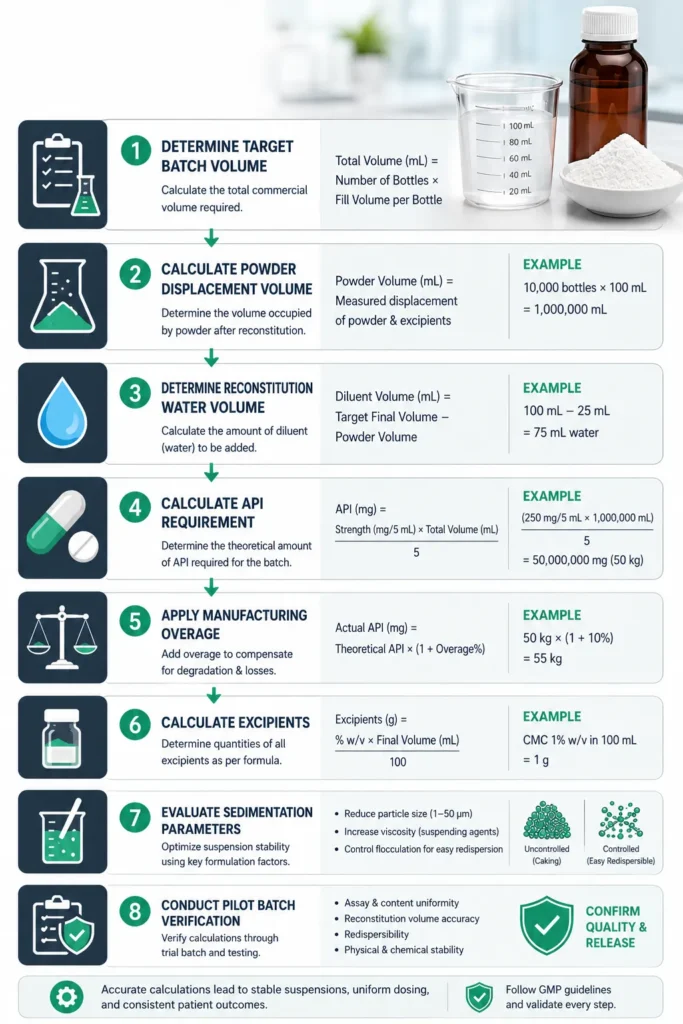
Diluent Volume=Target Final Volume−Powder Volume
Practical Example
Given
| Parameter | Value |
|---|---|
| Target Volume | 100 mL |
| Powder Displacement Volume | 25 mL |
Calculation
100−25=75mL
Result
Diluent Required = 75 mL
Typical Reconstitution Procedure
Step 1
Add approximately 50–75% of required water.
Step 2
Shake vigorously to wet powder.
Step 3
Allow foam to dissipate.
Step 4
Add remaining water to mark.
Step 5
Shake again until uniform.
Manufacturing Overages
What Are Manufacturing Overages?
Overages are additional quantities of API added during manufacturing to compensate for:
- Chemical degradation
- Stability loss
- Adsorption losses
- Processing losses
This ensures the product remains within specifications throughout its shelf life.
Typical Overage Ranges
| Product Type | Typical Overage |
|---|---|
| Stable Antibiotics | 5–10% |
| Moisture Sensitive Products | 10–20% |
| Highly Labile APIs | 20–30% |
Actual overages must be scientifically justified during product development and stability studies.
Overage Calculation Formula
Actual API Mass=Labeled Potency×(1+Overage Fraction)
Example Calculation
| Parameter | Value |
|---|---|
| Label Claim | 250 mg/5 mL |
| Overage | 10% |
Calculation
250×1.10=275mg
Result
Manufacturing Target = 275 mg/5 mL
Batch API Calculation with Overage
Example
Target Batch:
- 10,000 bottles
- 100 mL each
- Label claim = 250 mg/5 mL
- Overage = 10%
Step 1: Total Suspension Volume
10000×100=1,000,000mL
Step 2: Calculate Total API Requirement
5250=50mg/mL 50×1,000,000=50,000,000mg =50kg
Step 3: Apply Overage
50×1.10=55kg
Result
API Required = 55 kg
Sedimentation Considerations
Why Sedimentation Matters
Suspended particles naturally settle due to gravity.
Poorly designed suspensions may develop:
- Hard caking
- Poor redispersibility
- Non-uniform dosing
- Patient complaints
Stokes’ Law
Sedimentation behavior is described by Stokes’ Law:v=18ηd2(ρs−ρl)g
Where:
| Symbol | Meaning |
|---|---|
| v | Sedimentation rate |
| d | Particle diameter |
| ρs | Particle density |
| ρl | Liquid density |
| g | Gravitational force |
| η | Vehicle viscosity |
Factors Affecting Sedimentation
1. Particle Size
Impact
Sedimentation rate is proportional to:d2
Reducing particle size dramatically decreases settling.
Typical Target
1−50 μm
2. Viscosity
Increasing viscosity slows particle movement.
Common suspending agents:
| Agent | Typical Use Level |
|---|---|
| CMC Sodium | 0.5–2% |
| Xanthan Gum | 0.1–1% |
| HPMC | 0.5–2% |
| MCC/CMC Blend | 1–3% |
3. Density Difference
Reducing density differences between particles and vehicle reduces sedimentation velocity.
4. Controlled Flocculation
Controlled flocculation creates loose particle aggregates that:
- Settle predictably
- Redisperse easily
- Prevent hard cake formation
Sedimentation Control Strategies
Particle Engineering
- Micronization
- Controlled milling
- Narrow particle distribution
Vehicle Optimization
- Increase viscosity
- Use structured vehicles
- Optimize rheology
Flocculating Agents
Common agents include:
- Sodium citrate
- Electrolytes
- Surfactants
- Polymers
Oral Suspension Manufacturing Calculator
1. Reconstitution Volume Calculator
Diluent Required: 0 mL
2. Manufacturing Overage Calculator
Manufacturing Target: 0 mg
3. Batch API Requirement Calculator
Total API Required: 0 kg
4. Sedimentation Rate Calculator (Stokes’ Law)
Relative Sedimentation Value: 0
Higher value = Faster settlingLower value = Better suspension stability
5. Particle Size Impact Calculator
Settling Rate Reduction: 0%
| Calculator | Output |
|---|---|
| Reconstitution Volume | Exact water to add |
| API Overage | Manufacturing target potency |
| Batch API Requirement | Total API needed (kg) |
| Sedimentation Rate | Relative settling tendency |
| Particle Size Impact | % reduction in sedimentation |
| Suspension Stability Assessment | Based on viscosity and particle size |
GMP and Regulatory Considerations
ICH and GMP Expectations
Manufacturers must demonstrate:
Dose Uniformity
Every dose must meet label claim.
Physical Stability
No excessive caking or phase separation.
Reconstitution Accuracy
Instructions must reliably achieve target volume.
Stability Support
Overages require documented scientific justification.
Validation
Manufacturing processes should be validated for:
- Mixing efficiency
- Uniformity
- Yield
- Reconstitution performance
Common Calculation Errors
| Error | Consequence |
|---|---|
| Ignoring displacement volume | Incorrect concentration |
| Excessive overage | Regulatory concern |
| Insufficient overage | Potency loss |
| Large particle size | Rapid settling |
| Low viscosity | Poor suspension stability |
| No flocculation control | Hard caking |
Frequently Asked Questions (FAQs)
1. What is reconstitution volume in oral suspensions?
Reconstitution volume is the amount of diluent required to achieve the labeled final suspension volume after accounting for powder displacement.
2. Why is powder displacement important?
Powder displacement affects final concentration and dose accuracy.
3. What are manufacturing overages?
Additional API quantities added to compensate for degradation and stability-related losses.
4. What is a typical API overage range?
Typically between 5% and 30%, depending on API stability.
5. Why do suspensions sediment?
Particles settle under gravity because they are insoluble in the vehicle.
6. What is Stokes’ Law?
A mathematical equation used to predict sedimentation velocity in suspensions.
7. How can sedimentation be reduced?
By reducing particle size, increasing viscosity, and using controlled flocculation.
8. What causes caking?
Formation of dense, compact sediment that cannot be easily redispersed.
9. Why are suspending agents used?
They increase viscosity and improve physical stability.
10. Why must overages be justified?
Regulatory agencies require scientific evidence supporting overage levels to ensure patient safety and product quality.