


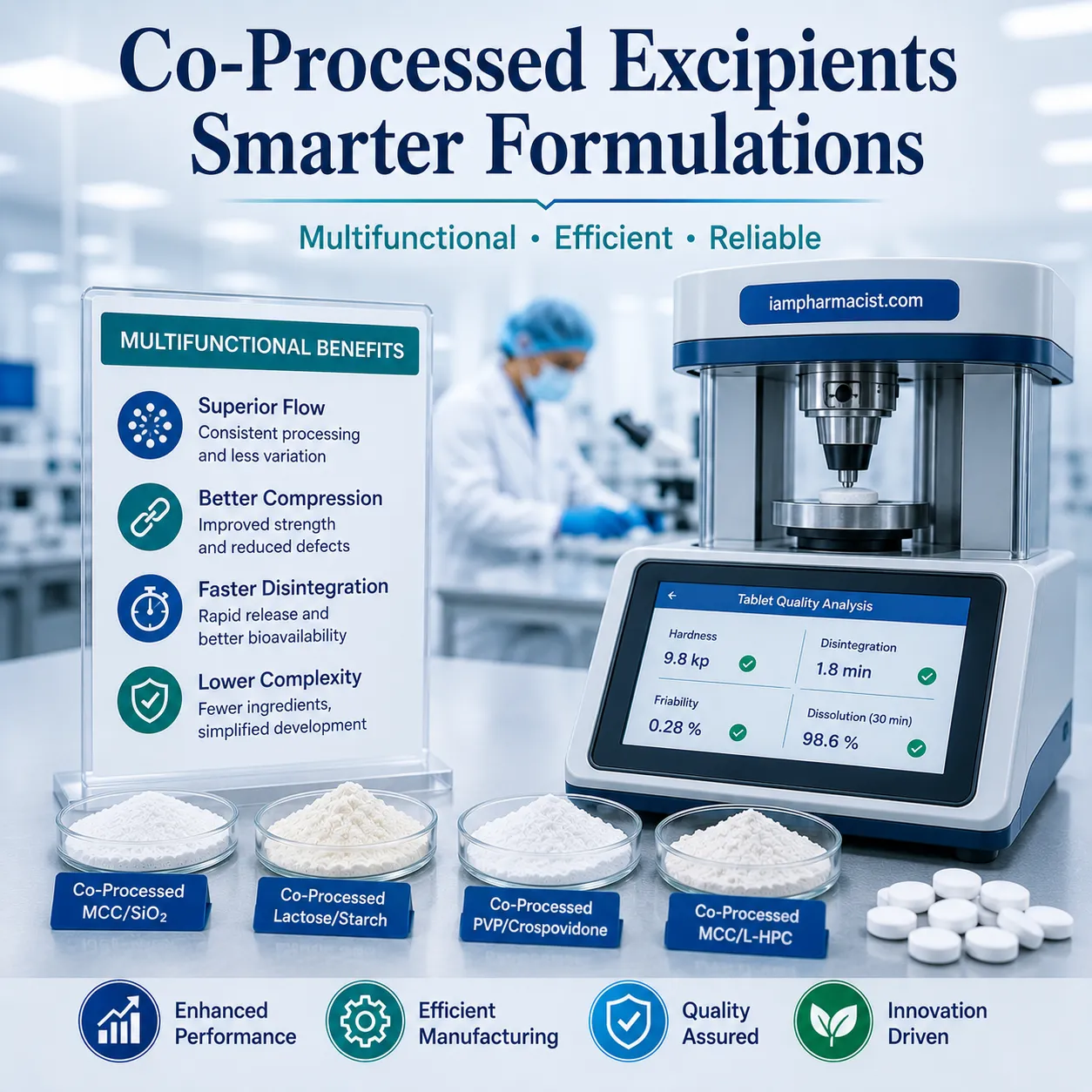

Explore multifunctional and co-processed excipients, their benefits, manufacturing methods, regulatory considerations, and impact on modern pharmaceutical formulations.
Definition
Co-processed excipients (CPEs) are multifunctional pharmaceutical excipients created by physically combining two or more existing excipients at the sub-particle level without chemical modification. They provide improved flowability, compressibility, disintegration, and manufacturing efficiency, making them essential for modern tablet, capsule, and advanced drug delivery formulations.
Introduction
Pharmaceutical formulation science has evolved significantly over the past two decades. Increasingly complex Active Pharmaceutical Ingredients (APIs), accelerated development timelines, and continuous manufacturing initiatives have driven demand for excipients that offer more than a single functionality.
Traditional formulations often require multiple excipients to achieve acceptable flowability, compressibility, disintegration, and stability. However, blending numerous individual excipients can introduce challenges such as segregation, content variability, manufacturing inefficiencies, and prolonged development cycles.
To address these issues, formulators increasingly rely on multifunctional and co-processed excipients (CPEs)—advanced excipient systems engineered to provide synergistic functionality within a single particle.
These innovative excipient platforms have become critical enablers of direct compression, orally disintegrating tablets (ODTs), sustained-release systems, and next-generation drug delivery technologies.
What Are Multifunctional and Co-Processed Excipients?
Definition of Co-Processed Excipients
Co-processed excipients are combinations of two or more established excipients that are physically engineered together at the particle level without altering their chemical structures.
Unlike simple physical blends, CPEs are produced using specialized particle-engineering technologies that integrate functionalities into homogeneous particles.
Key Characteristics
- No chemical modification
- Synergistic functionality
- Improved physical properties
- Enhanced manufacturing performance
- Reduced formulation complexity
Multifunctional Excipients vs Traditional Excipients
| Parameter | Traditional Excipients | Co-Processed Excipients |
|---|---|---|
| Functionality | Single function | Multiple functions |
| Segregation Risk | Higher | Lower |
| Flowability | Variable | Improved |
| Compressibility | Moderate | Enhanced |
| Development Complexity | Higher | Reduced |
| Direct Compression Suitability | Limited | Excellent |
Why the Pharmaceutical Industry Needs Co-Processed Excipients
Modern drug products face several formulation challenges:
- Poor flowability
- Low compressibility
- High-dose APIs
- Moisture sensitivity
- Fast development timelines
- Continuous manufacturing requirements
Traditional excipient combinations often require extensive optimization.
Co-processed excipients simplify formulation design while improving robustness.
Limitations of Conventional Excipient Blends
Common Problems
| Challenge | Impact |
|---|---|
| Powder segregation | Content uniformity issues |
| Poor flow | Weight variation |
| Low compactability | Tablet defects |
| Multiple ingredients | Complex manufacturing |
| Batch variability | Quality risks |
CPEs are specifically designed to overcome these limitations.
Key Benefits of Co-Processed Excipients
Superior Flowability
Particle engineering optimizes:
- Particle size distribution
- Surface morphology
- Density characteristics
Benefits
- Uniform die filling
- Consistent tablet weight
- Improved process efficiency
Enhanced Compressibility
Co-processed systems often combine:
- Plastic deformation properties
- Brittle fracture characteristics
This produces stronger tablets at lower compression forces.
Quality Improvements
- Increased hardness
- Reduced friability
- Lower risk of capping
- Reduced lamination
Optimized Disintegration
Many CPEs incorporate disintegrant functionality within the excipient matrix.
Results
- Faster water penetration
- Rapid tablet breakup
- Improved dissolution
Particularly valuable for ODTs and immediate-release formulations.
Reduced Segregation Risk
Since multiple functionalities exist within a single engineered particle:
- Demixing is minimized
- Blend uniformity improves
- Manufacturing consistency increases
This advantage becomes especially important during high-speed tableting.
Common Types of Multifunctional and Co-Processed Excipients
Direct Compression Excipients
Direct compression remains the largest application area for CPEs.
Popular Examples
| Product | Components |
|---|---|
| Prosolv® SMCC | MCC + Colloidal Silicon Dioxide |
| Cellactose® | Lactose + Cellulose |
| Ludipress® | Lactose + Povidone + Crospovidone |
| StarLac® | Lactose + Starch |
Orally Disintegrating Tablet (ODT) Excipients
ODT formulations require:
- Rapid disintegration
- Good mouthfeel
- Adequate hardness
Examples
| Product | Application |
|---|---|
| Prosolv® ODT | ODT platform |
| F-Melt® | Fast disintegration |
| Pharmaburst® | Mouth-dissolving tablets |
Sustained-Release Platforms
Tailored co-processed systems may combine:
- Matrix-forming polymers
- Release modifiers
- Compressible fillers
Applications include:
- Once-daily tablets
- Controlled-release capsules
- Modified-release dosage forms
Manufacturing Methods for Co-Processed Excipients
Particle engineering technology determines final functionality.
Spray Drying
Most Widely Used Method
Spray drying creates highly uniform multifunctional particles.
Process Steps
- Excipients dissolved or dispersed
- Atomization into fine droplets
- Rapid solvent evaporation
- Formation of engineered particles
Advantages
- Excellent homogeneity
- Improved flow
- Controlled particle morphology
Wet Granulation
Granulation liquids bind excipient particles together.
Benefits
- Improved compressibility
- Enhanced particle strength
- Better flowability
Dry Granulation
Uses:
- Roller compaction
- Slugging techniques
Particularly useful for moisture-sensitive materials.
Melt Granulation
Thermally induced binding creates stable multifunctional matrices.
Applications
- Sustained release systems
- Specialized drug delivery platforms
Impact on Product Quality Attributes (PQAs)
Co-Processed Excipients and Quality Performance
| Product Quality Attribute | Impact of CPEs |
|---|---|
| Flowability | Significant improvement |
| Content Uniformity | Improved |
| Hardness | Increased |
| Friability | Reduced |
| Disintegration | Optimized |
| Dissolution | Enhanced |
| Process Robustness | Improved |
Applications in Modern Drug Delivery
Direct Compression Tablets
Direct compression offers:
- Lower costs
- Faster production
- Simplified manufacturing
CPEs significantly expand direct compression feasibility.
Orally Disintegrating Tablets (ODTs)
ODTs require a delicate balance between:
- Mechanical strength
- Fast disintegration
Co-processed excipients help achieve both simultaneously.
Sustained-Release Formulations
Specialized CPEs enable:
- Controlled diffusion
- Consistent drug release
- Improved patient compliance
Biopharmaceutical Formulations
Emerging applications include stabilization of:
- Proteins
- Peptides
- Nucleic acids
- mRNA-based therapeutics
Practical Example: Direct Compression Formulation
Challenge
A formulation containing a poorly compressible API exhibited:
- Tablet capping
- Weight variation
- Low hardness
Solution
Replaced conventional lactose and MCC blend with a co-processed direct compression excipient.
Outcome
| Parameter | Before | After |
|---|---|---|
| Hardness | 5 kp | 9 kp |
| Friability | 1.2% | 0.3% |
| Weight Variation | High | Low |
| Compression Force | High | Moderate |
The formulation achieved improved manufacturability and product quality.
Regulatory Considerations for Co-Processed Excipients
Unique Regulatory Challenges
Although CPEs consist of approved excipients, regulators often require additional justification because the engineered combination behaves differently than individual components.
Information Typically Required
Component Details
- Identity of all excipients
- Composition ratios
- Functional purpose
Manufacturing Information
- Production process
- Controls
- Specifications
Performance Data
- Stability studies
- Compatibility studies
- Functional characterization
Regulatory References
FDA Expectations
The FDA generally evaluates:
- Safety of individual components
- Manufacturing consistency
- Intended use
- Functional performance
ICH Guidelines
Relevant guidelines include:
- ICH Q8(R2) Pharmaceutical Development
- ICH Q9 Quality Risk Management
- ICH Q10 Pharmaceutical Quality System
- ICH Q11 Development and Manufacture
GMP Considerations
Manufacturers should implement controls for:
Supplier Qualification
Evaluate:
- Manufacturing capability
- Quality systems
- Regulatory compliance
Critical Material Attributes (CMAs)
Monitor:
- Particle size distribution
- Density
- Moisture content
- Compressibility
- Flowability
Change Control
Because functionality depends on particle engineering, even small process changes may affect performance.
Robust change management is essential.
How to Select a Co-Processed Excipient
Step 1: Define Formulation Objectives
Identify:
- Direct compression needs
- ODT requirements
- Controlled-release goals
Step 2: Evaluate API Characteristics
Assess:
- Dose
- Compressibility
- Solubility
- Moisture sensitivity
Step 3: Match Functional Requirements
Select excipients providing:
- Flow enhancement
- Binding
- Disintegration
- Release modification
Step 4: Conduct Compatibility Studies
Evaluate:
- Chemical compatibility
- Physical stability
- Processing behavior
Step 5: Optimize Through DoE
Use Design of Experiments to determine:
- Excipient level
- Compression force
- Release profile
Step 6: Validate Manufacturing Performance
Confirm:
- Blend uniformity
- Tablet properties
- Process robustness
Future Trends in Multifunctional Excipients
Emerging innovations include:
- AI-assisted excipient design
- Continuous manufacturing-compatible excipients
- Multifunctional biopharmaceutical stabilizers
- 3D-printing excipient platforms
- Smart responsive excipients
- Personalized medicine delivery systems
These developments will further expand the role of engineered excipient technologies.
FAQs
1. What are co-processed excipients?
Co-processed excipients are multifunctional excipient systems created by physically combining two or more excipients without chemical modification.
2. How do co-processed excipients differ from physical blends?
Their components are integrated at the particle level, reducing segregation and improving performance.
3. What are the main advantages of co-processed excipients?
Improved flowability, compressibility, disintegration, content uniformity, and manufacturing efficiency.
4. Why are co-processed excipients important for direct compression?
They provide excellent flow and compression properties, eliminating the need for granulation in many formulations.
5. What is the most common manufacturing method for CPEs?
Spray drying is the most widely used particle-engineering technique.
6. Are co-processed excipients chemically modified?
No. They are physically engineered combinations of existing excipients.
7. Which dosage forms benefit most from CPEs?
Direct compression tablets, ODTs, sustained-release formulations, and some biopharmaceutical products.
8. Do co-processed excipients improve tablet hardness?
Yes. Many CPEs significantly enhance compactability and mechanical strength.
9. What regulatory concerns exist for co-processed excipients?
Manufacturers must provide data on composition, functionality, manufacturing controls, and safety.
10. Are co-processed excipients compatible with QbD?
Yes. Their multifunctional nature supports robust formulation design and process optimization.