


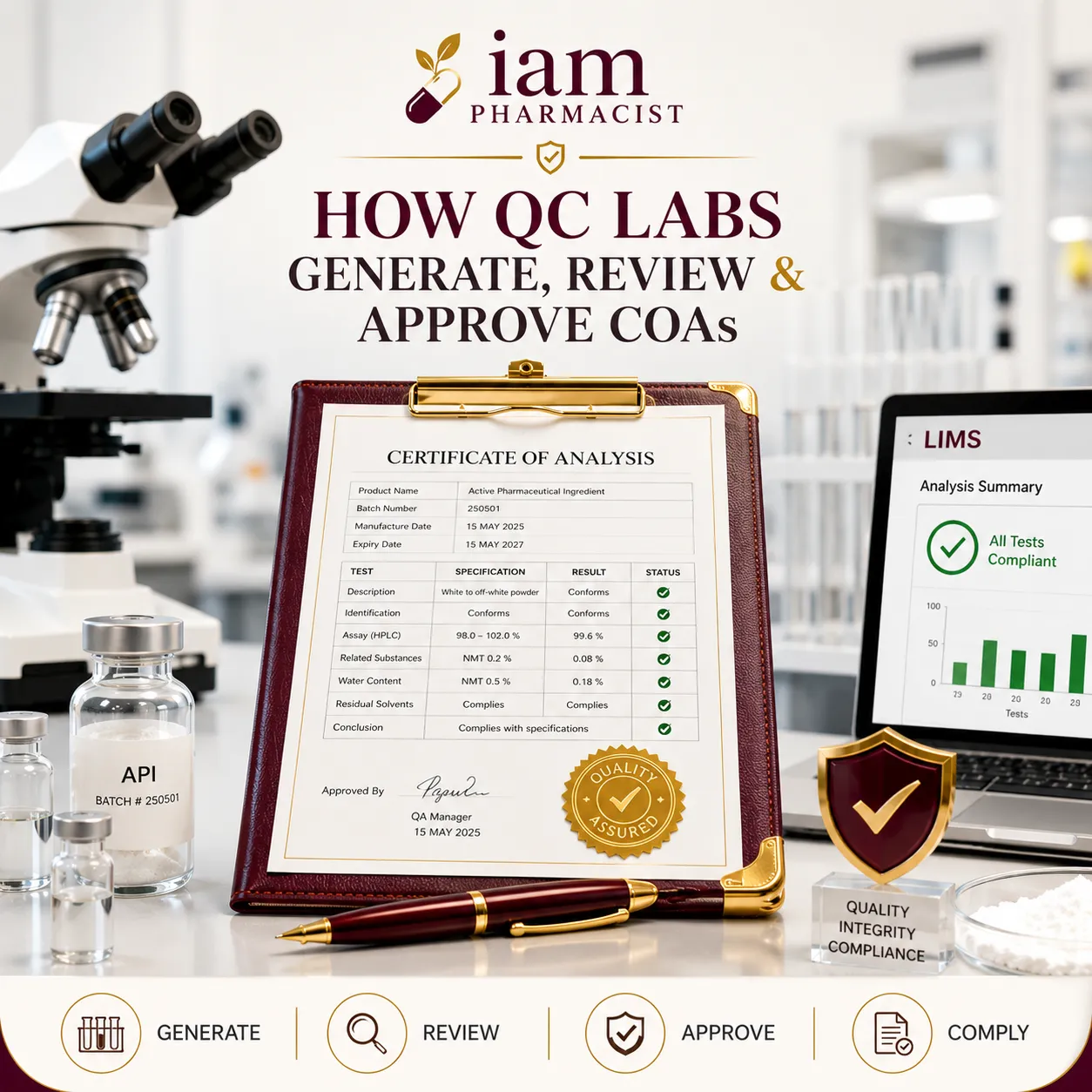

Learn how QC laboratories generate, review & approve Certificates of Analysis (CoAs) with GMP compliance, data integrity, and QA oversight.
Definition
A Certificate of Analysis (CoA) is a GMP-controlled quality document issued by a Quality Control (QC) laboratory that summarizes analytical testing results for a specific batch and confirms whether it meets approved specifications. The CoA generation, review, and approval process involves sample testing, data verification, quality review, and final authorization before batch release.
Introduction
In pharmaceutical manufacturing, the Certificate of Analysis (CoA) serves as the official proof that a raw material, active pharmaceutical ingredient (API), excipient, packaging component, or finished product complies with approved quality standards.
Regulatory agencies including the FDA, EMA, MHRA, WHO, and PIC/S authorities routinely inspect CoA records because they directly impact batch disposition decisions and patient safety. A single transcription error, unsupported result, or incomplete review can lead to product recalls, warning letters, import alerts, or batch rejection.
To prevent such risks, pharmaceutical companies implement highly controlled procedures governing the generation, review, approval, issuance, and archival of CoAs.
This guide explains how modern QC laboratories create compliant Certificates of Analysis while meeting GMP, data integrity, and regulatory expectations.
What Is a Certificate of Analysis (CoA)?
A Certificate of Analysis is an official quality document that records analytical test results for a specific batch or lot and demonstrates compliance with predefined specifications.
The CoA typically includes:
- Product identification
- Batch or lot number
- Manufacturing date
- Expiry or retest date
- Test methods
- Acceptance criteria
- Actual numerical results
- Authorized approval signatures
The document becomes a critical component of batch release and product traceability.
Why CoAs Are Critical in Pharmaceutical GMP
CoAs support:
| Function | Importance |
|---|---|
| Batch Release | Confirms compliance before distribution |
| Supplier Qualification | Verifies incoming material quality |
| Regulatory Compliance | Demonstrates GMP adherence |
| Product Traceability | Links testing data to specific batches |
| Customer Assurance | Provides documented quality evidence |
| Audit Readiness | Supports inspections and investigations |
Overview of the CoA Lifecycle
The CoA process generally consists of three major phases:
- Generation
- Review
- Approval and Release
Phase 1: Generation of the Certificate of Analysis
Step 1: Sample Collection and Submission
Following manufacturing, representative samples are collected according to approved sampling procedures.
Samples may include:
- Raw materials
- APIs
- Intermediates
- Finished products
- Stability samples
Each sample receives a unique identification number for complete traceability.
GMP Requirement
Sampling activities must follow:
- Approved SOPs
- Validated sampling plans
- Contamination control measures
Step 2: Analytical Testing
The QC laboratory performs testing using validated analytical methods.
Common tests include:
| Test Category | Examples |
|---|---|
| Chemical | Assay, impurities, pH |
| Physical | Appearance, particle size |
| Microbiological | Bioburden, sterility |
| Performance | Dissolution, disintegration |
| Stability | Degradation studies |
Testing is performed according to:
- USP
- EP
- BP
- JP
- Validated in-house methods
Step 3: Recording Raw Data
Analysts document:
- Observations
- Instrument outputs
- Chromatograms
- Calculations
- Worksheets
Data may be stored in:
| System | Usage |
|---|---|
| Laboratory Notebooks | Manual recording |
| LIMS | Electronic data management |
| CDS Systems | Chromatography data |
| ELN | Electronic laboratory notebooks |
All entries must comply with ALCOA+ principles.
Step 4: Data Compilation
After testing is completed:
- Results are entered into LIMS
- Calculations are verified
- Specification comparisons are performed
- Supporting records are linked
Modern systems automatically compare analytical results against predefined limits.
Example:
| Test | Specification | Result |
|---|---|---|
| Assay | 98.0–102.0% | 99.3% |
| Water Content | NMT 0.5% | 0.21% |
| Related Substances | NMT 0.2% | 0.08% |
Step 5: Drafting the CoA
The draft Certificate of Analysis is generated.
Typical sections include:
| CoA Element | Description |
|---|---|
| Product Name | Official material name |
| Batch Number | Unique batch identifier |
| Manufacturing Date | Production date |
| Expiry/Retest Date | Stability date |
| Test Method | USP, EP, BP, or validated method |
| Specification | Acceptance criteria |
| Result | Actual numerical value |
| Conclusion | Pass/Fail determination |
Phase 2: Review of the Certificate of Analysis
Before approval, the CoA undergoes a detailed review.
Step 6: Data Verification
A second qualified individual reviews:
- Raw data
- Instrument outputs
- Calculations
- CoA entries
The objective is to eliminate:
- Transcription errors
- Calculation mistakes
- Missing data
- Documentation inconsistencies
Reviewer Checklist
✔ Correct batch number
✔ Correct product name
✔ Correct analytical method
✔ Accurate calculations
✔ Complete documentation
Step 7: Specification Compliance Check
Every result is evaluated against approved specifications.
Example:
| Test | Specification | Result | Status |
|---|---|---|---|
| Assay | 98.0–102.0% | 99.4% | Pass |
| Dissolution | NLT 80% | 92% | Pass |
| Water | NMT 0.5% | 0.62% | Fail |
Any failing result triggers investigation procedures.
Step 8: OOS and OOT Assessment
QC personnel review results for:
Out-of-Specification (OOS)
Results outside approved limits.
Example:
- Assay result = 96.8%
- Specification = 98.0–102.0%
Out-of-Trend (OOT)
Results within limits but inconsistent with historical data.
Example:
- Historical assay = 99.5–100.2%
- Current assay = 98.1%
Although compliant, the trend may require investigation.
Regulatory Expectation
OOS/OOT investigations must be completed before CoA approval.
Phase 3: Approval and Release
Step 9: Quality Review
The Quality Unit performs final review of:
- Laboratory data
- Deviations
- Investigations
- Batch documentation
- Change controls
This review ensures the complete manufacturing and testing history supports release.
Step 10: Authorized Approval
The final CoA is approved by authorized personnel such as:
| Role | Responsibility |
|---|---|
| QC Manager | Technical review |
| QA Manager | Compliance review |
| Qualified Person (EU) | Batch certification |
| Authorized Signatory | Final approval |
Electronic approval systems typically utilize:
- Audit trails
- User authentication
- Electronic signatures
Step 11: CoA Release and Distribution
Following approval:
- CoA becomes official
- Batch status changes to released
- Customers receive copies
- Supply chain distribution begins
The released CoA becomes a controlled GMP record.
Step 12: Archival and Retention
CoAs are archived according to GMP retention requirements.
Typical retention includes:
| Record Type | Retention Period* |
|---|---|
| Finished Product CoA | Product lifecycle + 1 year |
| API CoA | As per GMP requirements |
| Electronic Records | Defined by local regulations |
*Requirements vary by region.
Practical Example: Finished Product CoA Workflow
Scenario
A batch of film-coated tablets is manufactured.
QC Testing
| Test | Result |
|---|---|
| Identification | Pass |
| Assay | 100.2% |
| Dissolution | 95% |
| Related Substances | 0.05% |
| Microbial Limits | Pass |
Review Activities
- Chromatograms reviewed
- Calculations verified
- Specifications checked
- OOS review completed
Approval
QA Manager electronically signs the CoA.
Outcome
Batch released for commercial distribution.
GMP and Regulatory Expectations for CoAs
FDA Requirements
Under 21 CFR Part 211:
- Laboratory records must be complete
- Test results must be verified
- Batch release documentation must be retained
EU GMP Requirements
EU GMP requires:
- Complete traceability
- Qualified Person review
- Data integrity controls
- Controlled electronic systems
WHO GMP Expectations
WHO emphasizes:
- Transparency
- Laboratory accountability
- Authorized approval
- Accurate reporting of results
Data Integrity Expectations
Both FDA and EU regulators focus heavily on:
ALCOA+ Principles
| Principle | Meaning |
|---|---|
| Attributable | Person identified |
| Legible | Readable |
| Contemporaneous | Recorded immediately |
| Original | Source retained |
| Accurate | Correct |
| Complete | No omissions |
| Consistent | Uniform records |
| Enduring | Permanently retained |
| Available | Retrievable |
Common Inspection Findings Related to CoAs
Regulators frequently identify:
- Missing analytical results
- Incorrect calculations
- Incomplete reviews
- Unauthorized changes
- Missing signatures
- Unresolved OOS investigations
- Weak audit trails
- Poor data integrity practices
Best Practices for CoA Management
Utilize Validated LIMS Systems
Reduce manual transcription risks.
Implement Independent Reviews
Ensure second-person verification.
Strengthen Data Integrity Controls
Protect laboratory records.
Train QC Personnel
Maintain competency in GMP documentation.
Automate Specification Checks
Reduce human error.
Control Electronic Signatures
Meet Part 11 and Annex 11 requirements.
FAQs
1. What is a Certificate of Analysis (CoA)?
A CoA is a quality document that summarizes analytical test results and confirms whether a batch meets approved specifications.
2. Who generates a CoA in pharmaceutical companies?
QC laboratories generate CoAs based on testing results obtained from validated analytical methods.
3. What information is included in a CoA?
Product details, batch number, test methods, specifications, results, dates, and approval signatures.
4. Who reviews a Certificate of Analysis?
Typically a QC supervisor, reviewer, or designated quality professional verifies the data before approval.
5. Who approves a CoA?
An authorized QA or QC representative, QA Manager, or Qualified Person (QP) approves the final document.
6. What happens if a result is out of specification?
The result triggers an OOS investigation, and the CoA cannot be approved until the investigation is completed.
7. What is the role of LIMS in CoA generation?
LIMS automates result collection, specification comparison, reporting, and document control.
8. Are electronic signatures allowed on CoAs?
Yes, provided they comply with 21 CFR Part 11 and EU GMP Annex 11 requirements.
9. How long should CoAs be retained?
Retention periods vary but generally extend through the product lifecycle plus additional regulatory requirements.
10. Why are CoAs important during inspections?
Inspectors use CoAs to verify batch quality, data integrity, testing compliance, and release decisions.