


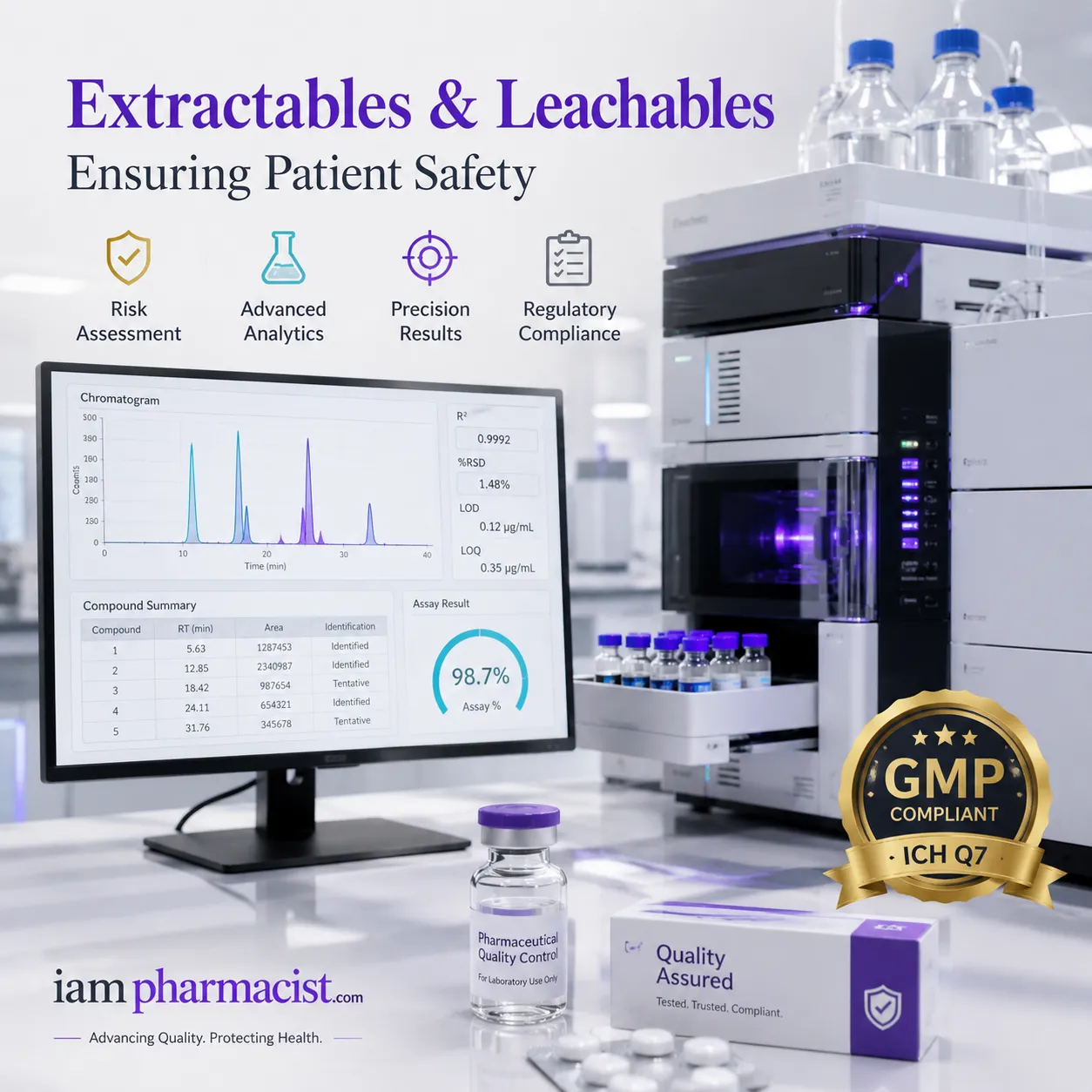

Learn extractables and leachables testing for pharmaceutical packaging, USP <1663>/<1664>, risk assessment, analytical methods, and GMP compliance.
Definition
Extractables and Leachables (E&L) testing is a scientific evaluation used to identify, quantify, and assess chemicals that can migrate from pharmaceutical packaging, container closure systems, manufacturing equipment, and delivery devices into drug products. The testing ensures product quality, patient safety, and regulatory compliance according to USP <1663>, USP <1664>, FDA, EMA, PQRI, BPOG, and other global guidelines.
Introduction
Pharmaceutical packaging does far more than protect a product from environmental exposure. Packaging materials such as rubber stoppers, plastic bottles, syringes, IV bags, tubing, filters, and single-use systems may contain additives, stabilizers, antioxidants, lubricants, plasticizers, and residual manufacturing chemicals that can migrate into drug products over time.
Such migrated compounds can compromise drug safety, efficacy, stability, and regulatory compliance.
This is where Extractables and Leachables (E&L) testing becomes a critical part of pharmaceutical development, manufacturing, and lifecycle management.
Regulatory agencies worldwide expect manufacturers to evaluate the potential for product contamination from packaging and process-contact materials. Comprehensive E&L studies help identify risks early and support successful regulatory submissions.
This guide explains E&L testing principles, regulatory expectations, analytical techniques, risk assessment approaches, and GMP best practices for pharmaceutical professionals.
What Are Extractables and Leachables?
| Parameter | Extractables | Leachables |
|---|---|---|
| Definition | Compounds that can be extracted from packaging under aggressive laboratory conditions | Compounds that actually migrate into the drug product under normal storage conditions |
| Purpose | Hazard identification | Patient exposure assessment |
| Testing Conditions | Exaggerated extraction conditions | Real-time or accelerated storage conditions |
| Study Duration | Short-term | Long-term stability studies |
| Regulatory Use | Risk assessment | Product safety evaluation |
| Example | Plasticizer extracted from rubber stopper using solvent | Plasticizer detected in injectable product after storage |
Why Extractables and Leachables Testing Is Important
E&L testing helps pharmaceutical companies:
- Ensure patient safety
- Meet regulatory expectations
- Support NDA, ANDA, BLA, and MAA submissions
- Prevent product recalls
- Evaluate packaging compatibility
- Assess single-use systems
- Verify container closure integrity
- Support lifecycle management
Potential contaminants include:
- Plasticizers
- Antioxidants
- Stabilizers
- Lubricants
- Monomers
- Oligomers
- Heavy metals
- Degradation products
- Processing aids
Regulatory Expectations for E&L Testing
Major Regulatory References
| Regulatory Body | Guideline |
|---|---|
| USP | USP <1663> Assessment of Extractables |
| USP | USP <1664> Assessment of Leachables |
| FDA CDER/CBER | Container Closure Guidance |
| EMA | Packaging Material Guidelines |
| PQRI | OINDP Recommendations |
| BPOG | Single-Use Systems Guidance |
| BPSA | Bioprocess Systems Standards |
| ICH Q9 | Quality Risk Management |
| ICH Q3D | Elemental Impurities |
USP <1663>
Provides guidance for:
- Controlled extraction studies
- Selection of solvents
- Extraction conditions
- Analytical characterization
USP <1664>
Focuses on:
- Leachables assessment
- Safety evaluation
- Stability study integration
- Risk-based approaches
Sources of Extractables and Leachables
Packaging Components
| Component | Potential Leachables |
|---|---|
| Rubber Stoppers | Plasticizers, antioxidants |
| Syringes | Silicone oils, lubricants |
| Plastic Bottles | Phthalates, oligomers |
| IV Bags | Stabilizers |
| Caps and Seals | Additives, pigments |
| Tubing | Plasticizers, residual monomers |
| Filters | Wetting agents |
| Bioprocess Bags | Antioxidants and polymer additives |
Risk-Based Approach to E&L Testing
Modern E&L programs follow Quality Risk Management principles.
Key Risk Factors
- Route of administration
- Dose frequency
- Product formulation
- Contact time
- Storage conditions
- Packaging composition
- Patient population
Highest Risk Products
| Product Type | Risk Level |
|---|---|
| Injectable Products | Very High |
| Ophthalmic Products | High |
| Inhalation Products | High |
| Biologics | High |
| Oral Liquids | Moderate |
| Solid Oral Dosage Forms | Lower |
Extractables Study Design
The goal of an extractables study is to identify compounds with the potential to migrate into the drug product.
Step 1: Material Characterization
Identify:
- Polymers
- Elastomers
- Additives
- Manufacturing aids
Step 2: Select Extraction Conditions
Aggressive conditions maximize extraction.
Common Extraction Techniques
| Technique | Purpose |
|---|---|
| Reflux | High-temperature extraction |
| Soxhlet Extraction | Exhaustive extraction |
| Sonication | Accelerated extraction |
| Controlled Incubation | Simulated storage conditions |
Step 3: Choose Extraction Solvents
Typical solvents include:
| Solvent Type | Purpose |
|---|---|
| Water | Polar compounds |
| Ethanol | Intermediate polarity |
| Isopropanol | Semi-polar compounds |
| Hexane | Non-polar compounds |
| Acidic Solutions | Ionic contaminants |
| Basic Solutions | pH-sensitive compounds |
Analytical Techniques Used in E&L Testing
Comprehensive characterization requires multiple orthogonal techniques.
1. GC-MS
Applications
- Volatile compounds
- Semi-volatile compounds
Detects
- Solvents
- Plasticizers
- Antioxidants
2. Headspace GC-MS
Used for:
- Residual solvents
- Volatile organic compounds (VOCs)
3. LC-MS
Applications
- Non-volatile compounds
- Polar compounds
- Oligomers
Ionization Modes
- Electrospray Ionization (ESI)
- Atmospheric Pressure Chemical Ionization (APCI)
4. LC-UV/Vis
Used for:
- Quantitative impurity determination
- Targeted analysis
5. ICP-OES / ICP-MS
Metal Screening
Commonly evaluates:
- Lead
- Cadmium
- Arsenic
- Mercury
- Chromium
- Nickel
Often covering more than 30 elemental impurities.
6. TOC Analysis
Measures:
- Total Organic Carbon
- Overall organic contamination
7. Gravimetric Analysis
Used for:
- Total extractable residue determination
8. Supporting Tests
- pH
- Conductivity
- Impurity profiling
Typical Extractables Workflow
Step-by-Step Process
Step 1
Define product and packaging system.
Step 2
Perform risk assessment.
Step 3
Select extraction solvents.
Step 4
Conduct controlled extraction study.
Step 5
Analyze extracts using:
- GC-MS
- LC-MS
- ICP-OES
- TOC
Step 6
Identify compounds.
Step 7
Perform toxicological assessment.
Step 8
Develop targeted leachables methods.
Step 9
Conduct stability studies.
Step 10
Prepare regulatory documentation.
Leachables Testing Program
After identifying extractables, targeted leachables studies evaluate actual migration into the drug product.
Typical Stability Conditions
| Condition | Duration |
|---|---|
| Long-Term | 12–36 Months |
| Accelerated | 6 Months |
| Stress Studies | Product-Specific |
Monitoring Parameters
- Compound concentration
- Trend analysis
- Toxicological thresholds
- Product stability
Practical Example: Injectable Product
Scenario
A biologic drug is stored in a prefilled syringe.
Extractables Study Findings
| Compound | Source |
|---|---|
| BHT | Rubber plunger |
| Silicone Oil | Syringe lubricant |
| Antioxidant Degradant | Plastic components |
Follow-Up
- Develop targeted LC-MS method
- Conduct stability study
- Quantify detected leachables
- Compare against safety thresholds
Outcome
Product approved after demonstrating acceptable patient exposure levels.
Toxicological Risk Assessment
Toxicologists evaluate:
- Daily exposure
- Route of administration
- Toxicity data
- Thresholds of toxicological concern (TTC)
Assessment Process
- Compound identification
- Exposure estimation
- Hazard evaluation
- Safety margin calculation
- Risk conclusion
GMP Requirements for Extractables and Leachables Testing
A GMP-compliant E&L program should include:
Documentation
- Approved protocols
- Risk assessments
- Validation reports
- Analytical reports
Data Integrity
- ALCOA+ compliance
- Audit trails
- Controlled documentation
Method Validation
Parameters include:
- Accuracy
- Precision
- Specificity
- Linearity
- Robustness
- Detection limits
Change Control
Requalification required when:
- Packaging changes
- Supplier changes
- Formulation changes
- Process modifications
Common Challenges in E&L Testing
| Challenge | Solution |
|---|---|
| Unknown compounds | High-resolution LC-MS |
| Complex matrices | Sample cleanup techniques |
| Trace-level detection | Sensitive instrumentation |
| Regulatory expectations | Risk-based study design |
| Data interpretation | Toxicological assessment |
Best Practices for Successful E&L Programs
✓ Begin studies early in development
✓ Apply risk-based strategies
✓ Follow USP <1663> and <1664> https://www.webofpharma.com/2025/03/usp-2025-pdf-free-download-united-state.html
✓ Use orthogonal analytical methods
✓ Maintain GMP compliance
✓ Include toxicological evaluation
✓ Document scientific justification
✓ Integrate E&L into lifecycle management
Conclusion
Extractables and Leachables testing is a critical component of pharmaceutical packaging qualification and patient safety assurance. Regulatory agencies increasingly expect robust, science-based E&L programs supported by risk assessments, validated analytical methods, toxicological evaluations, and GMP-compliant documentation.
By combining controlled extraction studies, advanced analytical techniques such as GC-MS, LC-MS, ICP-OES, and comprehensive leachables monitoring, pharmaceutical manufacturers can confidently demonstrate packaging compatibility, product safety, and regulatory compliance throughout the product lifecycle.
FAQs
1. What is extractables and leachables testing?
E&L testing identifies chemicals that can migrate from packaging materials or manufacturing systems into pharmaceutical products.
2. What is the difference between extractables and leachables?
Extractables are obtained under aggressive laboratory conditions, while leachables are compounds that migrate during actual product storage.
3. Why is E&L testing required?
It ensures patient safety, product quality, and compliance with FDA, EMA, and USP expectations.
4. Which USP chapters cover E&L testing?
USP <1663> covers extractables assessment, and USP <1664> covers leachables assessment.
5. What analytical techniques are commonly used?
GC-MS, LC-MS, ICP-OES, ICP-MS, LC-UV, TOC, gravimetric analysis, pH, and conductivity testing.
6. What materials require E&L testing?
Bottles, stoppers, syringes, tubing, filters, single-use systems, IV bags, and container closure systems.
7. What are common leachables?
Plasticizers, antioxidants, lubricants, residual monomers, metals, and degradation products.
8. Is E&L testing required for biologics?
Yes. Biologics are considered high-risk products and generally require comprehensive E&L assessments.
9. How are unknown compounds identified?
Using advanced analytical techniques such as high-resolution LC-MS and GC-MS databases.
10. When should E&L studies begin?
Ideally during product development to support formulation, packaging selection, and regulatory submissions.