


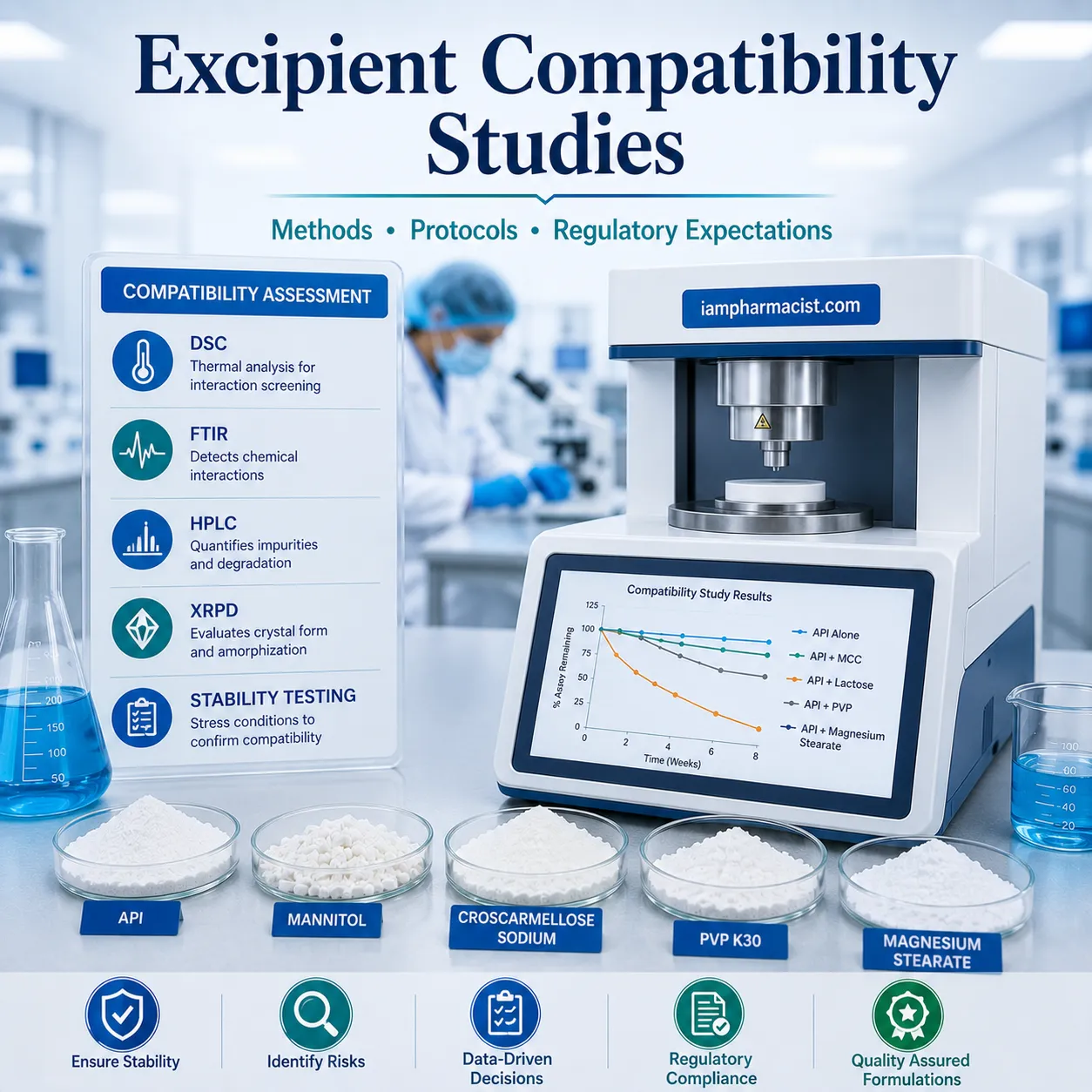

Learn excipient compatibility studies, analytical methods, protocols, regulatory expectations, and risk-based strategies for stable pharmaceutical formulations.
Definition
Excipient compatibility studies are preformulation investigations designed to identify physical and chemical interactions between an Active Pharmaceutical Ingredient (API) and formulation excipients. These studies help ensure product stability, safety, efficacy, manufacturability, and regulatory compliance by supporting evidence-based excipient selection during pharmaceutical development.
Introduction
The development of a stable, safe, and effective pharmaceutical product begins long before process validation and commercial manufacturing. One of the most critical preformulation activities is the evaluation of potential interactions between the Active Pharmaceutical Ingredient (API) and selected excipients.
While excipients are often considered inactive ingredients, they can significantly influence the chemical stability, dissolution behavior, bioavailability, and shelf life of a drug product. Incompatible excipients may accelerate degradation, alter drug release profiles, trigger discoloration, or compromise overall product quality.
Excipient compatibility studies provide the scientific foundation for rational excipient selection and are increasingly important within modern Quality by Design (QbD) frameworks and regulatory submissions.
This article explores compatibility study objectives, analytical methods, study protocols, risk assessment strategies, and regulatory expectations from FDA, EMA, ICH, USP, and global health authorities.
What Are Excipient Compatibility Studies?
Excipient compatibility studies are systematic investigations performed during preformulation development to determine whether excipients interact negatively with an API.
Primary Objectives
- Identify potential incompatibilities
- Predict long-term stability risks
- Support excipient selection decisions
- Reduce formulation failure risk
- Establish robust control strategies
- Generate regulatory documentation
Types of Interactions Evaluated
Chemical Interactions
Examples include:
- Hydrolysis
- Oxidation
- Maillard reactions
- Esterification
- Acid-base reactions
Physical Interactions
Examples include:
- Polymorphic conversion
- Amorphization
- Moisture transfer
- Adsorption
- Phase separation
Why Compatibility Studies Are Critical
Impact on Product Quality
Drug-excipient incompatibilities may lead to:
| Potential Issue | Impact |
|---|---|
| API degradation | Reduced potency |
| Increased impurities | Regulatory risk |
| Color changes | Product rejection |
| Reduced dissolution | Lower bioavailability |
| Stability failures | Shelf-life reduction |
| Manufacturing issues | Batch rejection |
Real-World Example
Lactose-containing formulations may undergo Maillard reactions with primary or secondary amine-containing APIs.
Observed Effects
- Tablet discoloration
- Increased degradation products
- Reduced assay values
Early compatibility screening helps avoid such failures during scale-up.
Common Drug–Excipient Interaction Mechanisms
Moisture-Induced Degradation
Hygroscopic excipients may accelerate:
- Hydrolysis
- Polymorphic transitions
- Stability loss
High-Risk Excipients
- Povidone
- Lactose
- Starch derivatives
- Cellulose-based materials
Oxidative Degradation
Certain excipients contain peroxide impurities.
Common Examples
| Excipient | Potential Risk |
|---|---|
| PVP | Peroxide formation |
| PEG | Oxidative degradation |
| Polysorbates | Peroxide generation |
These impurities may catalyze API degradation.
pH-Mediated Reactions
Excipients may alter the microenvironmental pH surrounding an API.
Potential consequences:
- Reduced stability
- Solubility changes
- Altered dissolution
Analytical Methods Used in Compatibility Studies
Modern compatibility programs combine multiple analytical techniques.
Thermal Analysis Methods
Differential Scanning Calorimetry (DSC)
DSC is among the most widely used screening tools.
Purpose
Measures heat flow associated with:
- Melting
- Crystallization
- Glass transitions
- Degradation events
Signs of Incompatibility
| DSC Observation | Possible Interpretation |
|---|---|
| Peak shift | Interaction occurring |
| Peak disappearance | Possible incompatibility |
| Broadening | Structural change |
| New thermal event | Reaction formation |
Isothermal Stress Testing (IST)
IST evaluates API-excipient mixtures under accelerated stress conditions.
Typical Conditions
- 40°C / 75% RH
- 50°C / 75% RH
- 60°C dry heat
Advantages
- Rapid screening
- Simulates long-term instability risks
- Supports excipient ranking
Spectroscopic Methods
Fourier Transform Infrared Spectroscopy (FTIR)
FTIR evaluates chemical bonding and functional group changes.
Detects
- Hydrogen bonding
- Salt formation
- Chemical degradation
- Functional group interactions
Typical Indicators
- Peak shifts
- Peak disappearance
- New absorption bands
These changes may indicate API-excipient interactions.
X-Ray Powder Diffraction (XRPD)
XRPD evaluates solid-state characteristics.
Applications
- Polymorphic changes
- Crystallinity assessment
- Amorphous conversion
- Solid-state stability
Example
An API may lose crystallinity when mixed with certain polymers, altering dissolution behavior.
Chromatographic Methods
HPLC and UPLC
HPLC remains the gold standard for compatibility assessment.
Measures
- API assay
- Impurity formation
- Degradation products
- Stability trends
Advantages
| Benefit | Explanation |
|---|---|
| Quantitative | Precise impurity measurement |
| Stability-indicating | Detects degradation |
| Regulatory acceptance | Industry standard |
TLC and HPTLC
These methods are commonly used for:
- Preliminary screening
- Confirmation studies
- Identification of degradation products
Standard Excipient Compatibility Study Protocol
Step 1: Risk Assessment
Begin with a scientific review of:
- API structure
- Stability profile
- Functional groups
- Moisture sensitivity
- Oxidation susceptibility
Step 2: Excipient Selection
Evaluate excipients based on:
- Functionality
- Regulatory acceptance
- Prior experience
- Manufacturing requirements
Step 3: Prepare Binary Mixtures
API and excipient are mixed in predetermined ratios.
Common Ratios
| Blend Type | Ratio |
|---|---|
| Binary Blend | 1:1 |
| API-Rich Blend | 2:1 |
| Excipient-Rich Blend | 1:2 |
Binary blends help isolate specific interactions.
Step 4: Prepare Ternary and Prototype Blends
Evaluate:
- Multiple excipient combinations
- Final formulation simulations
This identifies matrix-related interactions.
Step 5: Apply Stress Conditions
Samples are stored under:
Open Containers
Assess:
- Humidity effects
- Environmental exposure
Closed Containers
Simulate commercial packaging conditions.
Typical Storage Conditions
| Condition | Purpose |
|---|---|
| 25°C/60% RH | Long-term reference |
| 40°C/75% RH | Accelerated testing |
| 50–60°C | Stress testing |
Step 6: Evaluate at Predetermined Intervals
Common checkpoints:
- Initial
- 2 weeks
- 4 weeks
- 8 weeks
Step 7: Perform Analytical Testing
Assess:
- Appearance
- Color changes
- Moisture content
- Assay
- Impurities
- Thermal behavior
- Crystallinity
Example Compatibility Study Design
Immediate-Release Tablet Development
API Characteristics
- BCS Class II
- Amine-containing molecule
- Moisture sensitive
Excipients Evaluated
- Lactose
- MCC
- Crospovidone
- Magnesium Stearate
- PVP
Results
| Excipient | Observation |
|---|---|
| MCC | Compatible |
| Crospovidone | Compatible |
| PVP | Minor oxidation concern |
| Lactose | Maillard reaction detected |
| Magnesium Stearate | Compatible |
Outcome
Lactose was excluded from formulation development.
Regulatory Expectations
ICH Q8(R2)
ICH Q8 emphasizes:
- Pharmaceutical development
- Scientific understanding
- Risk-based excipient selection
Manufacturers should justify excipient choices using compatibility data.
FDA Expectations
The FDA’s Quality by Design and Question-Based Review (QbR) approach expects evidence supporting:
- Excipient selection rationale
- Drug-excipient compatibility
- Product robustness
EMA Expectations
EMA requires demonstration that excipients:
- Do not compromise safety
- Do not affect efficacy
- Support intended performance
USP and Pharmacopoeial Guidance
USP <1059> Excipient Performance
Provides guidance regarding:
- Excipient characterization
- Performance evaluation
- Risk assessment
GMP Considerations
Documentation Requirements
Compatibility studies should include:
- Study protocols
- Analytical methods
- Raw data
- Conclusions
- Risk assessments
Data Integrity Expectations
Data should comply with ALCOA+ principles:
- Attributable
- Legible
- Contemporaneous
- Original
- Accurate
- Complete
- Consistent
- Enduring
- Available
Change Control
Compatibility should be reassessed when:
- API source changes
- Excipient source changes
- Manufacturing process changes
- Formulation composition changes
How to Conduct an Excipient Compatibility Study
Step 1: Characterize the API
Assess:
- Stability profile
- Solubility
- Functional groups
- Sensitivity to heat, moisture, and oxidation
Step 2: Select Candidate Excipients
Choose excipients based on:
- Functionality
- Regulatory status
- Prior formulation experience
Step 3: Prepare Binary and Ternary Blends
Use worst-case ratios when appropriate.
Step 4: Conduct Stress Testing
Store samples under accelerated conditions.
Step 5: Analyze Using Multiple Techniques
Apply:
- DSC
- FTIR
- XRPD
- HPLC
Step 6: Evaluate Risks
Determine excipient suitability.
Step 7: Document Findings
Generate reports supporting formulation decisions and regulatory submissions.
Best Practices for Compatibility Studies
Use Orthogonal Analytical Techniques
No single test detects every interaction.
Follow Risk-Based Principles
Focus resources on high-risk APIs and excipients.
Include Accelerated Conditions
Reveal instability mechanisms early.
Integrate Findings into QbD Programs
Link compatibility outcomes to formulation strategy.
Maintain Complete Documentation
Support inspection readiness and regulatory review.
FAQs
1. What are excipient compatibility studies?
They are preformulation investigations used to identify physical and chemical interactions between APIs and excipients.
2. Why are compatibility studies important?
They help ensure product stability, efficacy, safety, and regulatory compliance.
3. What is the purpose of DSC in compatibility studies?
DSC identifies thermal events that may indicate API-excipient interactions.
4. Why is HPLC considered the gold standard?
HPLC accurately quantifies degradation products and impurity formation.
5. What storage conditions are commonly used?
Accelerated conditions such as 40°C/75% RH are frequently used.
6. What are binary mixtures?
Mixtures containing one API and one excipient used to isolate specific interactions.
7. Can excipients affect drug stability?
Yes. Moisture, peroxide impurities, pH changes, and chemical reactions can impact stability.
8. Which guidelines discuss compatibility studies?
ICH Q8(R2), FDA QbR expectations, USP <1059>, and EMA development guidelines.
9. How often should samples be evaluated?
Typically at initial, 2-week, 4-week, and extended stability intervals.
10. When should compatibility studies be repeated?
Following major changes in API source, excipient source, formulation, or manufacturing process.