


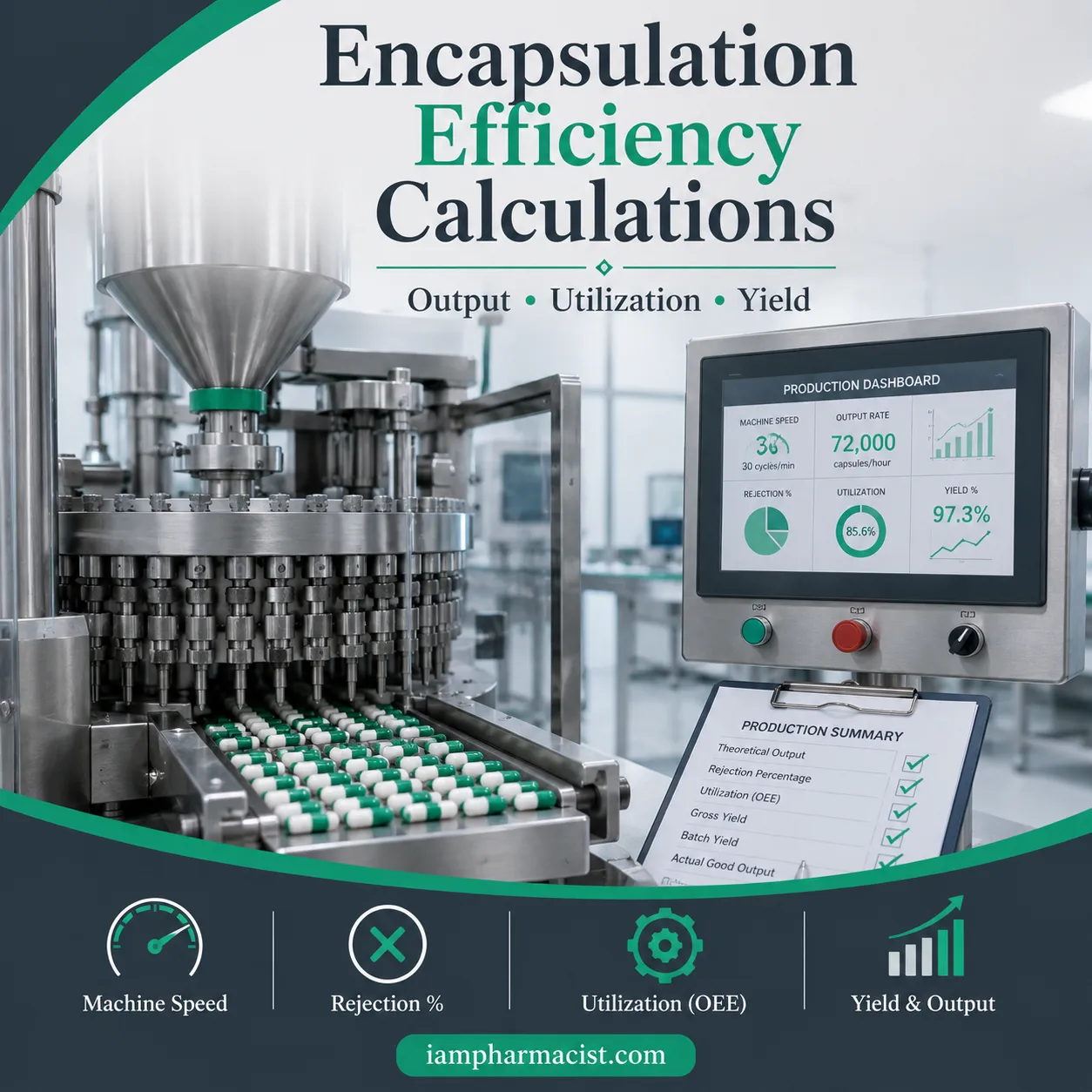

Learn encapsulation machine output and Production efficiency calculations including machine speed, rejection %, utilization, OEE, and yield formulas.
Definition
Encapsulation machine output and production efficiency calculations measure machine speed, rejection percentage, utilization, and yield to optimize capsule manufacturing productivity, minimize losses, and ensure GMP-compliant pharmaceutical production.
Encapsulation Machine Output and Production Efficiency Calculations
Encapsulation efficiency calculations are critical in pharmaceutical capsule manufacturing because they directly affect production capacity, process reliability, batch yield, and regulatory compliance.
Modern capsule filling operations require continuous monitoring of:
- Machine speed
- Rejection percentage
- Equipment utilization
- Production yield
- Actual output rate
Accurate production calculations help pharmaceutical manufacturers:
- Reduce downtime
- Improve operational efficiency
- Minimize material losses
- Increase batch consistency
- Meet production targets
This guide explains the key pharmaceutical calculations used to evaluate and optimize encapsulation machine performance.
Why Production Efficiency Calculations Matter
Production efficiency calculations are essential for:
- Capacity planning
- Cost reduction
- GMP documentation
- OEE monitoring
- Process optimization
- Preventive maintenance
- Batch reconciliation
These calculations are commonly used during:
- Commercial manufacturing
- Process validation
- Equipment qualification
- Production planning
- Lean manufacturing initiatives
1. Machine Speed (Capacity) Calculation
What is Machine Speed?
Machine speed determines the theoretical maximum number of capsules an encapsulation machine can produce within a specific period.
The output depends on:
- Number of machine cycles
- Dosing disc configuration
- Number of holes/stations
- Equipment design
Factors Affecting Machine Speed
| Parameter | Effect on Output |
|---|---|
| Powder flowability | Filling consistency |
| Capsule size | Machine throughput |
| Machine vibration | Weight variation |
| Product stickiness | Downtime increase |
| Dust generation | Cleaning frequency |
2. Rejection Rate Calculation
What is Rejection Rate?
Rejection rate measures the percentage of defective capsules rejected during production.
Rejected capsules may include:
- Underweight capsules
- Overweight capsules
- Improperly locked capsules
- Split capsules
- Empty capsules
Common Causes of Capsule Rejection
| Defect | Possible Cause |
| Weight variation | Poor powder flow |
| Capsule separation | Improper locking |
| Empty capsules | Feeding issues |
| Cracked shells | Excessive machine force |
| Powder leakage | Incorrect capsule alignment |
3. Utilization (OEE) Calculation
What is Utilization?
Utilization measures how effectively production time is used compared to planned production time.
It accounts for:
- Cleaning downtime
- Changeovers
- Maintenance
- Material replenishment
- Machine stoppages
OEE Components in Pharmaceutical Manufacturing
| OEE Component | Description |
| Availability | Machine uptime |
| Performance | Actual vs theoretical speed |
| Quality | Good capsules produced |
4. Yield Calculations
What is Yield?
Yield measures the percentage of usable capsules obtained compared to the theoretical maximum production.
Yield calculations help identify:
- Material losses
- Powder wastage
- Dust extraction losses
- Process inefficiencies
Step-by-Step HowTo: Encapsulation Efficiency Calculations
Step 1: Determine Machine Speed
Record cycles per minute and dosing disc configuration.
Step 2: Calculate Theoretical Output
Determine maximum production capacity.
Step 3: Measure Rejected Capsules
Calculate rejection percentage during production.
Step 4: Evaluate Utilization
Measure actual operating time versus planned production time.
Step 5: Calculate Yield
Compare actual production with theoretical production.
Step 6: Determine Actual Output
Incorporate utilization and rejection losses.
Step 7: Optimize Process Parameters
Improve:
- Powder flow
- Capsule feeding
- Machine settings
- Cleaning efficiency
1. Machine Speed (Capacity) Calculator
2. Rejection Rate Calculator
3. Utilization (OEE) Calculator
4. Batch Yield Calculator
5. Gross Yield Calculator
6. Actual Production Rate Calculator
7. Complete Encapsulation Efficiency Calculator
Common Encapsulation Efficiency Problems
| Issue | Possible Cause |
| Low utilization | Frequent stoppages |
| High rejection | Powder segregation |
| Reduced speed | Poor flowability |
| Low yield | Dust loss |
| Capsule jams | Incorrect setup |
| Inconsistent weights | Machine vibration |
Regulatory and GMP Insights
Encapsulation operations should comply with:
- cGMP regulations
- Process validation requirements
- Equipment qualification standards
- Data integrity principles
- In-process control requirements
Critical GMP recommendations:
- Maintain equipment calibration
- Document downtime events
- Monitor rejection trends
- Validate machine speed ranges
- Conduct preventive maintenance
Regulatory inspectors often review:
- OEE records
- Reconciliation reports
- Yield calculations
- Deviation investigations
- Machine maintenance logs
FAQs
1. What is encapsulation machine output?
Encapsulation machine output is the number of capsules produced per hour based on machine speed and configuration.
2. How is machine speed calculated?
Machine speed is calculated using cycles per minute multiplied by the number of holes and operating time.
3. What is rejection percentage in capsule filling?
Rejection percentage measures defective capsules discarded during production.
4. What is acceptable capsule rejection rate?
Most pharmaceutical processes aim for rejection rates below 2–3%.
5. What is machine utilization?
Machine utilization measures actual operating time compared to planned production time.
6. What is OEE in pharmaceutical manufacturing?
OEE stands for Overall Equipment Effectiveness and measures equipment productivity.
7. Why is yield calculation important?
Yield calculations help identify production losses and process inefficiencies.
8. What affects encapsulation efficiency?
Powder flow, machine settings, downtime, and rejection rates affect efficiency.
9. How can capsule filling efficiency be improved?
Efficiency improves through preventive maintenance, optimized machine settings, and better powder flow.
10. Why are production calculations important in GMP?
Production calculations ensure traceability, process control, and regulatory compliance.