


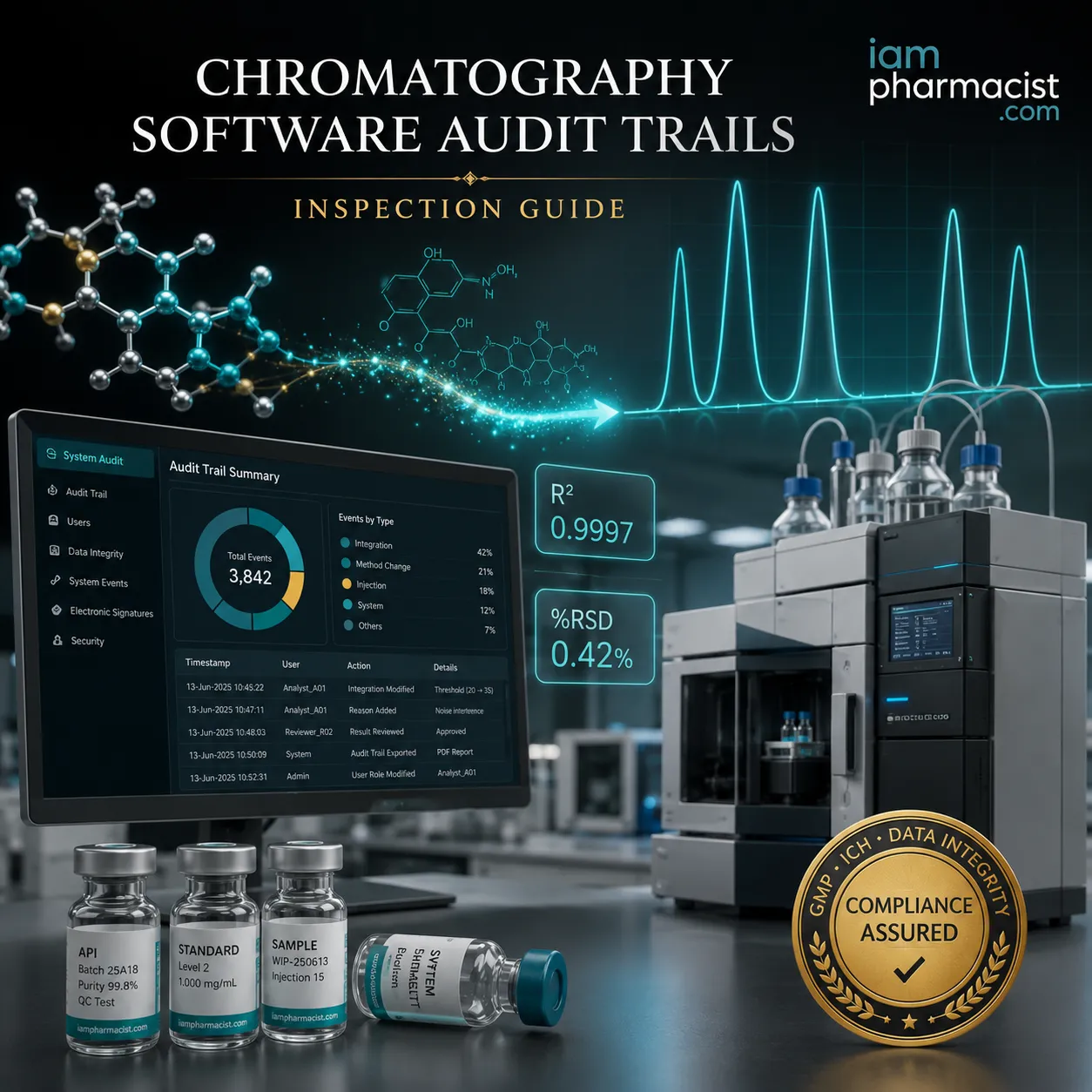

Learn how to manage Chromatography Software Audit Trails for GMP compliance, data integrity, and inspection readiness. Avoid FDA findings with practical audit trail controls.
What is a chromatography software audit trail?
A chromatography software audit trail is a secure, computer-generated record within a Chromatography Data System (CDS) that automatically captures who performed an action, when it occurred, what was changed, and why the change was made. Audit trails support GMP compliance, data integrity, and regulatory inspection readiness by providing a complete history of analytical data activities.
Introduction
In today’s pharmaceutical quality environment, chromatography software audit trails have become one of the most scrutinized areas during regulatory inspections. Whether your laboratory uses Waters Empower, Thermo Scientific Chromeleon, Agilent OpenLab, or another CDS platform, inspectors routinely evaluate audit trail controls to verify the integrity of analytical data.
Recent regulatory observations from the FDA, EMA, MHRA, WHO, and PIC/S consistently highlight deficiencies involving incomplete audit trails, inadequate review processes, excessive manual integrations, and poor access control management.
An effective audit trail program demonstrates that laboratory results are accurate, attributable, contemporaneous, original, and complete (ALCOA+). This guide explains the essential requirements, inspection expectations, common compliance risks, and practical steps needed to maintain an inspection-ready chromatography data system.
Why Audit Trails Matter in GMP Laboratories
Audit trails serve as a critical control mechanism for ensuring analytical data remains trustworthy throughout its lifecycle.
Key Objectives
| Objective | Purpose |
|---|---|
| Data Integrity | Prevent unauthorized data manipulation |
| Traceability | Track all actions performed on data |
| Accountability | Identify responsible personnel |
| Regulatory Compliance | Meet FDA, EMA, MHRA, WHO, and PIC/S requirements |
| Investigation Support | Facilitate OOS and deviation investigations |
| Inspection Readiness | Demonstrate controlled laboratory operations |
Without robust audit trail controls, laboratories may struggle to prove the authenticity and reliability of analytical results.
Regulatory Expectations for CDS Audit Trails
Several regulations and guidance documents explicitly require audit trail functionality and review.
Regulatory Framework
| Regulation | Audit Trail Requirement |
|---|---|
| FDA 21 CFR Part 11 | Secure, computer-generated audit trails |
| FDA Data Integrity Guidance | Routine review of critical audit trails |
| EU GMP Annex 11 | Recording of changes and deletions |
| MHRA GxP Data Integrity Guidance | Risk-based audit trail review |
| WHO TRS Data Integrity Guidance | Complete audit trail records |
| PIC/S PI 041 | Data governance and audit trail controls |
Inspector Focus
Regulators expect firms to:
- Enable audit trails permanently
- Review audit trails routinely
- Document audit trail assessments
- Investigate suspicious activities
- Restrict administrative privileges
- Maintain secure backups
The Essential “4 Ws” of an Inspection-Ready Audit Trail
Every audit trail entry should clearly capture four fundamental elements.
| Element | Description |
|---|---|
| Who | Unique user performing the action |
| When | Accurate timestamp of activity |
| What | Specific change including old and new values |
| Why | Business justification for change |
Example Audit Trail Entry
| Field | Example |
|---|---|
| User | Analyst_A01 |
| Date/Time | 2026-06-13 10:45:22 |
| Action | Integration threshold modified |
| Old Value | 20 |
| New Value | 35 |
| Reason | Noise interference observed during peak integration review |
This level of detail provides transparency and supports regulatory compliance.
High-Risk Areas Scrutinized During Inspections
Certain CDS activities receive greater regulatory attention because they directly affect analytical results.
1. Manual Integration Changes
Inspectors carefully examine:
- Baseline adjustments
- Peak splitting
- Peak merging
- Threshold modifications
Risk
Improper manual integration can artificially alter assay results or impurity levels.
2. Injection Deletions
Regulators evaluate whether:
- Failed injections were removed
- Data files were deleted
- Results were hidden from reports
Risk
Selective reporting may indicate data falsification.
3. Processing Method Changes
Inspectors review:
- Calibration curves
- Response factors
- Quantitation parameters
- Processing methods
Risk
Post-analysis modifications can influence final reportable results.
4. System Clock Manipulation
Investigators verify:
- Time synchronization
- Network time controls
- User restrictions
Risk
Timestamp alterations can conceal actual testing activities.
5. Run Aborts and Interrupted Sequences
Inspectors assess:
- Aborted runs
- Stopped sequences
- Repeat injections
Risk
Stopping analyses to avoid failing results raises serious data integrity concerns.
CDS System Configuration Checklist
A properly configured chromatography system significantly reduces compliance risk.
Inspection Readiness Checklist
| Control Area | Requirement | Status |
|---|---|---|
| Audit Trails | Enabled permanently | ✓ |
| User Accounts | Individual logins only | ✓ |
| Password Policy | GMP-compliant | ✓ |
| User Roles | Role-based permissions | ✓ |
| Time Synchronization | Network time server | ✓ |
| Electronic Signatures | Enabled where required | ✓ |
| Data Backup | Automated and validated | ✓ |
| Audit Trail Review | Documented procedure | ✓ |
Step-by-Step Audit Trail Review Process
Step 1: Access Audit Trail Records
Retrieve audit trail data associated with:
- Sample sets
- Standards
- System suitability runs
- Analytical sequences
Step 2: Review Critical Events
Focus on:
- Integration changes
- Reprocessing activities
- Method modifications
- Sequence interruptions
- User privilege changes
Step 3: Verify Change Justifications
Confirm every modification includes:
- Clear rationale
- Scientific justification
- Reviewer approval
Avoid entries such as:
❌ N/A
❌ Test
❌ .
❌ Routine
Step 4: Assess Data Impact
Determine whether changes affected:
- Assay results
- Impurity levels
- Release decisions
- Stability outcomes
Step 5: Document Review Completion
Maintain evidence of review:
- Electronic signatures
- Reviewer comments
- Approval records
Step 6: Escalate Findings
Investigate:
- Unexplained changes
- Repeated modifications
- Missing justifications
- Suspicious user activity
Practical Examples of Audit Trail Review
Example 1: Manual Peak Integration
Observation
Analyst manually adjusted impurity peak baseline.
Audit Trail Record
| Field | Value |
|---|---|
| User | QC_Analyst_05 |
| Action | Manual integration |
| Reason | Baseline drift due to detector noise |
Review Outcome
✓ Acceptable if scientifically justified and approved.
Example 2: Deleted Injection
Observation
One injection removed from sequence.
Audit Trail Finding
No documented explanation.
Review Outcome
❌ Data integrity concern requiring investigation.
Example 3: Calibration Curve Modification
Observation
Calibration points excluded after analysis.
Review Outcome
Acceptable only when:
- Procedure allows exclusion
- Scientific rationale exists
- Reviewer approval documented
SOP Requirements for Audit Trail Management
A robust SOP should define responsibilities and review expectations.
Required SOP Elements
| SOP Section | Requirement |
|---|---|
| Purpose | Audit trail management process |
| Scope | Applicable systems and users |
| Roles | Analyst, reviewer, administrator |
| Review Frequency | Before result approval |
| Escalation Process | Handling suspicious findings |
| Investigation Linkage | OOS and deviation support |
| Backup Requirements | Audit trail archival controls |
| Training | Personnel qualification requirements |
Common Audit Trail Red Flags to Eliminate
The following issues frequently appear in FDA Warning Letters and inspection observations.
| Red Flag | Compliance Risk |
|---|---|
| Blank reason fields | Inadequate documentation |
| Excessive manual integrations | Method robustness concerns |
| Shared accounts | Lack of accountability |
| Analyst admin privileges | Segregation of duties failure |
| Missing audit trail reviews | Regulatory non-compliance |
| Timestamp discrepancies | Potential data manipulation |
| Disabled audit trails | Critical GMP violation |
Audit Trails and ALCOA+ Data Integrity Principles
Audit trails directly support ALCOA+ compliance.
| Principle | Audit Trail Contribution |
|---|---|
| Attributable | Identifies responsible user |
| Legible | Permanent electronic record |
| Contemporaneous | Timestamped activity |
| Original | Preserves source information |
| Accurate | Tracks authorized changes |
| Complete | Captures all actions |
| Consistent | Maintains chronological order |
| Enduring | Secure long-term retention |
| Available | Accessible during inspections |
Conclusion
Chromatography software audit trails are among the most important controls supporting pharmaceutical data integrity and GMP compliance. Regulatory agencies increasingly expect laboratories to move beyond merely enabling audit trails and demonstrate that they are actively reviewed, investigated, and managed throughout the data lifecycle.
By implementing robust system controls, enforcing meaningful audit trail reviews, restricting user privileges, and maintaining detailed SOPs, organizations can significantly improve inspection readiness and reduce the risk of data integrity observations during regulatory inspections.
A well-managed CDS audit trail program not only satisfies regulatory expectations but also strengthens confidence in analytical results, product quality, and patient safety.
AQs
1. What is a CDS audit trail?
A CDS audit trail is a secure electronic record that tracks user actions, data changes, and system events within chromatography software.
2. Why are audit trails important in GMP laboratories?
They provide evidence of data integrity, traceability, accountability, and regulatory compliance.
3. Which regulations require audit trails?
FDA 21 CFR Part 11, EU GMP Annex 11, MHRA guidance, WHO guidance, and PIC/S recommendations.
4. What are inspectors looking for in audit trails?
Integration changes, deleted injections, method modifications, run aborts, and user privilege activities.
5. How often should audit trails be reviewed?
Audit trails should be reviewed before analytical result approval and according to risk-based SOP requirements.
6. Can analysts have administrator rights?
No. Analysts should not have administrative privileges due to segregation-of-duties requirements.
7. What are the four Ws of audit trail compliance?
Who performed the action, When it occurred, What changed, and Why it was changed.
8. What is a common audit trail deficiency?
Missing or inadequate justification for data modifications.
9. How do audit trails support ALCOA+?
They ensure data remains attributable, contemporaneous, complete, accurate, and available throughout its lifecycle.
10. What is the biggest audit trail risk during inspections?
Unexplained data manipulation, deletion of records, or failure to review critical audit trail events.