


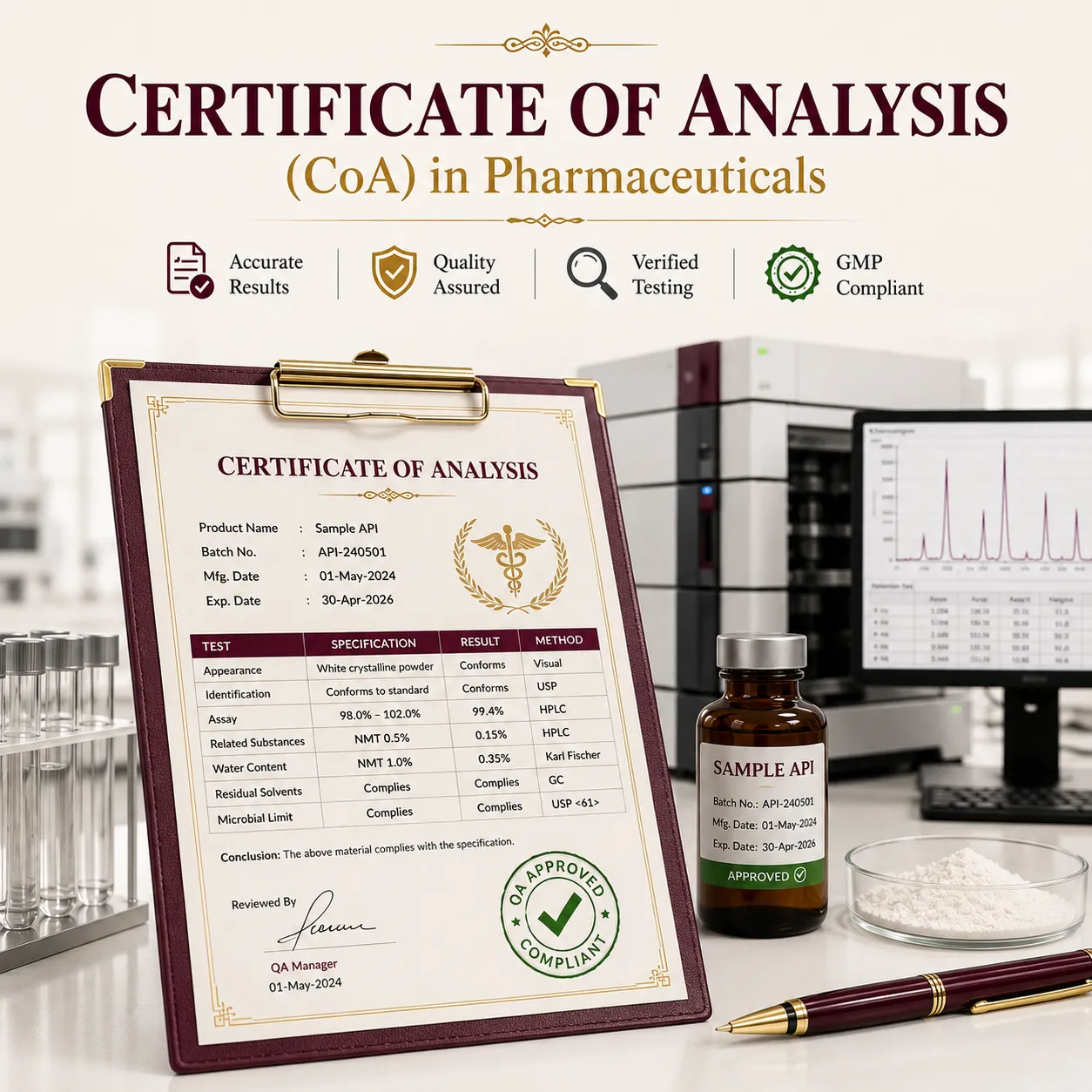

Learn how to review, verify, and manage Certificates of Analysis (CoA) in pharmaceuticals, including QA, QC, GMP, and regulatory requirements.
Definition
A Certificate of Analysis (CoA) is a batch-specific document issued by a pharmaceutical quality control laboratory that confirms a material or product meets predefined quality specifications. It includes analytical test results, acceptance criteria, test methods, batch information, and an official compliance statement used for material release and regulatory compliance.
In pharmaceutical manufacturing, product quality cannot be assumed—it must be documented, verified, and demonstrated through robust quality records. Among these records, the Certificate of Analysis (CoA) is one of the most important documents supporting GMP compliance, supplier qualification, material release, and regulatory inspections.
Whether reviewing an Active Pharmaceutical Ingredient (API), excipient, packaging material, or finished drug product, Quality Assurance (QA), Quality Control (QC), Manufacturing, and Regulatory Affairs professionals rely on the CoA to confirm that a batch meets predefined specifications before it is used or released.
A well-prepared CoA acts as the product’s quality passport, providing objective evidence of safety, identity, purity, potency, and compliance.
What Is a Certificate of Analysis (CoA)?
A Certificate of Analysis (CoA) is an official, batch-specific document issued by a Quality Control laboratory that verifies a material’s conformance to established specifications.
The document contains:
- Product identification details
- Batch or lot information
- Analytical test parameters
- Acceptance criteria
- Actual test results
- Test methods used
- Compliance statement
- Authorized approval signatures
The CoA serves as documented proof that the tested material complies with approved quality standards.
Why Is a Certificate of Analysis Important?
The CoA plays a critical role throughout the pharmaceutical supply chain.
| Function | Importance |
|---|---|
| Material Release | Confirms material meets quality requirements |
| Batch Disposition | Supports QA release decisions |
| Regulatory Compliance | Demonstrates GMP adherence |
| Supplier Qualification | Assesses vendor reliability |
| Traceability | Links analytical data to a specific batch |
| Audits & Inspections | Provides evidence of quality control activities |
Without a valid CoA, pharmaceutical companies cannot adequately justify material acceptance or product release decisions.
Core Components of a Pharmaceutical CoA
Every pharmaceutical CoA must be batch-specific and contain essential information.
1. Header Information
The header establishes document traceability.
Typical information includes:
- Manufacturer name
- Laboratory name and address
- Certificate number
- Document identification code
- Issue date
- Page numbering
2. Material Identification
This section identifies exactly what material was tested.
Key Details
- Product name
- Material grade
- Batch/Lot number
- Manufacturing date
- Expiration date
- Retest date
- Packaging description
3. Analytical Results Section
This is the most critical portion of the CoA.
Example CoA Analytical Table
| Test Parameter | Specification | Result | Method |
|---|---|---|---|
| Identification | Conforms | Conforms | USP |
| Assay | 98.0–102.0% | 99.4% | HPLC |
| Water Content | NMT 1.0% | 0.35% | Karl Fischer |
| Related Substances | NMT 0.5% | 0.12% | USP |
| Residual Solvents | Complies | Complies | GC |
Best Practice
Results should be reported as actual numerical values whenever possible. Generic statements such as “Pass” or “Complies” without supporting data may raise regulatory concerns.
4. Certification Statement
A formal declaration confirming specification compliance.
Example
“This batch has been tested according to approved procedures and complies with established specifications.”
5. Authorization and Approval
The CoA must include:
- Reviewer name
- Reviewer designation
- Signature
- Approval date
Authorized approval ensures accountability and regulatory compliance.
Quality Control (QC) Responsibilities
Quality Control laboratories are responsible for generating reliable analytical data that forms the basis of the CoA.
Analytical Testing
QC performs testing using:
- Validated analytical methods
- Pharmacopoeial procedures
- Approved specifications
Common analytical techniques include:
- HPLC
- GC
- UV Spectroscopy
- FTIR
- Dissolution Testing
- Microbiological Analysis
Data Integrity Responsibilities
QC must ensure:
- Accurate recording of raw data
- Complete traceability
- Secure data storage
- Controlled documentation practices
ALCOA+ Principles
- Attributable
- Legible
- Contemporaneous
- Original
- Accurate
- Complete
- Consistent
- Enduring
- Available
Data integrity failures can compromise the validity of the entire CoA.
OOS Investigation Requirements
If a result falls outside specifications:
- Material is immediately quarantined.
- OOS investigation is initiated.
- Root cause analysis is performed.
- Corrective actions are implemented.
- Batch disposition is determined.
A CoA should never be approved until the investigation is complete.
Quality Assurance (QA) Responsibilities
QA acts as the final authority for material release decisions.
Supplier Qualification
Before accepting supplier CoAs, QA should verify:
- GMP compliance status
- Audit history
- Technical capability
- Quality agreements
- Regulatory inspection outcomes
CoA Verification
QA review should confirm:
✔ Product identity
✔ Batch number accuracy
✔ Specification compliance
✔ Analytical methods
✔ Approval signatures
✔ Authenticity of supplier documentation
Material Release
Incoming materials remain under quarantine until QA verifies:
- CoA accuracy
- Supplier approval status
- Compliance with specifications
Only then can materials be released for manufacturing use.
Step-by-Step Guide: How to Review a Pharmaceutical CoA
Step 1: Verify Material Information
Confirm:
- Product name
- Batch number
- Manufacturing date
- Expiry or retest date
Step 2: Confirm Supplier Qualification
Verify supplier approval status within the quality system.
Step 3: Review Test Results
Compare reported values against approved specifications.
Step 4: Verify Analytical Methods
Ensure methods align with:
- USP
- EP
- BP
- JP
- Validated in-house procedures
Step 5: Assess Critical Quality Attributes
Review:
- Assay
- Identity
- Impurities
- Water content
- Residual solvents
- Microbiological quality
Step 6: Verify Approvals
Confirm authorized reviewer signatures and dates.
Step 7: Approve or Reject Material
Document the final decision according to GMP procedures.
Practical Example of CoA Review
Scenario
A manufacturer receives an API shipment from an approved supplier.
CoA Data
| Parameter | Specification | Result |
|---|---|---|
| Assay | 98.0–102.0% | 99.3% |
| Water Content | NMT 1.0% | 0.40% |
| Impurity A | NMT 0.20% | 0.06% |
| Identification | Positive | Positive |
QA Assessment
| Review Item | Status |
|---|---|
| Supplier Approved | Yes |
| Results Within Limits | Yes |
| Documentation Complete | Yes |
| Data Integrity Concerns | No |
Decision
Material Released for Production
Regulatory Requirements and GMP Expectations
ICH Requirements
ICH Q6A
Provides guidance on:
- Specifications
- Test procedures
- Acceptance criteria
ICH Q7
Defines GMP expectations for API manufacturing and quality systems.
FDA cGMP Requirements
Relevant regulations include:
- 21 CFR Part 210
- 21 CFR Part 211
These regulations require scientifically sound testing, documentation, and quality oversight.
WHO Model CoA
The World Health Organization provides a globally recognized framework for Certificates of Analysis covering:
- APIs
- Excipients
- Finished pharmaceutical products
Reduced Testing and Supplier CoAs
Pharmaceutical manufacturers may implement reduced testing programs when:
- Suppliers are fully qualified
- Supplier audits have been completed
- Historical quality performance is acceptable
- Periodic verification testing is conducted
Reduced testing should be supported by documented risk assessments and ongoing supplier monitoring.
Common CoA Deficiencies Found During Audits
| Deficiency | Potential Risk |
|---|---|
| Missing batch information | Traceability issues |
| Missing signatures | Regulatory non-compliance |
| Undefined specifications | Ambiguous acceptance criteria |
| Incomplete analytical data | Product quality risk |
| Data integrity concerns | Inspection observations |
| Unvalidated test methods | Unreliable results |
Such deficiencies are frequently cited during FDA, MHRA, and EU GMP inspections.
Frequently Asked Questions (FAQs)
1. What is a Certificate of Analysis (CoA)?
A CoA is a batch-specific document that confirms a material meets predefined quality specifications based on analytical testing.
2. Who issues a pharmaceutical CoA?
A qualified Quality Control laboratory issues the CoA after completing required testing.
3. Why is a CoA important in pharmaceuticals?
It provides documented evidence of quality, safety, compliance, and suitability for release.
4. What information should be included in a CoA?
Product identification, batch details, specifications, test results, methods, and approval signatures.
5. What is the difference between a CoA and a CoC?
A CoA contains analytical data, whereas a Certificate of Conformance (CoC) simply certifies compliance.
6. Can a supplier CoA be accepted without testing?
Only under a qualified supplier program supported by risk assessment and periodic verification testing.
7. What is reduced testing?
A risk-based approach that allows limited testing of incoming materials from qualified suppliers.
8. Which regulations govern pharmaceutical CoAs?
ICH Q6A, ICH Q7, FDA cGMP regulations, WHO guidelines, and regional GMP requirements.
9. What should QA verify during CoA review?
Material identity, specifications, test results, analytical methods, signatures, and supplier qualification status.
10. What happens if a CoA result is out of specification?
An OOS investigation must be initiated before material release or rejection decisions are made.