


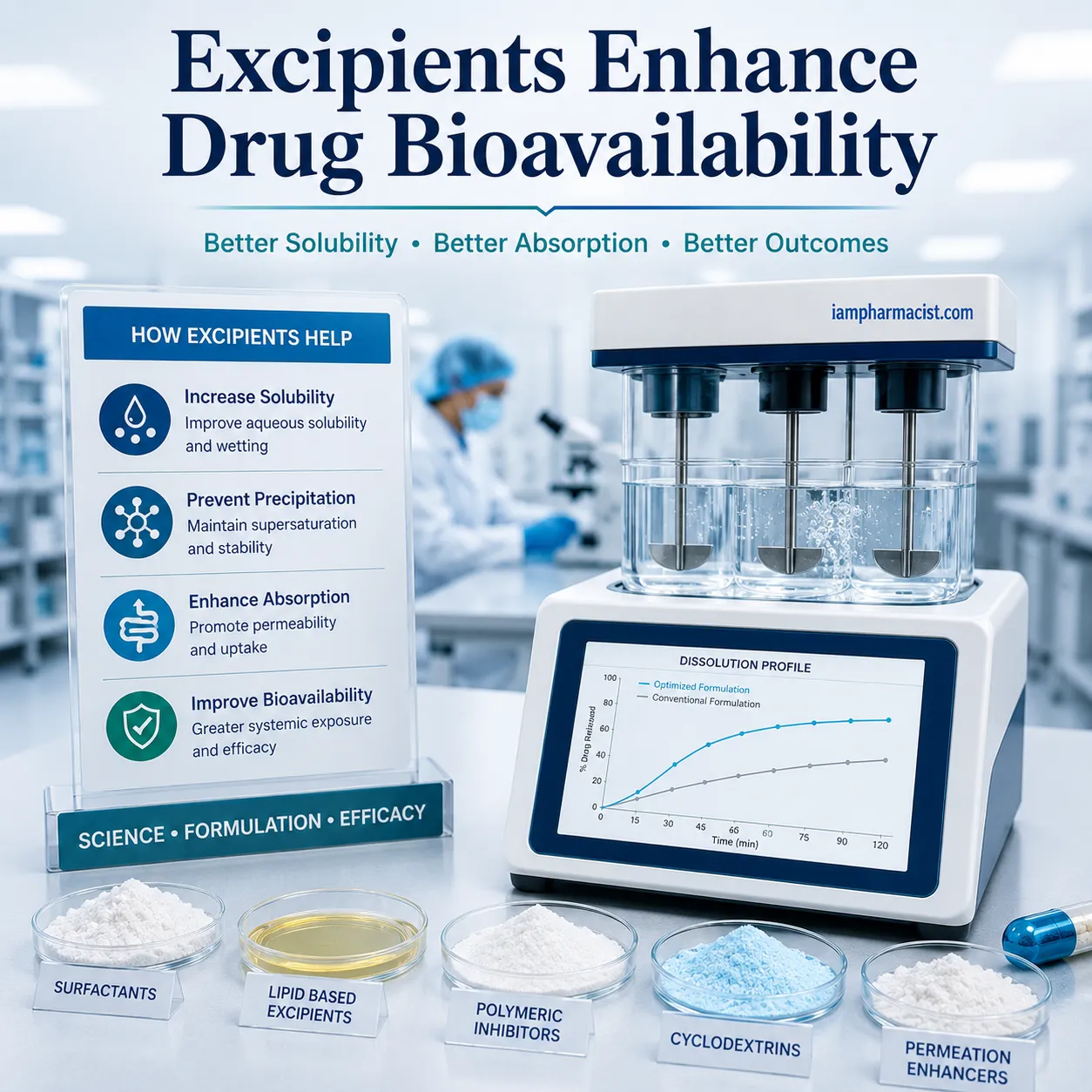

Discover how pharmaceutical excipients improve the bioavailability of poorly soluble drugs through solubilization, lipid delivery systems, solid dispersions, and advanced drug delivery technologies.
Definition
Pharmaceutical excipients enhance the bioavailability of poorly soluble drugs by improving aqueous solubility, increasing dissolution rates, preventing precipitation, enhancing intestinal permeability, and enabling advanced drug delivery systems such as solid dispersions, nanoparticles, cyclodextrin complexes, and lipid-based formulations.
Introduction
Poor aqueous solubility remains one of the greatest challenges in modern drug development. According to the Biopharmaceutics Classification System (BCS), a significant proportion of newly discovered drug candidates fall into BCS Class II and Class IV, where poor solubility limits oral absorption and therapeutic effectiveness.
While innovative APIs continue to emerge, many promising molecules fail during development because they cannot achieve sufficient systemic exposure. This challenge has transformed pharmaceutical excipients from simple formulation aids into critical functional components that directly influence drug absorption, pharmacokinetics, and clinical performance.
Today, excipients serve as the foundation of advanced bioavailability enhancement technologies, enabling formulators to convert poorly soluble compounds into effective and commercially viable medicines.
Understanding Bioavailability and Solubility Challenges
What Is Bioavailability?
Bioavailability refers to the rate and extent to which an administered drug reaches systemic circulation and becomes available for therapeutic action.
Factors Affecting Oral Bioavailability
- Aqueous solubility
- Dissolution rate
- Intestinal permeability
- First-pass metabolism
- Drug stability in GI fluids
- Food effects
For poorly soluble drugs, dissolution often becomes the rate-limiting step in absorption.
Why Poor Solubility Is a Major Development Challenge
Modern drug discovery increasingly generates highly lipophilic molecules.
Common Problems Associated with Poor Solubility
| Challenge | Impact |
|---|---|
| Slow dissolution | Delayed absorption |
| Low systemic exposure | Reduced efficacy |
| High dose requirements | Increased formulation complexity |
| Variable absorption | Inconsistent therapeutic outcomes |
| Food dependency | Unpredictable pharmacokinetics |
How Excipients Improve Bioavailability
Pharmaceutical excipients enhance bioavailability through several complementary mechanisms.
Major Bioavailability Enhancement Mechanisms
| Mechanism | Objective |
|---|---|
| Solubilization | Increase drug solubility |
| Wetting Enhancement | Improve particle-fluid interaction |
| Dissolution Promotion | Accelerate drug release |
| Precipitation Inhibition | Maintain supersaturation |
| Permeation Enhancement | Improve intestinal transport |
| Lymphatic Delivery | Bypass hepatic first-pass metabolism |
Surfactants and Solubilizers
Surfactants are among the most widely used excipients for poorly soluble drugs.
Mechanism of Action
Surfactants reduce interfacial tension between drug particles and gastrointestinal fluids.
Above their critical micelle concentration (CMC), surfactants form micelles that encapsulate hydrophobic molecules.
Benefits
- Enhanced wetting
- Increased dissolution
- Improved dispersion
- Reduced precipitation
Common Surfactants Used in Formulations
| Excipient | Function |
|---|---|
| Sodium Lauryl Sulfate (SLS) | Wetting agent and solubilizer |
| Polysorbate 80 | Micellar solubilization |
| Polysorbate 20 | Solubility enhancement |
| Poloxamer 188 | Solubilizer and stabilizer |
| Poloxamer 407 | Micelle formation |
Practical Example
Itraconazole capsules use surfactant-based systems to improve dissolution and oral absorption compared with crystalline drug forms.
Lipid-Based Formulations (LBFs)
Lipid excipients have revolutionized oral delivery of poorly soluble compounds.
How Lipid Systems Work
Lipids:
- Dissolve lipophilic APIs
- Stimulate bile secretion
- Promote mixed micelle formation
- Facilitate lymphatic transport
This improves drug absorption while reducing first-pass metabolism.
Common Lipid Excipients
| Excipient | Application |
|---|---|
| Medium Chain Triglycerides (MCTs) | Solubilization |
| Long Chain Triglycerides | Lymphatic transport |
| Caprylocaproyl Polyoxyl Glycerides | SEDDS |
| Propylene Glycol Esters | Solvent system |
| Oleic Acid | Lipid carrier |
Self-Emulsifying Drug Delivery Systems (SEDDS)
SEDDS combine:
- Oils
- Surfactants
- Co-solvents
Upon contact with GI fluids, they spontaneously form fine emulsions.
Benefits
- Improved dissolution
- Reduced food effect
- Enhanced oral absorption
Polymeric Precipitation Inhibitors
Supersaturation often leads to rapid drug precipitation.
Polymeric excipients help maintain drugs in a dissolved state.
Key Mechanism
Polymers:
- Interact with drug molecules
- Inhibit crystal growth
- Stabilize supersaturated solutions
- Extend absorption windows
Common Polymeric Inhibitors
| Polymer | Function |
|---|---|
| PVP | Crystallization inhibition |
| HPMC | Supersaturation maintenance |
| HPMCAS | Amorphous stabilization |
| Soluplus® | Solubilization and stabilization |
| Copovidone | Solid dispersion matrix |
Amorphous Solid Dispersions (ASDs)
ASDs are among the most successful technologies for poorly soluble drugs.
What Are ASDs?
The API is dispersed within a hydrophilic polymer matrix in an amorphous form.
Advantages
- Increased free energy
- Improved wettability
- Faster dissolution
- Enhanced absorption
Example
| Drug | Polymer |
|---|---|
| Posaconazole | HPMCAS |
| Itraconazole | HPMC |
| Ritonavir | Copovidone |
Several blockbuster medicines rely on ASD technology for commercial success.
Cyclodextrins and Complexing Agents
Cyclodextrins are cyclic oligosaccharides that improve drug solubility through molecular encapsulation.
Mechanism
The hydrophobic drug molecule resides within the cyclodextrin cavity while the hydrophilic outer surface interacts with water.
Benefits
- Increased apparent solubility
- Improved stability
- Enhanced dissolution
- Taste masking
Common Cyclodextrins
| Type | Application |
|---|---|
| β-Cyclodextrin | Inclusion complexes |
| HP-β-CD | Injectable formulations |
| Sulfobutyl Ether β-CD | Solubility enhancement |
Permeation Enhancers
In some cases, solubility alone is not sufficient.
Permeation enhancers improve drug transport across biological membranes.
Mechanisms
- Tight junction modulation
- Membrane fluidization
- Enhanced transcellular transport
Examples
| Excipient | Function |
|---|---|
| Sodium Caprate | Permeation enhancer |
| Lauryl Macrogol Glycerides | Absorption enhancement |
| Bile Salts | Membrane interaction |
Nanotechnology and Functional Excipients
Nanoparticle-based systems dramatically increase surface area.
Why Nanoparticles Improve Bioavailability
According to the Noyes-Whitney equation:
Smaller particles dissolve faster because they have greater surface area.
Stabilizing Excipients
| Excipient | Purpose |
|---|---|
| Poloxamers | Stabilization |
| PVP | Agglomeration prevention |
| HPMC | Surface protection |
| Lecithin | Nanoparticle stabilization |
Comparison of Bioavailability Enhancement Excipients
| Excipient Category | Primary Function | Typical Applications |
|---|---|---|
| Surfactants | Solubilization | Tablets, capsules |
| Lipid Excipients | Lymphatic transport | SEDDS, SMEDDS |
| Polymers | Precipitation inhibition | ASDs |
| Cyclodextrins | Complexation | Oral and parenteral |
| Permeation Enhancers | Absorption enhancement | Oral peptides |
| Nanostabilizers | Particle stabilization | Nanocrystals |
How to Select Excipients for Poorly Soluble Drugs
Step 1: Characterize the API
Evaluate:
- Solubility profile
- pKa
- LogP
- Crystallinity
- Permeability
Step 2: Determine BCS Classification
Identify whether the molecule belongs to:
- BCS Class II
- BCS Class IV
Step 3: Select Appropriate Enhancement Strategy
Match formulation challenges with suitable technologies.
| Challenge | Recommended Excipient |
|---|---|
| Poor dissolution | Surfactants |
| Rapid precipitation | Polymers |
| High lipophilicity | Lipid excipients |
| Low permeability | Permeation enhancers |
Step 4: Conduct Compatibility Studies
Assess:
- Drug-excipient interactions
- Stability
- Moisture sensitivity
Step 5: Optimize Through DoE
Use Design of Experiments (DoE) to optimize:
- Excipient concentration
- Drug loading
- Release profile
Step 6: Confirm Bioavailability Improvement
Evaluate using:
- Dissolution studies
- Biorelevant media testing
- Pharmacokinetic studies
Regulatory and GMP Considerations
Regulatory Expectations
Regulators require scientific justification for excipient selection.
Relevant guidelines include:
- ICH Q8(R2)
- ICH Q9
- ICH Q10
- FDA Inactive Ingredient Database (IID)
- USP-NF Monographs
- European Pharmacopoeia
GMP Considerations
Manufacturers should ensure:
- Excipient qualification
- Supplier approval
- Change control management
- Material traceability
- Stability monitoring
Functional excipients used in advanced delivery systems often require additional characterization and risk assessments.
Practical Case Study
Improving Bioavailability of a BCS Class II Antifungal Drug
Problem
Drug exhibited:
- Solubility below 1 µg/mL
- Highly variable absorption
- Strong food effect
Solution
Formulation team developed:
- Amorphous solid dispersion
- HPMCAS polymer matrix
- Surfactant-assisted dissolution enhancement
Results
- 15-fold increase in dissolution rate
- Significant increase in Cmax
- Improved patient response
Future Trends in Excipient-Based Bioavailability Enhancement
Emerging technologies include:
- Multifunctional polymers
- Smart excipients
- Nano-lipid carriers
- Mesoporous silica systems
- AI-assisted formulation design
- Personalized drug delivery systems
These innovations continue to expand possibilities for developing challenging molecules.
FAQs
1. What role do excipients play in bioavailability enhancement?
Excipients improve solubility, dissolution, absorption, and stability, increasing drug bioavailability.
2. Why are poorly soluble drugs difficult to formulate?
Their low aqueous solubility limits dissolution and gastrointestinal absorption.
3. Which excipients are commonly used for solubility enhancement?
Surfactants, polymers, lipid excipients, cyclodextrins, and permeation enhancers.
4. What are amorphous solid dispersions?
Formulations where the drug is dispersed in a polymer matrix to improve dissolution and absorption.
5. How do surfactants improve bioavailability?
They reduce surface tension and form micelles that solubilize hydrophobic drugs.
6. What are lipid-based formulations?
Drug delivery systems that use oils and lipid excipients to improve absorption and lymphatic transport.
7. How do cyclodextrins increase solubility?
They form inclusion complexes that temporarily mask drug hydrophobicity.
8. What is a precipitation inhibitor?
An excipient that prevents dissolved drug molecules from recrystallizing.
9. Which guidelines govern excipient selection?
ICH Q8, Q9, Q10, USP-NF standards, and FDA IID recommendations.
10. What is the best excipient for poorly soluble drugs?
The optimal excipient depends on the API’s physicochemical properties and formulation objectives.