


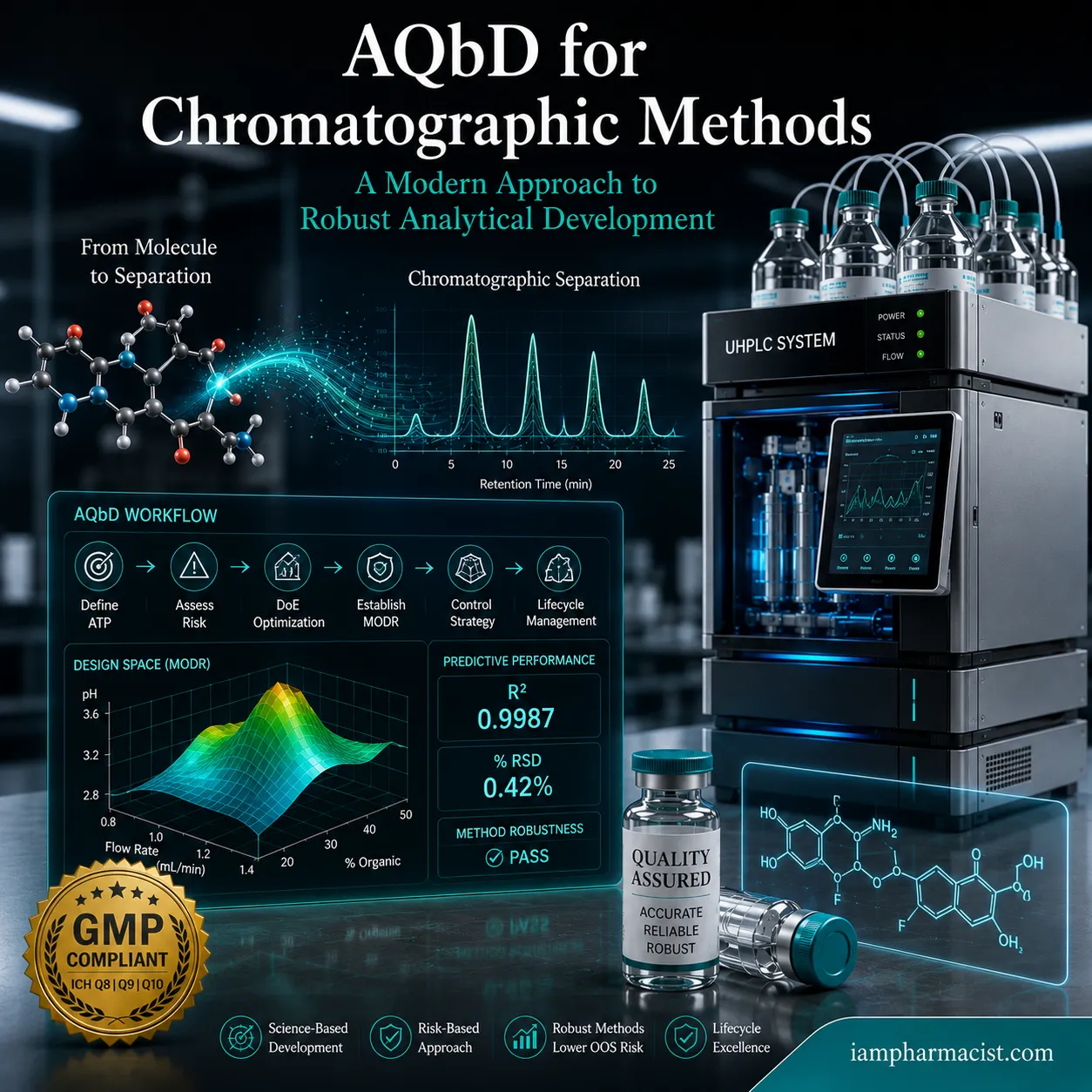

Learn how AQbD improves chromatographic method development through ATP, risk assessment, DoE, MODR, lifecycle management, and GMP compliance.
Definition
Analytical Quality by Design (AQbD) for chromatographic methods is a systematic, science- and risk-based approach to analytical method development that begins with predefined analytical objectives, identifies critical method variables through risk assessment and Design of Experiments (DoE), establishes a Method Operable Design Region (MODR), and supports lifecycle management for robust, regulatory-compliant chromatographic methods.
Introduction
Chromatographic methods are the backbone of pharmaceutical quality control, stability testing, impurity profiling, assay determination, and process monitoring. Traditionally, many HPLC and UPLC methods were developed using a trial-and-error approach, often resulting in lengthy optimization cycles, limited process understanding, and frequent out-of-specification (OOS) investigations.
To address these challenges, regulators and industry experts increasingly advocate Analytical Quality by Design (AQbD)—an extension of Quality by Design (QbD) principles into analytical method development. AQbD provides a structured framework that combines scientific understanding, risk assessment, statistical experimentation, and lifecycle management to create robust chromatographic methods that consistently meet intended performance requirements.
With the publication of ICH Q14 Analytical Procedure Development, USP <1220> Analytical Procedure Lifecycle, and alignment with ICH Q8, Q9, and Q10, AQbD has become a strategic tool for modern pharmaceutical laboratories.
What Is AQbD?
AQbD applies Quality by Design principles to analytical procedures.
Instead of developing a method through repeated trial-and-error experimentation, AQbD establishes a deep understanding of analytical performance, risk factors, and method robustness from the beginning.
Traditional Method Development vs AQbD
| Traditional Approach | AQbD Approach |
|---|---|
| Trial-and-error | Science- and risk-based |
| Fixed conditions | Flexible operating region |
| Limited understanding | Comprehensive process knowledge |
| Reactive troubleshooting | Proactive risk control |
| Frequent revalidation | Lifecycle management |
| Higher OOS risk | Improved robustness |
Why AQbD Matters for Chromatographic Methods
Chromatographic procedures involve numerous variables that can influence analytical performance.
Examples include:
- Mobile phase composition
- Buffer pH
- Column temperature
- Flow rate
- Gradient slope
- Injection volume
- Detection wavelength
- Sample preparation conditions
AQbD helps laboratories understand how these factors interact and affect analytical performance before routine implementation.
Key Benefits
✅ Improved method robustness
✅ Reduced OOS results
✅ Faster method development
✅ Enhanced regulatory flexibility
✅ Improved lifecycle management
✅ Better transferability between laboratories
✅ Stronger GMP compliance
Core AQbD Workflow for Chromatography
Overview of AQbD Lifecycle
| Step | Purpose |
|---|---|
| Analytical Target Profile (ATP) | Define method objectives |
| Risk Assessment | Identify critical variables |
| Screening DoE | Select significant factors |
| Optimization DoE | Optimize method conditions |
| MODR Establishment | Define design space |
| Validation | Confirm method performance |
| Lifecycle Management | Continuous monitoring |
Step 1: Define the Analytical Target Profile (ATP)
The ATP is the foundation of AQbD.
According to ICH Q14, ATP is:
“A prospective description of the desired performance of an analytical procedure.”
ATP Components
| ATP Element | Example |
|---|---|
| Analyte | API and impurities |
| Matrix | Drug substance |
| Technique | HPLC-UV |
| Purpose | Quantitative assay |
| Accuracy | 98–102% |
| Precision | RSD ≤ 2.0% |
| Resolution | > 2.0 |
Example ATP
Objective: Quantify API and related impurities in a tablet formulation using RP-HPLC with acceptable accuracy, precision, specificity, and robustness.
Step 2: Perform Risk Assessment
Risk assessment identifies variables that may impact analytical performance.
Common Tools
Ishikawa (Fishbone) Diagram
Categories include:
- Method
- Materials
- Machine
- Measurement
- Environment
- Personnel
Failure Mode and Effects Analysis (FMEA)
FMEA evaluates:
| Parameter | Evaluation |
|---|---|
| Severity (S) | Impact on quality |
| Occurrence (O) | Probability |
| Detectability (D) | Ability to detect |
RPN = S × O × D
Higher Risk Priority Numbers indicate greater risk.
Traffic Light Risk Matrix
| Risk Level | Action |
|---|---|
| Green | Monitor |
| Yellow | Evaluate |
| Red | Control |
Step 3: Identify CAPAs and CAPPs
Critical Analytical Procedure Attributes (CAPAs)
These represent analytical performance outputs.
Examples:
- Resolution
- Peak symmetry
- Retention time
- Accuracy
- Precision
- Peak purity
Critical Analytical Procedure Parameters (CAPPs)
These are method variables that influence CAPAs.
Examples:
| CAPP | Impact |
|---|---|
| Flow rate | Retention time |
| pH | Selectivity |
| Temperature | Resolution |
| Gradient slope | Peak separation |
| Injection volume | Sensitivity |
Step 4: Apply Design of Experiments (DoE)
DoE allows simultaneous evaluation of multiple variables.
Unlike One-Factor-at-a-Time (OFAT), DoE identifies interactions between factors.
Screening Designs
Full Factorial Design (FFD)
Used when few factors are investigated.
Fractional Factorial Design (fFD)
Reduces experimental burden.
Plackett-Burman Design (PBD)
Efficient screening for numerous variables.
| Design | Typical Purpose |
|---|---|
| FFD | Main effects and interactions |
| fFD | Rapid screening |
| PBD | High-factor screening |
Optimization Designs
After identifying critical variables, optimization studies establish optimal conditions.
Common Optimization Models
| Design | Application |
|---|---|
| Central Composite Design (CCD) | Response surface modeling |
| Box-Behnken Design (BBD) | Process optimization |
| Doehlert Design | Efficient factor exploration |
Step 5: Establish the Method Operable Design Region (MODR)
The MODR is a multidimensional region where the method consistently meets ATP requirements.
Benefits of MODR
- Improved robustness
- Regulatory flexibility
- Reduced revalidation burden
- Enhanced process understanding
Example
| Parameter | MODR Range |
|---|---|
| pH | 3.0–3.4 |
| Flow Rate | 0.9–1.1 mL/min |
| Temperature | 28–35°C |
Changes within the MODR generally maintain acceptable analytical performance.
Step 6: Develop an Analytical Control Strategy
The control strategy ensures the method remains within validated performance boundaries.
Typical Controls
- Mobile phase preparation procedures
- System suitability testing (SST)
- Calibration requirements
- Instrument qualification
- Analyst training
- Environmental monitoring
Step 7: Validate the Chromatographic Method
Validation confirms that ATP requirements are achieved.
ICH Q2 Validation Parameters
| Parameter | Purpose |
|---|---|
| Specificity | Selectivity |
| Accuracy | Correctness |
| Precision | Reproducibility |
| Linearity | Response proportionality |
| Range | Working interval |
| Detection Limit | Sensitivity |
| Quantitation Limit | Quantification capability |
| Robustness | Resistance to variation |
Step 8: Lifecycle Management
Lifecycle management extends beyond initial validation.
Modern guidance emphasizes continuous method performance verification.
Lifecycle Activities
- Trend analysis
- OOS investigation review
- Method performance monitoring
- Change control
- Continuous improvement
This aligns with USP <1220> and ICH Q14 principles.
Practical Example: AQbD-Based HPLC Method Development
Objective
Develop an RP-HPLC method for impurity profiling.
ATP
- Resolution > 2.0
- RSD < 2.0%
- Accuracy 98–102%
Risk Assessment
Identified high-risk parameters:
- Mobile phase pH
- Flow rate
- Gradient slope
Screening DoE
Plackett-Burman design identified pH and gradient slope as critical.
Optimization
Box-Behnken design optimized:
- pH = 3.2
- Flow rate = 1.0 mL/min
- Column temperature = 30°C
Outcome
- Improved robustness
- Reduced development time
- Successful method transfer
GMP and Regulatory Considerations
AQbD aligns strongly with modern regulatory expectations.
Relevant Guidelines
ICH Q8 (R2)
Pharmaceutical Development
ICH Q9
Quality Risk Management
ICH Q10
Pharmaceutical Quality System
ICH Q14
Analytical Procedure Development
ICH Q2 (R2)
USP <1220>
Analytical Procedure Lifecycle
FDA PAT Initiative
These frameworks encourage scientific understanding and lifecycle-based analytical control.
AQbD and Medicinal Plant Analysis
AQbD is increasingly used in herbal and botanical product analysis due to the complexity of multi-component systems. Challenges include defining ATPs for multiple phytochemicals, identifying meaningful CAPAs and CAPPs, and managing variability arising from plant source diversity, extraction methods, and environmental influences. Nevertheless, AQbD offers a structured path to robust chromatographic fingerprinting and quantitative analysis of medicinal plants.
FAQs
1. What is AQbD in chromatography?
AQbD is a systematic, risk-based approach to developing robust chromatographic methods using scientific understanding and statistical experimentation.
2. What is an Analytical Target Profile (ATP)?
ATP defines the intended performance requirements of an analytical procedure.
3. What is the difference between ATP and validation criteria?
ATP defines desired performance objectives, while validation confirms those objectives are achieved.
4. What is MODR?
Method Operable Design Region (MODR) is the multidimensional operating space where the method consistently meets ATP requirements.
5. Why is risk assessment important in AQbD?
It identifies critical variables that affect analytical performance and prioritizes development efforts.
6. Which DoE models are commonly used in AQbD?
Plackett-Burman, Full Factorial Design, Central Composite Design, and Box-Behnken Design.
7. How does AQbD reduce OOS results?
By building robustness into the method and controlling critical variables throughout the lifecycle.
8. Is AQbD required by ICH Q14?
ICH Q14 promotes AQbD as an enhanced approach to analytical procedure development.
9. What role does USP <1220> play in AQbD?
USP <1220> provides lifecycle management guidance for analytical procedures.
10. Can AQbD be applied to herbal medicines?
Yes. AQbD is increasingly used for medicinal plant analysis, chromatographic fingerprinting, and phytochemical quantification.