


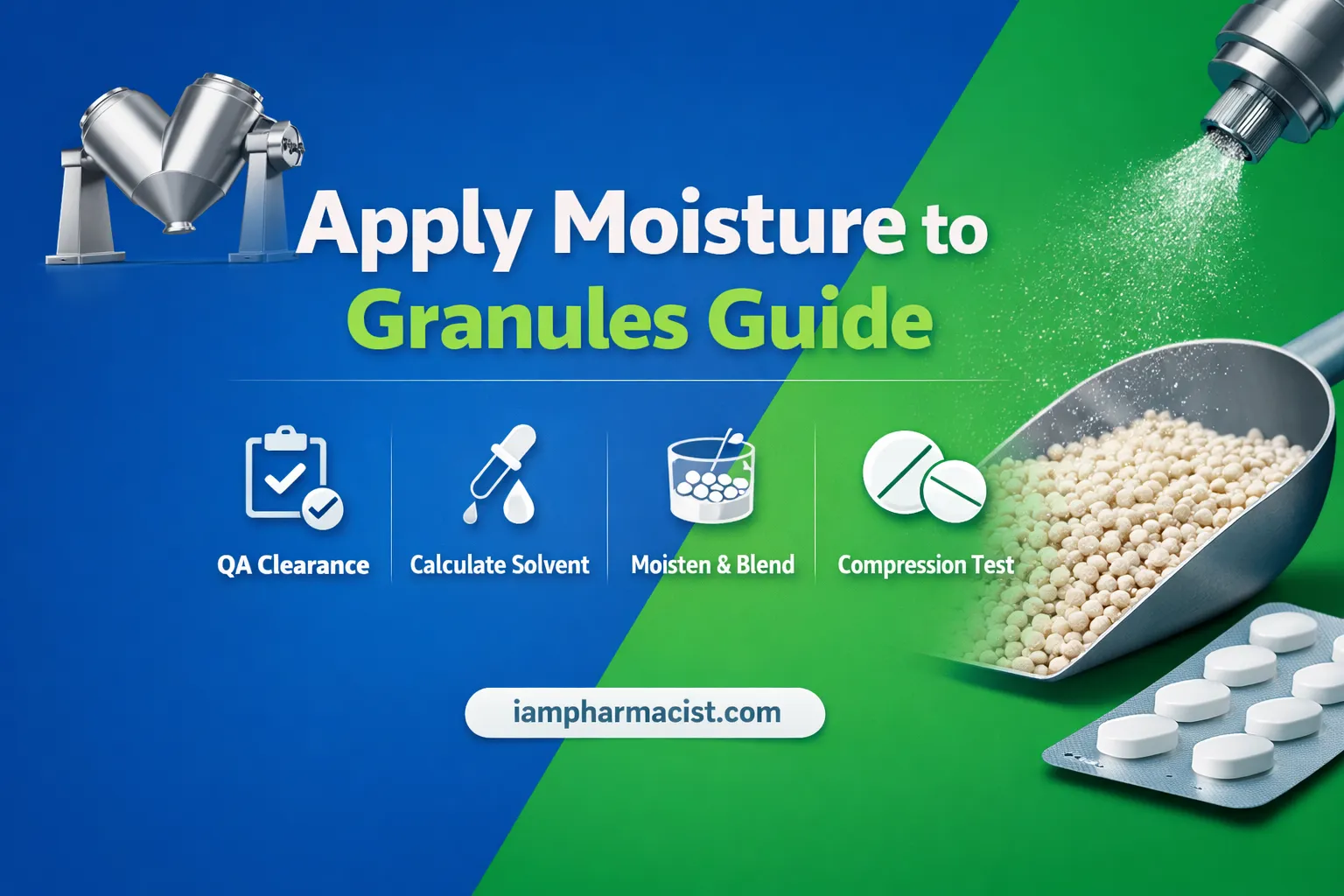

Learn how to apply moisture to granules to fix tablet capping and lamination with practical steps and expert tips.
How to Apply Moisture to Granules (Complete Guide)
Tablet capping and lamination are among the most common defects encountered during tablet compression. These issues can compromise product quality, leading to rejected batches and production delays.
A typical first response is to reduce tablet hardness or slow down the compression machine. While this may help in some cases, it doesn’t always resolve the issue. When these adjustments fail, it’s time to look deeper into the root cause.
Why Capping and Lamination Occur
The primary cause of tablet capping and lamination is low moisture content in granules. This usually happens due to over-drying during the granulation process.
When granules lose too much moisture:
- Binding properties weaken
- Compression becomes ineffective
- Tablets split or separate into layers
Maintaining the correct Loss on Drying (LOD) is critical. If the granules are too dry, defects are almost inevitable.
The Solution: Apply Moisture to Granules
To correct over-dried granules, the most effective approach is to apply moisture to granules. This restores their binding ability and improves compression performance.
However, this must be done carefully and in compliance with quality procedures.
How to Apply Moisture to Granules
When a batch is already prepared and shows signs of capping or lamination, follow this structured approach:
1. Obtain Line Clearance
Before starting:
- Get approval from Quality Assurance (QA)
- Ensure proper documentation and compliance
2. Use the Same Solvent
Always use the same solvent that was used during the kneading stage (e.g., purified water). This ensures compatibility and consistency.
Practical Example
Consider a batch of Metformin tablets:
- During compression, capping and lamination were observed
- Machine speed and hardness were reduced
- The issue persisted
After discussion with QA and product development teams, the decision was made to apply moisture to granules.
Step-by-Step Method
Trial Run (Highly Recommended)
Start with a small-scale trial:
- Take 5–10 kg of granules
- Apply calculated moisture
- Test compression results
If defects disappear, proceed to full-scale processing.
Moisture Application Process
- Calculate Solvent Quantity
Determine how much solvent is needed based on initial formulation. - Prepare a Portion of Granules
- Take 10–15 kg of granules in a stainless steel container
- Apply Moisture Manually
- Sprinkle the solvent evenly
- Mix thoroughly
- Sieve the Moist Granules
- Use mesh #8 or #10
- Ensure uniform particle size
- Blend with Remaining Batch
- Transfer remaining granules into a double cone blender
- Add moistened granules
- Blend for 2–3 minutes
This ensures even distribution of moisture across the batch.
Alternative Method (Without Blender)
If a blender is unavailable:
- Use large polythene bags
- Divide solvent for each container
- Moisturize small portions (4–5 kg at a time)
- Sieve and mix manually with remaining granules
Repeat this process for all containers.
Important Considerations
- Always perform tablet weight adjustment calculations after moisture addition
- Avoid over-wetting, which can create new issues
- Ensure uniform mixing to prevent batch inconsistency
- This method is suitable only for wet granulation processes
Conclusion
To overcome tablet capping and lamination effectively, the best corrective action is to apply moisture to granules that have been over-dried. By carefully reintroducing moisture and ensuring uniform blending, you can restore granule integrity and achieve smooth tablet compression.
This practical and proven method helps maintain product quality while minimizing batch rejection.
Frequently Asked Questions (FAQs)
1. What does “apply moisture to granules” mean?
It means adding a controlled amount of solvent to dried granules to restore proper moisture levels for tablet compression.
2. Why is moisture important in granules?
Moisture improves binding properties, ensuring tablets compress properly without defects.
3. What causes tablet capping and lamination?
The main cause is over-dried granules with insufficient moisture content.
4. Can reducing machine speed fix capping issues?
Sometimes, but if moisture is too low, speed adjustments alone won’t solve the problem.
5. Which solvent should be used to moisten granules?
Always use the same solvent used during the kneading stage, such as purified water.
6. How much moisture should be added?
It depends on the formulation and initial LOD; calculations must be done carefully.
7. Why is a trial batch recommended?
A small trial ensures the method works before applying it to the full batch.
8. Can moisture be applied without a blender?
Yes, manual mixing using polythene bags is an alternative method.
9. Is this method suitable for all tablet formulations?
No, it is mainly used for products manufactured by wet granulation.
10. What precautions should be taken after moisture application?
Ensure uniform mixing, adjust tablet weight, and avoid over-wetting.