


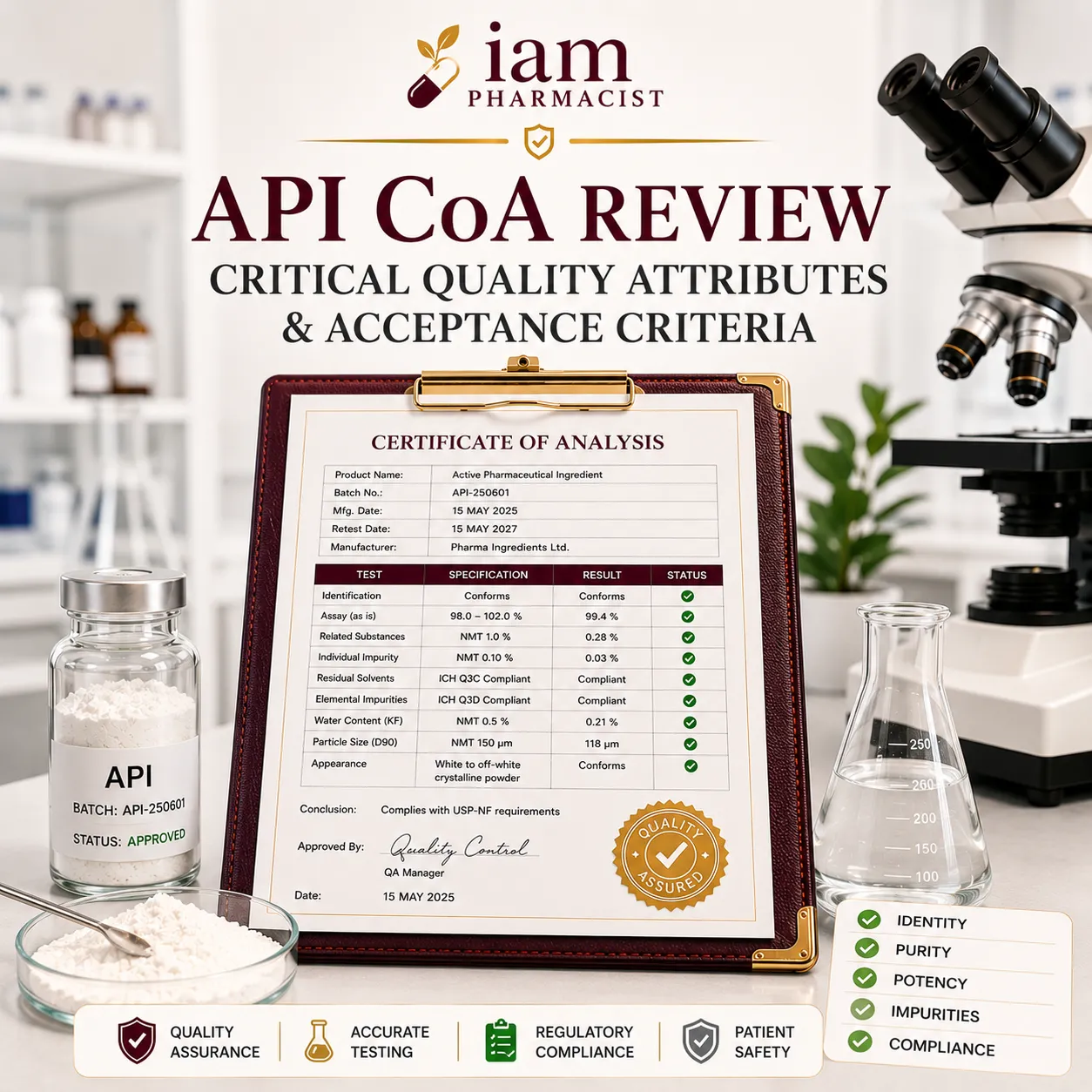

Learn how to review API Certificate of Analysis (CoAs), verify critical quality attributes, assess acceptance criteria, and ensure GMP compliance.
Definition
An API Certificate of Analysis (CoA) review is the process of evaluating analytical test results, specifications, and quality attributes to verify that an Active Pharmaceutical Ingredient (API) complies with approved regulatory, pharmacopeial, and internal quality standards. Critical Quality Attributes (CQAs) reviewed include identity, assay, impurities, residual solvents, elemental impurities, water content, and physical characteristics.
Introduction
The Active Pharmaceutical Ingredient (API) is the component responsible for a drug product’s therapeutic effect. Because API quality directly impacts product safety, efficacy, stability, and regulatory compliance, every incoming API batch must undergo rigorous evaluation before use in manufacturing.
The primary document supporting this evaluation is the Certificate of Analysis (CoA). During GMP inspections, regulatory authorities such as the FDA, EMA, MHRA, WHO, and PMDA routinely review API CoAs to verify that incoming materials meet approved specifications and that release decisions are supported by scientifically valid data.
For Quality Assurance (QA) and Quality Control (QC) professionals, reviewing an API CoA is not simply checking for a “Pass” status. It involves a detailed assessment of Critical Quality Attributes (CQAs), acceptance criteria, traceability, analytical methods, and regulatory compliance.
This guide explains how to perform a comprehensive API CoA review and identify the critical parameters that determine batch acceptability.
What Is an API Certificate of Analysis?
An API Certificate of Analysis is a batch-specific quality document issued by the manufacturer or testing laboratory that summarizes analytical testing results and confirms compliance with predefined specifications.
The CoA serves as evidence that the API:
- Meets identity requirements
- Complies with purity standards
- Contains the correct potency
- Meets impurity limits
- Conforms to pharmacopeial specifications
- Is suitable for pharmaceutical manufacturing
Why API CoA Review Is Critical
An API CoA review supports:
| Function | Importance |
|---|---|
| Incoming Material Release | Determines suitability for use |
| Supplier Qualification | Confirms supplier reliability |
| GMP Compliance | Supports regulatory expectations |
| Batch Traceability | Links testing to specific lots |
| Product Quality | Protects patient safety |
| Audit Readiness | Supports inspections and audits |
A deficient API CoA review can result in:
- Batch rejection
- Product recalls
- FDA observations
- Warning letters
- Supply chain disruptions
Critical Quality Attributes (CQAs) Every QA Professional Must Review
1. Identification (ID)
Purpose
Identification testing confirms the material is exactly what it claims to be.
Common Identification Methods
| Technique | Example |
|---|---|
| FTIR | Infrared Spectrum Match |
| HPLC | Retention Time Match |
| TLC | Spot Comparison |
| UV Spectroscopy | Reference Standard Match |
Typical Acceptance Criteria
Conforms to Reference Standard
or
Spectrum matches USP/EP Reference Standard
Example
| Test | Specification | Result |
|---|---|---|
| FTIR Identification | Conforms | Conforms |
2. Assay / Potency
Purpose
Assay determines the amount of active pharmaceutical ingredient present in the material.
Typical Acceptance Criteria
| API Type | Typical Limit |
|---|---|
| Compendial APIs | 98.0–102.0% |
| Proprietary APIs | Product-specific |
Example
| Test | Specification | Result |
|---|---|---|
| Assay (Anhydrous Basis) | 98.0–102.0% | 99.6% |
QA Review Points
✔ Result within specification
✔ Correct calculation basis
✔ Method referenced
3. Related Substances (Impurities)
Purpose
Measures process-related and degradation impurities.
Regulatory Reference
ICH Q3A(R2) – Impurities in New Drug Substances
Example Acceptance Criteria
| Parameter | Limit |
|---|---|
| Individual Impurity | NMT 0.10% |
| Unspecified Impurity | NMT 0.10% |
| Total Impurities | NMT 1.0% |
Example Results
| Test | Limit | Result |
|---|---|---|
| Impurity A | NMT 0.10% | 0.03% |
| Impurity B | NMT 0.10% | 0.05% |
| Total Impurities | NMT 1.0% | 0.18% |
4. Residual Solvents
Purpose
Detects volatile solvents used during API synthesis.
Regulatory Reference
ICH Q3C(R8)
Common Solvents Monitored
| Solvent | Typical Limit |
|---|---|
| Methanol | NMT 3000 ppm |
| Toluene | NMT 890 ppm |
| Acetone | NMT 5000 ppm |
Example
| Solvent | Limit | Result |
|---|---|---|
| Methanol | NMT 3000 ppm | 150 ppm |
5. Elemental Impurities (Heavy Metals)
Purpose
Ensures toxic metals remain below permitted daily exposure limits.
Regulatory Reference
ICH Q3D
Common Elements
| Element | Risk |
|---|---|
| Lead (Pb) | Toxicity |
| Cadmium (Cd) | Carcinogenicity |
| Arsenic (As) | Toxicity |
| Mercury (Hg) | Neurotoxicity |
Example
| Element | Limit | Result |
|---|---|---|
| Lead | NMT 0.5 ppm | 0.08 ppm |
6. Water Content and Loss on Drying (LOD)
Purpose
Moisture affects:
- Stability
- Potency calculations
- Flowability
- Manufacturing performance
Common Methods
- Karl Fischer Titration
- Loss on Drying
Example
| Test | Limit | Result |
|---|---|---|
| Water Content | NMT 1.0% | 0.32% |
7. Physical Characteristics
Purpose
Physical properties influence processing performance and product quality.
Common Parameters
| Attribute | Importance |
|---|---|
| Appearance | Identity confirmation |
| Color | Product consistency |
| Polymorphic Form | Bioavailability |
| Particle Size Distribution | Dissolution and blending |
| Bulk Density | Compression performance |
Example
| Test | Specification | Result |
|---|---|---|
| Appearance | White to Off-White Powder | Conforms |
| PSD D90 | NMT 150 µm | 122 µm |
API CoA Acceptance Criteria Summary
| Critical Quality Attribute | Typical Acceptance Criteria |
|---|---|
| Identification | Conforms |
| Assay | 98.0–102.0% |
| Individual Impurity | NMT 0.10% |
| Total Impurities | NMT 1.0% |
| Residual Solvents | Per ICH Q3C |
| Elemental Impurities | Per ICH Q3D |
| Water Content | Product-specific |
| Appearance | Descriptive conformity |
| PSD | Product-specific |
API CoA Verification Checklist
Beyond CQAs, QA professionals should verify document integrity and compliance.
Traceability Verification
Confirm:
- Batch number matches container
- Batch number matches shipping documents
- Batch number matches ERP/LIMS records
Example
| Record | Batch Number |
|---|---|
| CoA | API-250604 |
| Container Label | API-250604 |
| Delivery Note | API-250604 |
Pharmacopeial Compliance
Verify declared compliance with:
- USP
- EP
- BP
- JP
Example Statement
“Complies with current USP monograph.”
Analytical Method Verification
Confirm methods are:
- Validated
- Current version
- Appropriate for intended use
Examples:
- USP Method
- EP Method
- Validated Internal Method
Authorization Verification
Ensure the CoA contains:
✔ Reviewer signature
✔ QA/QC authorization
✔ Approval date
✔ Electronic signature controls (if applicable)
Step-by-Step Guide to Reviewing an API CoA
Step 1: Verify Supplier Qualification
Confirm supplier remains approved.
Step 2: Confirm Material Identity
Review:
- API name
- Grade
- Compendial status
Step 3: Verify Batch Traceability
Match batch information across all records.
Step 4: Review Critical Quality Attributes
Evaluate:
- Identification
- Assay
- Impurities
- Solvents
- Elemental impurities
- Water content
Step 5: Verify Specifications
Ensure acceptance criteria align with:
- Approved specifications
- Regulatory filings
- Pharmacopeial standards
Step 6: Review Analytical Methods
Confirm current validated methods were used.
Step 7: Approve or Reject Material
Document QA disposition decision.
Practical Example: API CoA Review
API
Paracetamol USP
CoA Results
| Test | Specification | Result |
|---|---|---|
| Identification | Conforms | Conforms |
| Assay | 98.0–102.0% | 99.4% |
| Total Impurities | NMT 0.5% | 0.12% |
| Water Content | NMT 0.5% | 0.21% |
| Residual Solvents | Per ICH Q3C | Complies |
| Lead | NMT 0.5 ppm | 0.05 ppm |
QA Outcome
✔ Supplier qualified
✔ Specifications met
✔ Traceability confirmed
✔ Material released
Common GMP Audit Findings Related to API CoAs
Inspectors frequently identify:
- Missing batch traceability
- Unsupported specifications
- Missing signatures
- Incomplete impurity reporting
- Unvalidated analytical methods
- Missing residual solvent data
- Poor supplier qualification
GMP and Regulatory Insights
FDA Expectations
FDA inspectors evaluate:
- Supplier qualification
- Identity testing
- Analytical reliability
- Data integrity
Relevant Regulations
- 21 CFR Part 211
- FDA Data Integrity Guidance
ICH Expectations
ICH Q7
API GMP requirements
ICH Q3A
Impurity controls
ICH Q3C
Residual solvent limits
ICH Q3D
Elemental impurity limits
EU GMP Expectations
Focus areas include:
- Traceability
- Data integrity
- Supplier oversight
- Batch release support
Best Practices for QA Professionals
Use Standardized CoA Review Checklists
Improve review consistency.
Verify Supplier Reliability Periodically
Support supplier qualification programs.
Review Trends
Monitor assay, impurity, and moisture trends.
Utilize Electronic Review Systems
Improve traceability and audit readiness.
Maintain Regulatory Awareness
Stay current with ICH and pharmacopeial updates.
FAQs
1. What is an API Certificate of Analysis?
An API CoA is a batch-specific document that reports analytical results and confirms compliance with approved specifications.
2. Why is API CoA review important?
It verifies identity, purity, potency, and compliance before the API is used in manufacturing.
3. What are the critical quality attributes in an API CoA?
Identification, assay, impurities, residual solvents, elemental impurities, water content, and physical characteristics.
4. What assay limits are typically used for APIs?
Many APIs use acceptance criteria between 98.0% and 102.0%, although limits vary by product.
5. Which guideline governs API impurities?
ICH Q3A(R2) provides guidance on impurities in drug substances.
6. Why are residual solvents monitored?
To ensure solvents used during synthesis remain below safe exposure limits established by ICH Q3C.
7. What is the purpose of elemental impurity testing?
To control toxic metals such as lead, cadmium, arsenic, and mercury.
8. What should QA verify besides test results?
Batch traceability, pharmacopeial compliance, analytical methods, supplier status, and document authorization.
9. What are common API CoA audit deficiencies?
Missing signatures, incomplete impurity data, traceability gaps, and unsupported specifications.
10. Which GMP guideline applies specifically to API manufacturers?
ICH Q7 provides GMP guidance for Active Pharmaceutical Ingredients.