



Learn SOP for Chemical Spill Handling in laboratories with step-by-step procedures, safety measures, and compliance guidelines for safe cleanup.
Introduction
Chemical spills in laboratories pose serious risks including contamination, injury, fire hazards, and regulatory non-compliance. A structured SOP for chemical spill handling ensures immediate response, safe cleanup, and prevention of further hazards. This guide provides a practical, GMP-aligned procedure to manage spills effectively in quality control laboratories.
Definition
Chemical spill handling SOP refers to a standardized procedure used in laboratories to safely manage, contain, clean, and dispose of spilled chemicals while ensuring personnel safety and regulatory compliance.
Semantic Content Layer
Laboratory environments require strict adherence to safety protocols, especially during chemical handling. Spills involving acids, solvents, alkalis, or hazardous substances demand immediate containment using absorbents, personal protective equipment (PPE), and MSDS guidelines. Proper spill response minimizes exposure risks, environmental impact, and ensures compliance with occupational safety standards.
1.0 OBJECTIVE
To establish a clear procedure for handling chemical spillages in laboratories to maintain cleanliness, safety, and compliance.
2.0 SCOPE
Applicable to chemical rooms and instrument rooms within the Quality Control department.
3.0 RESPONSIBILITY
- Worker: Perform cleaning under supervision
- Technical Assistant / Executive: Monitor and verify cleaning
4.0 ACCOUNTABILITY
Executive / Manager
5.0 PROCEDURE
Calibration Failure Handling Steps
- Ensure personnel handle chemicals carefully to prevent spills
- Immediately alert laboratory personnel after a spill
- Assign trained worker for cleanup
- Use appropriate absorbent or dilution method
- Follow MSDS guidelines for hazardous chemicals
- Dispose of waste safely
- Clean and sanitize the affected area
General Safety Measures
- Promote awareness to prevent spills
- Always use proper PPE (gloves, goggles, masks)
- Maintain clean and organized workspace
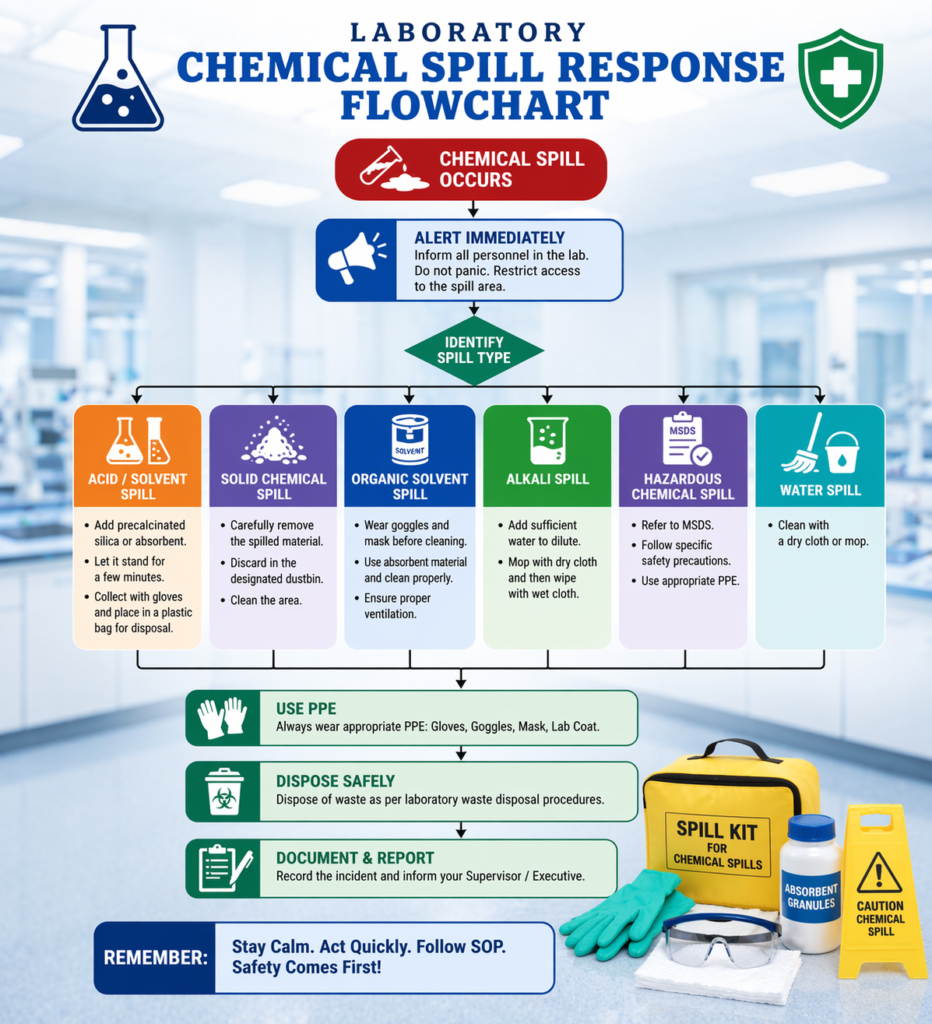
Spill Response Procedure
- Immediately inform all personnel in the lab
- Alert designated worker for cleanup
- Restrict access to spill area
Table Snippet (Data Type)
| Spill Type | Handling Method | Safety Measures |
|---|---|---|
| Acid/Solvent | Add silica absorbent, collect in bag | Use gloves |
| Solid Chemicals | Sweep and discard | Avoid inhalation |
| Organic Solvents | Clean with PPE | Use mask & goggles |
| Alkali Liquids | Dilute with water, wipe | Avoid contact |
| Hazardous Chemicals | Follow MSDS | Full PPE required |
| Water | Mop with dry cloth | Basic cleaning |
Detailed Actions
- Acid/Solvent Spills:
Add precalcinated silica or absorbent material, allow absorption, collect safely, and dispose. - Solid Spills:
Remove manually and discard in designated waste bin. - Organic Solvents:
Wear goggles and mask during cleanup to avoid inhalation. - Alkali Spills:
Dilute with water, clean with dry cloth, then wipe with wet cloth. - Hazardous Chemicals:
Follow instructions as per MSDS strictly. - Water Spills:
Clean using dry cloth or mop.
6.0 ABBREVIATIONS
- MSDS = Material Safety Data Sheet
FAQs
- What is a chemical spill SOP?
A documented procedure for safely handling chemical spills. - What should be done immediately after a spill?
Alert personnel and restrict access to the affected area. - Why is MSDS important in spill handling?
It provides safety and handling instructions for specific chemicals. - What PPE is required for spill cleanup?
Gloves, goggles, masks, and protective clothing. - How are acid spills handled?
Using absorbent materials like silica granules. - Can water be used for all spills?
No, only for alkali or water-based spills. - How to handle hazardous chemical spills?
Follow MSDS guidelines strictly. - What is the role of supervisor?
Ensure proper cleanup and compliance. - How to dispose of spill waste?
Place in designated waste bags and send to scrap. - Why is spill prevention important?
To avoid accidents, contamination, and regulatory issues.