


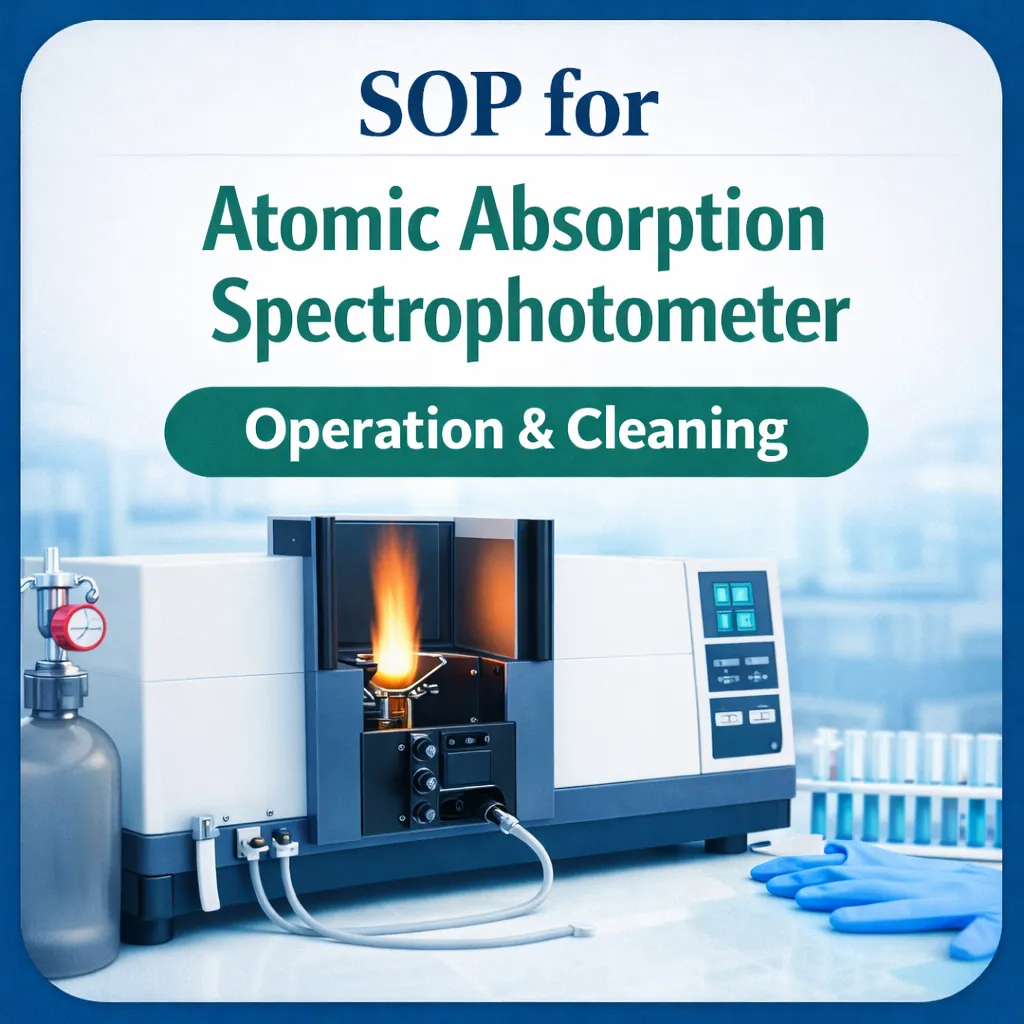

Learn SOP for atomic absorption spectrophotometer operation, calibration & cleaning with step-by-step guidance, safety tips, and QC best practices.
Introduction
The atomic absorption spectrophotometer (AAS) is a critical analytical instrument used in pharmaceutical and environmental laboratories to determine trace metal concentrations. A robust SOP for atomic absorption spectrophotometer ensures data accuracy, instrument longevity, and regulatory compliance.
This guide provides a comprehensive, step-by-step SOP covering operation, calibration, cleaning, and maintenance—ideal for QC analysts and auditors.
Objective
To establish a standardized procedure for the operation, calibration, and cleaning of the atomic absorption spectrophotometer.
Scope
Applicable to all AAS instruments installed in the Quality Control laboratory.
Responsibility
- Execution: Technical Assistant / Executive
- Verification: Executive / Manager
- Accountability: Head of Department
Step-by-Step SOP: Operation of AAS
Pre-Operational Checks
- Ensure gas supply (air/acetylene) is adequate
- Check lamp alignment (hollow cathode lamp)
- Verify wavelength and slit settings
- Ensure instrument calibration status
Operating Procedure
- Switch ON the instrument and stabilize
- Install appropriate hollow cathode lamp
- Set wavelength as per analyte
- Ignite flame (if flame AAS)
- Aspirate blank solution
- Calibrate using standard solutions
- Aspirate sample solution
- Record absorbance readings
- Perform replicate readings for accuracy
Calibration of Atomic Absorption Spectrophotometer
Calibration Parameters
- Wavelength accuracy
- Absorbance linearity
- Lamp performance
- Flame stability
Calibration Procedure
- Prepare standard solutions of known concentration
- Aspirate blank solution
- Run standards sequentially
- Plot calibration curve (absorbance vs concentration)
- Verify correlation coefficient (should be near 1.0)
- Document calibration data
✅ Calibration should be performed daily or before analysis
Electrode / Lamp Activation
Although AAS does not use electrodes like pH meters, lamp conditioning is essential:
- Install hollow cathode lamp
- Allow warm-up (15–30 minutes)
- Optimize lamp current
- Align for maximum sensitivity
SOP for Cleaning Atomic Absorption Spectrophotometer
Cleaning Objective
To prevent contamination, ensure accuracy, and extend instrument life.
Cleaning Procedure (Post-Analysis)
- Remove used glassware
- Aspirate blank solution for 1 minute
- Flush suction pipe with distilled water four times
- Switch OFF the instrument
- Switch OFF mains power
Component Cleaning
- Clean burner slit using:
- Wooden strip (manufacturer-provided) OR
- Hard paper
- Remove lamp and store properly
- Clean external surface:
- Use dry cotton cloth
- Remove stains with isopropyl alcohol
- Dry with tissue paper
- Record cleaning in instrument logbook
Safety Precautions
- Use PPE (gloves, goggles, lab coat)
- Handle acetylene gas carefully
- Avoid flame exposure risks
- Never aspirate corrosive solutions directly
- Ensure proper ventilation
Common Mistakes to Avoid
- ❌ Skipping blank aspiration
- ❌ Improper lamp alignment
- ❌ Not cleaning burner slit
- ❌ Using contaminated glassware
- ❌ Ignoring calibration checks
Best Practices for AAS in QC Labs
- Perform routine calibration
- Use high-purity reagents
- Maintain logbooks consistently
- Replace worn-out components
- Conduct periodic performance verification
FAQs (SEO Optimized)
1. What is an atomic absorption spectrophotometer?
It is an analytical instrument used to measure metal concentrations in samples.
2. Why is calibration important in AAS?
It ensures accurate quantification of analytes.
3. How often should AAS be cleaned?
After every analysis.
4. What is the purpose of blank aspiration?
To remove residues from the suction system.
5. What is a hollow cathode lamp?
A light source specific to the element being analyzed.
6. What gases are used in AAS?
Typically air and acetylene.
7. How to clean the burner slit?
Using a wooden strip or hard paper.
8. What happens if cleaning is not done properly?
It may cause inaccurate results and contamination.
9. What is the ideal calibration frequency?
Daily or before each analysis batch.
10. Who is responsible for SOP compliance?
QC staff, supervised by management.