


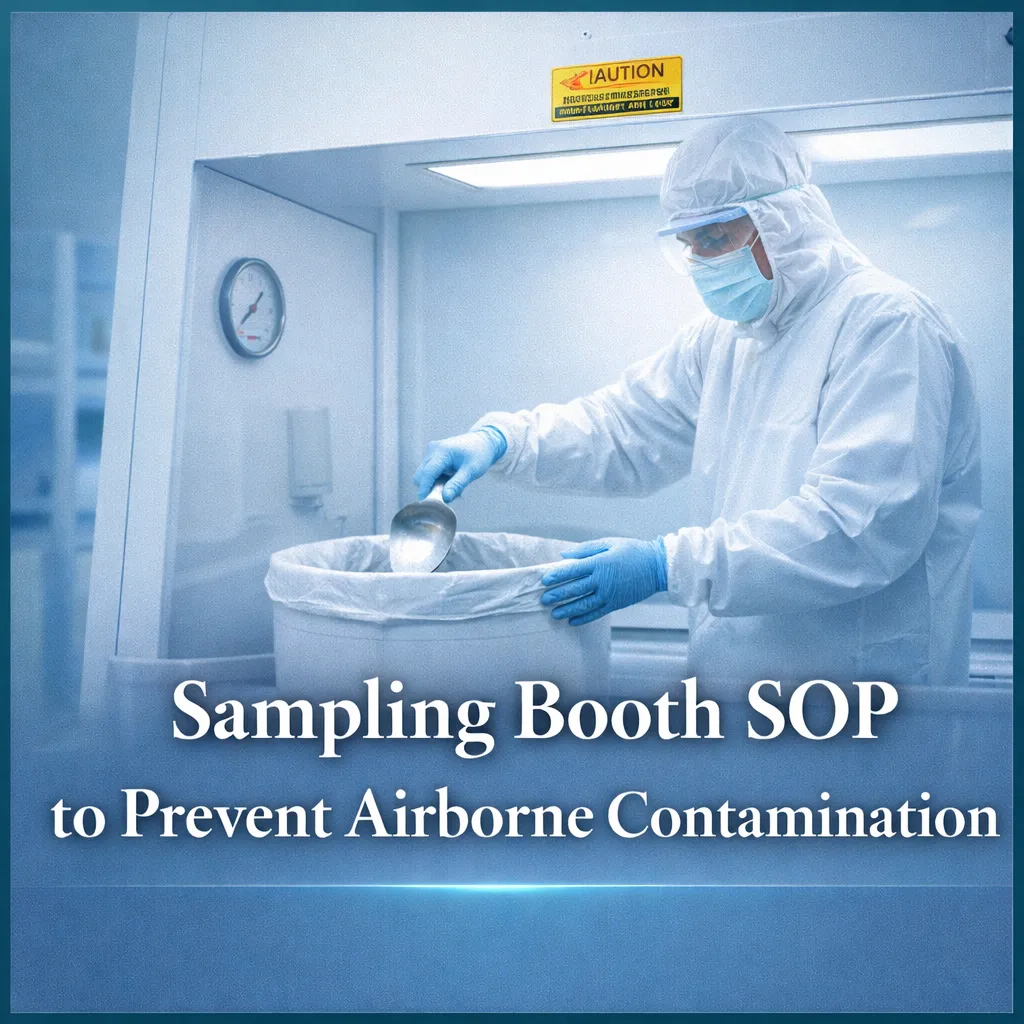

Learn SOP for sampling booth operation to prevent airborne contamination in pharma QC. Ensure clean environment and compliance.
Introduction
In pharmaceutical manufacturing, preventing airborne contamination during raw material sampling is critical to maintaining product quality and regulatory compliance. A sampling booth equipped with HEPA filtration and controlled airflow ensures a clean environment for safe and contamination-free sampling.
This SOP provides a detailed guide for operating, monitoring, and maintaining sampling booths to minimize contamination risks and ensure consistent sampling practices.
1.0 Objective
To define a procedure that prevents airborne contamination during raw material sampling.
2.0 Scope
This SOP applies to sampling activities carried out in sampling booths installed in raw material storage areas.
3.0 Responsibility
- Doing: Technical Assistant
- Checking: Executive / Manager
4.0 Accountability
- Head of the Department
5.0 Step-by-Step SOP for Sampling Booth
5.1 System Overview & Environmental Control
- Sampling booths provide a clean environment using multi-stage filtration:
- Core filter
- 5-micron pre-filter
- HEPA filter
- Filters reduce particle load and maintain sterile airflow
- Recommended manometer reading: 7–15 mm water column
Key Indicators:
- >15 mm: HEPA filter blockage → Replace filter
- Low reading: Pre-filter choking → Clean filter
- HEPA replacement requires PAO/DOP validation test
5.2 Operation of Sampling Booth
5.2.1 Start-Up Procedure
- Switch ON mains
- Switch ON light
- Start blower at slow speed 1 hour before sampling
5.2.2 During Operation
- Record differential pressure daily
- Ensure system is ON before opening materials
- Perform sampling as per raw material SOP
5.2.3 Sampling Controls
- Use clean sampling tools for each material
- Do not take sampling devices outside booth
- Collect samples in closed containers inside booth
- Close containers under laminar airflow
5.2.4 Monitoring
- Record manometer reading after each sampling
5.2.5 Shutdown
- Switch OFF system after use
5.3 Calibration & Validation
- Perform PAO (DOP) test after HEPA replacement
- Verify airflow velocity and pressure differentials
- Maintain calibration records for compliance
5.4 Cleaning & Maintenance
- Clean pre-filters (core & 5 micron) periodically
- Inform engineering team for maintenance
- Ensure no dust accumulation inside booth
- Maintain cleaning logs
6.0 Abbreviations
- HEPA: High Efficiency Particulate Air
- DOP/PAO: Filter integrity test
- PSIG: Pressure measurement unit
Safety Precautions
- Always operate booth before sampling
- Use PPE (gloves, mask, gown)
- Avoid material exposure outside booth
- Ensure proper airflow before use
- Handle filters carefully
Common Mistakes to Avoid
- Sampling without switching ON booth
- Ignoring manometer readings
- Using unclean sampling tools
- Opening containers outside controlled area
- Delayed filter maintenance
Best Practices
- Maintain daily pressure logs
- Perform routine filter cleaning
- Validate HEPA filters regularly
- Train staff on contamination control
- Follow strict SOP compliance
FAQs (Frequently Asked Questions)
1. What is a sampling booth?
A controlled environment used for contamination-free sampling.
2. Why is HEPA filtration important?
It removes airborne particles and ensures clean airflow.
3. What is the ideal pressure range?
7–15 mm of water column.
4. What happens if pressure is too high?
HEPA filter may be clogged and needs replacement.
5. What is a PAO/DOP test?
A validation test for HEPA filter integrity.
6. Can sampling be done without the booth ON?
No, it risks contamination.
7. Why use separate sampling tools?
To prevent cross-contamination.
8. How often should filters be cleaned?
Periodically or when pressure drops.
9. Who is responsible for operation?
Technical Assistant performs; Manager verifies.
10. Why is documentation important?
For compliance, audits, and traceability.