


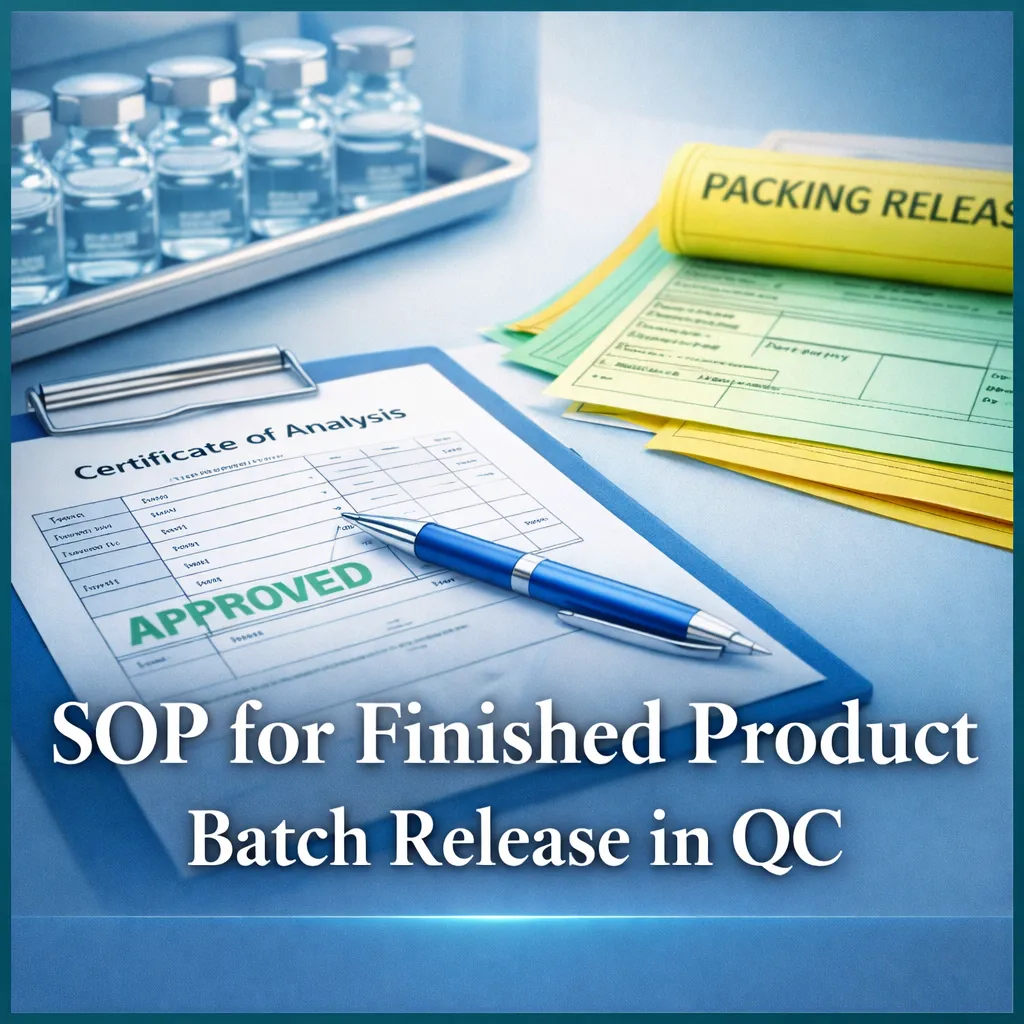

Learn SOP for finished product batch release after analysis in QC labs. Ensure compliance, accuracy, and smooth approval workflow.
Introduction
In pharmaceutical manufacturing, releasing a finished product batch is a critical step that ensures only compliant and high-quality products reach the market. The Quality Control (QC) department plays a vital role in verifying analytical results, documentation, and compliance before granting release.
This SOP provides a detailed, step-by-step guide for finished product batch release after completion of analysis, ensuring regulatory compliance, traceability, and product quality.
1.0 Objective
To define a standardized procedure for the release of finished products after completion of analytical testing.
2.0 Scope
This SOP applies to the release of all finished formulation products including tablets, capsules, parenterals, and contract manufacturing products.
3.0 Responsibility
- Doing: Technical Assistant / Executive / Manager
- Checking: Executive / Assistant Manager / Manager
4.0 Accountability
- Head of the Department
5.0 Step-by-Step SOP for Batch Release
5.1 Sample Receipt & QC Report Numbering
- Receive finished product sample with intimation slip from QA
- Assign QC Report Number based on coding system:
- X: Formulation type (T/C/P)
- Z: Serial number
- W: Location code
- Y: Batch number
- A: Lot number
5.2 Documentation & Sample Handling
- Enter details in respective registers (Tablet/Capsule/Parenteral)
- Place sample in “UNDER TEST SAMPLE” tray
5.3 Sample Distribution
- QC Incharge distributes samples to:
- Chemical section
- Instrument section
- Microbiology section
- Maintain protocol distribution records
5.4 Analysis & Data Recording
- Analyst performs testing as per specification and method
- Record results in:
- Data sheets
- SAP system
- If results are Out of Specification (OOS) → follow OOS SOP
5.5 Review & Approval
- QC Incharge reviews all test results
- Verify chemical, instrumental, and microbiological data
- Sign report if satisfactory
- Provide User Decision
5.6 Final Documentation & Release
- Enter results in register
- Prepare “Prior to Packing Release Slip” (triplicate)
- Yellow & Green → Production
- White → Attach with report
- Release product for packing
5.7 COA & QA Submission
- Prepare and verify Certificate of Analysis (COA)
- Send complete QC report to QA department
5.8 Export Product Handling
- Follow export-specific specifications
- Compare domestic vs export requirements
- Perform additional tests if required
- Issue Export Plan Slip
5.9 Sample Disposal
- Destroy samples as per SOP after testing completion
6.0 Abbreviations
- QC: Quality Control
- QA: Quality Assurance
- SOP: Standard Operating Procedure
- AR No.: Analytical Report Number
- MOA: Method of Analysis
- SAP: System Application Procedure
Safety & Compliance Precautions
- Ensure all data is verified before release
- Maintain traceability of samples and records
- Follow regulatory guidelines (GMP/GLP)
- Avoid unauthorized approvals
- Secure documentation and audit trails
Common Mistakes to Avoid
- Incorrect QC report numbering
- Missing documentation or signatures
- Ignoring OOS results
- Improper sample handling
- Delayed data entry in SAP
Best Practices
- Maintain clear documentation flow
- Perform cross-verification of results
- Use digital systems for traceability
- Conduct periodic audits
- Train staff on SOP compliance
FAQs (Frequently Asked Questions)
1. What is batch release in pharmaceutical QC?
It is the process of approving finished products after analysis.
2. What is QC report numbering?
A coding system used to track batch analysis records.
3. What happens if results are OOS?
Follow Out of Specification SOP for investigation.
4. What is a COA?
Certificate of Analysis confirming product quality.
5. Who approves batch release?
QC Incharge/Executive after verification.
6. What is the role of QA?
Final approval and compliance verification.
7. What is SAP used for?
Recording and managing analytical data.
8. Are export products handled differently?
Yes, based on country-specific requirements.
9. Why is documentation important?
For traceability, compliance, and audits.
10. What happens to samples after testing?
They are destroyed as per SOP.