


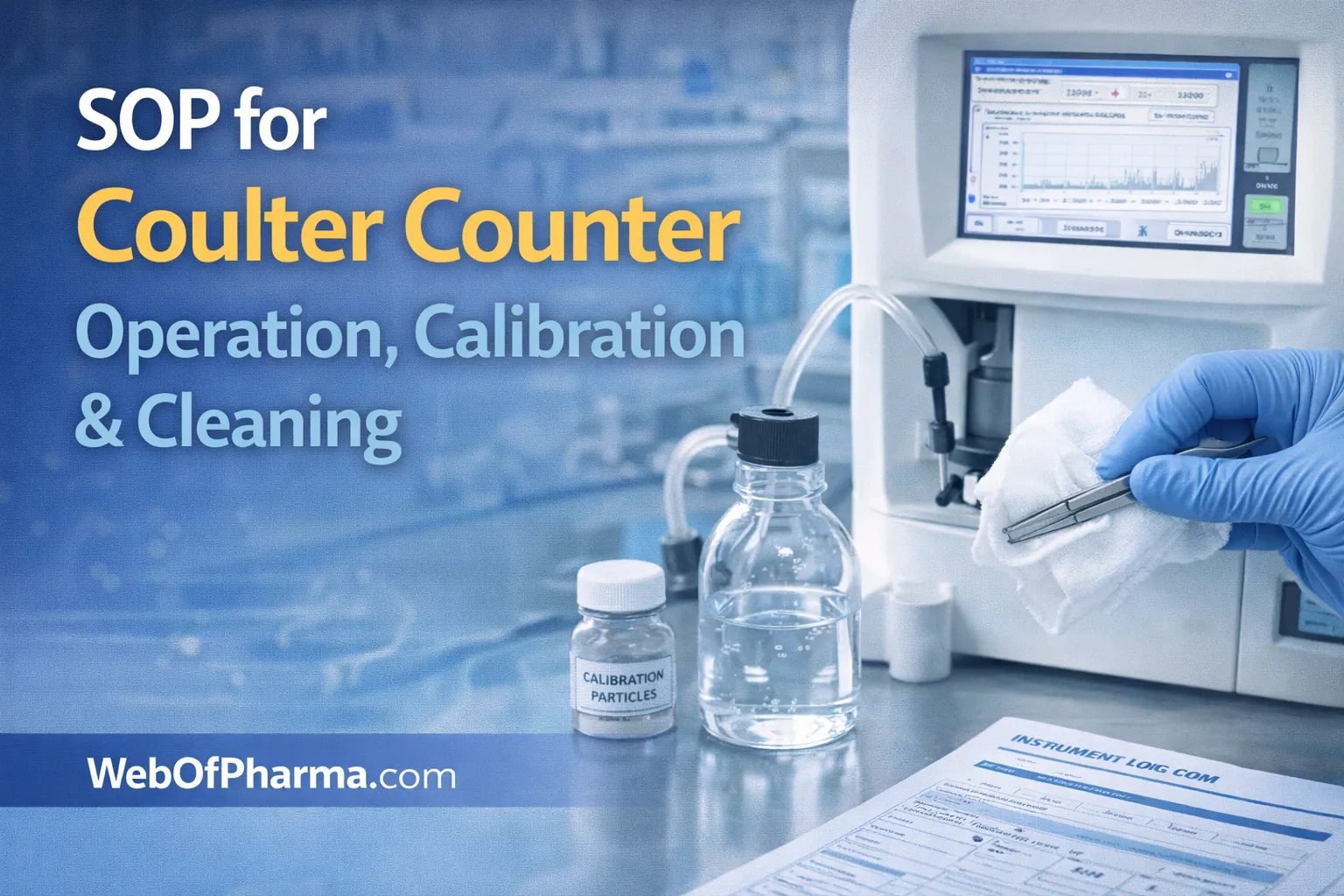

Learn SOP for Coulter Counter operation, calibration & cleaning. Ensure accurate particle counting.
In pharmaceutical quality control laboratories, precision and cleanliness are critical. Instruments like the Coulter Counter play a vital role in particle counting and size analysis. Therefore, following a proper SOP for Coulter Counter operation calibration and cleaning is essential to ensure accurate results and long-term equipment performance.
This guide provides a clear and practical SOP to help laboratory personnel operate, maintain, and clean the Coulter Counter effectively.
1. Objective of the SOP
The objective of this SOP is to:
- Ensure proper operation of the Coulter Counter
- Maintain accuracy in particle counting
- Define cleaning procedures to prevent contamination
- Extend instrument lifespan
2. Scope
This SOP applies to:
- Coulter Counter installed in the Quality Control (QC) department
- All personnel handling particle counting instruments
3. Roles and Responsibilities
3.1 Responsible Personnel
- Technical Assistant: Operates and cleans the instrument
- Executive/Manager: Verifies and monitors compliance
3.2 Accountability
- Head of Department: Ensures adherence to SOP
4. Overview of Coulter Counter
A Coulter Counter is used for:
- Particle counting
- Size distribution analysis
- Quality control of pharmaceutical products
👉 It works by detecting changes in electrical resistance caused by particles passing through an orifice.
5. Standard Operating Procedure
5.1 Operation Guidelines
- Ensure the instrument is properly set up
- Check that all components are clean and functional
- Load the sample into the sample holder
- Run analysis as per test requirements
👉 Always follow manufacturer guidelines for operation.
5.2 Calibration Procedure (General Guidelines)
Proper calibration ensures accuracy.
Steps:
- Use standard calibration particles
- Run calibration as per instrument manual
- Verify results against standard values
- Adjust settings if required
👉 Perform calibration regularly to maintain precision.
5.3 Cleaning Procedure
Cleaning is critical to avoid contamination and maintain accuracy.
Step-by-Step Cleaning Process
- Switch OFF the instrument after testing
- Switch OFF the mains power supply
- Open the instrument door
- Remove the sample holder
5.3.1 Cleaning of Sample Holder
- Wash with water
- Rinse with 0.2 µ filtered water
- Dry using tissue paper
5.3.2 Cleaning of Tubes and Waste Jar
- Clean with water
- Wipe with a cotton cloth
5.3.3 Cleaning of Orifice
- Remove the orifice carefully
- Wash with dilute nitric acid
- Rinse thoroughly with water
👉 This step ensures accurate particle detection.
5.3.4 External Cleaning
- Wipe outer surface with a clean cotton cloth
5.3.5 Internal Cleaning
- Fill vacuum flask with 0.2 µ filtered water for injection
- Pass through vacuum filling line
5.3.6 Documentation
- Record cleaning activity in instrument log card
👉 Documentation is essential for audit compliance.
6. Safety Precautions
- Always switch OFF power before cleaning
- Handle nitric acid with care
- Wear PPE (gloves, goggles, lab coat)
- Avoid damage to sensitive parts like orifice
7. Best Practices for Maintenance
- Clean instrument after every use
- Schedule periodic calibration
- Maintain cleaning logs
- Inspect parts regularly
- Train staff on proper handling
8. Common Mistakes to Avoid
- Skipping cleaning steps
- Improper handling of orifice
- Not recording cleaning activities
- Using unfiltered water
- Ignoring calibration
9. Benefits of Following This SOP
- Accurate and reliable test results
- Reduced contamination risks
- Extended equipment lifespan
- Improved compliance with GMP standards
- Better laboratory efficiency
10. Practical Example
👉 Example:
If the orifice is not cleaned properly, particle counts may be inaccurate, leading to incorrect quality decisions. Following SOP ensures consistent and reliable results.
FAQs
1. What is a Coulter Counter used for?
It is used for particle counting and size analysis in laboratories.
2. Why is cleaning important for Coulter Counter?
It prevents contamination and ensures accurate results.
3. What solution is used for cleaning the orifice?
Dilute nitric acid followed by water.
4. How often should the Coulter Counter be cleaned?
After every use.
5. What type of water is used for cleaning?
0.2 µ filtered water or water for injection.
6. Who is responsible for cleaning the instrument?
Technical assistants perform cleaning.
7. Why is calibration important?
It ensures accuracy and reliability of results.
8. What PPE should be used during cleaning?
Gloves, goggles, and lab coat.
9. What happens if cleaning is not recorded?
It may lead to audit non-compliance.
10. Can tap water be used for cleaning?
No, only filtered or purified water is recommended.
If you want, I can also design a realistic HD banner/thumbnail for this Coulter Counter SOP article to match your WebOfPharma branding.