


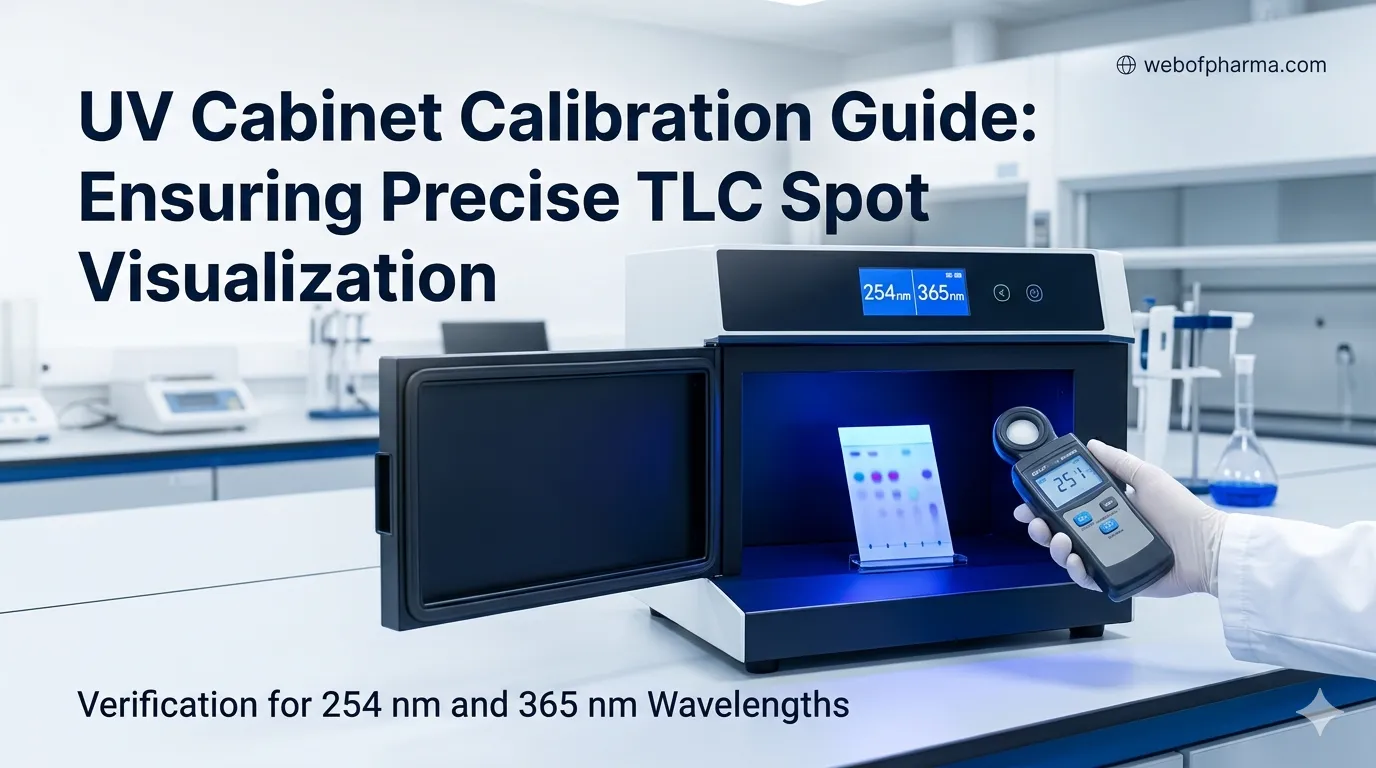

Learn how to correctly calibrate the UV Cabinet used to view the spots on Thin Layer Chromatographic (TLC) plate. Follow our detailed procedure for 254 nm and 365 nm lamps to ensure laboratory accuracy.
In the world of analytical chemistry, Thin Layer Chromatography (TLC) is a vital technique for identifying compounds. However, the reliability of your results depends heavily on the performance of your equipment. To maintain high standards, it is essential to regularly calibrate the UV Cabinet used to view the spots on Thin Layer Chromatographic (TLC) plate.
Without a properly calibrated lamp, faint spots might go unnoticed, leading to inaccurate purity assessments or failed identification tests. This guide provides a simple, standard procedure using Sodium Salicylate to verify that your UV cabinet is functioning within acceptable limits.
Calibration Procedure for 254 nm (Short-Wave) Lamp
The 254 nm wavelength is typically used to visualize spots on plates containing a fluorescent indicator (like Silica Gel GF254). Here is how to verify its intensity:
- Plate Selection: Use a pre-coated TLC plate with Silica Gel G as the coating substance.
- Solution Preparation: Prepare a 0.04% w/v solution of Sodium Salicylate in methanol.
- Calculation: Dissolve 40.0 mg of Sodium Salicylate in 100 ml of methanol.
- Application: Apply 5 µL (microliters) of this solution onto the plate.
- Drying: Allow the plate to dry naturally in the air.
- Observation: Place the dry plate into the UV chamber and select the 254 nm wavelength setting.
- Compliance Check: The lamp is considered compliant if a clear, distinct spot of approximately 5 mm in diameter is revealed.
Calibration Procedure for 365 nm (Long-Wave) Lamp
The 365 nm wavelength is often used to observe substances that naturally fluoresce. Because the sensitivity at this wavelength differs, a higher concentration of the test solution is required:
- Plate Selection: Again, select a pre-coated TLC plate with Silica Gel G.
- Solution Preparation: Prepare a 0.2% w/v solution of Sodium Salicylate in methanol.
- Calculation: Dissolve 200.0 mg of Sodium Salicylate in 100 ml of methanol.
- Application: Apply 5 µL of this solution onto the plate.
- Drying: Dry the plate in the air before placing it in the chamber.
- Observation: Switch the UV cabinet to the 365 nm wavelength setting.
- Compliance Check: The lamp complies if it reveals a clear spot with a diameter of about 5 mm.
Why Is This Calibration Necessary?
UV lamps lose intensity over time, even if they still appear to be “on.” This chemical test ensures that the radiation emitted is strong enough to trigger the fluorescence required for standard TLC analysis. If the 5 mm spot is blurry or invisible, it is time to replace the UV tubes.
Frequently Asked Questions (FAQ)
1. How often should I calibrate the UV cabinet? Most laboratories perform this calibration monthly or quarterly, depending on the frequency of use. It should also be done immediately after replacing the UV lamps.
2. Why use Sodium Salicylate for this test? Sodium Salicylate is a stable compound that fluoresces reliably under both short-wave and long-wave UV light, making it an ideal standard for intensity verification.
3. What happens if the spot diameter is less than 5 mm? If the spot is visible but smaller or very faint, the lamp intensity has likely degraded. The UV tubes should be replaced to ensure you don’t miss important data on your TLC plates.
4. Is 5 µL the same as 5 mL for application? In chromatography, we usually work with microliters (µL). While some older texts might use “mL” loosely, applying 5 milliliters would flood the plate. For a 5 mm spot, use a micro-pipette or capillary to apply 5 µL.
5. Can I use any TLC plate for calibration? It is best to use a standard Silica Gel G plate as specified in the pharmacopoeia to ensure the results are comparable to established standards.
6. Does the distance from the lamp affect the result? Yes. Always place the plate in the same position (usually the floor of the cabinet) as you would during a real analysis to ensure the calibration is relevant to your work.
7. Why is the concentration higher for the 365 nm test? Sodium Salicylate responds differently to different wavelengths. A concentration of 0.2% is required at 365 nm to achieve a visual response similar to the 0.04% concentration at 254 nm.
8. Do I need to wear protection while calibrating? Yes. While UV cabinets are shielded, ensure you do not look directly at the lamps if the safety curtain or door is open. UV radiation can cause “welder’s flash” or eye strain.
9. What should I do if the spot is not clear? Check if the plate is fully dry. Residual methanol can interfere with the spot’s appearance. If it’s still not clear after drying, the lamp is likely failing.
10. Are these procedures based on official standards? Yes, these procedures are generally aligned with the guidelines found in the Indian Pharmacopoeia (IP) and British Pharmacopoeia (BP) for the verification of UV lamps used in TLC.