


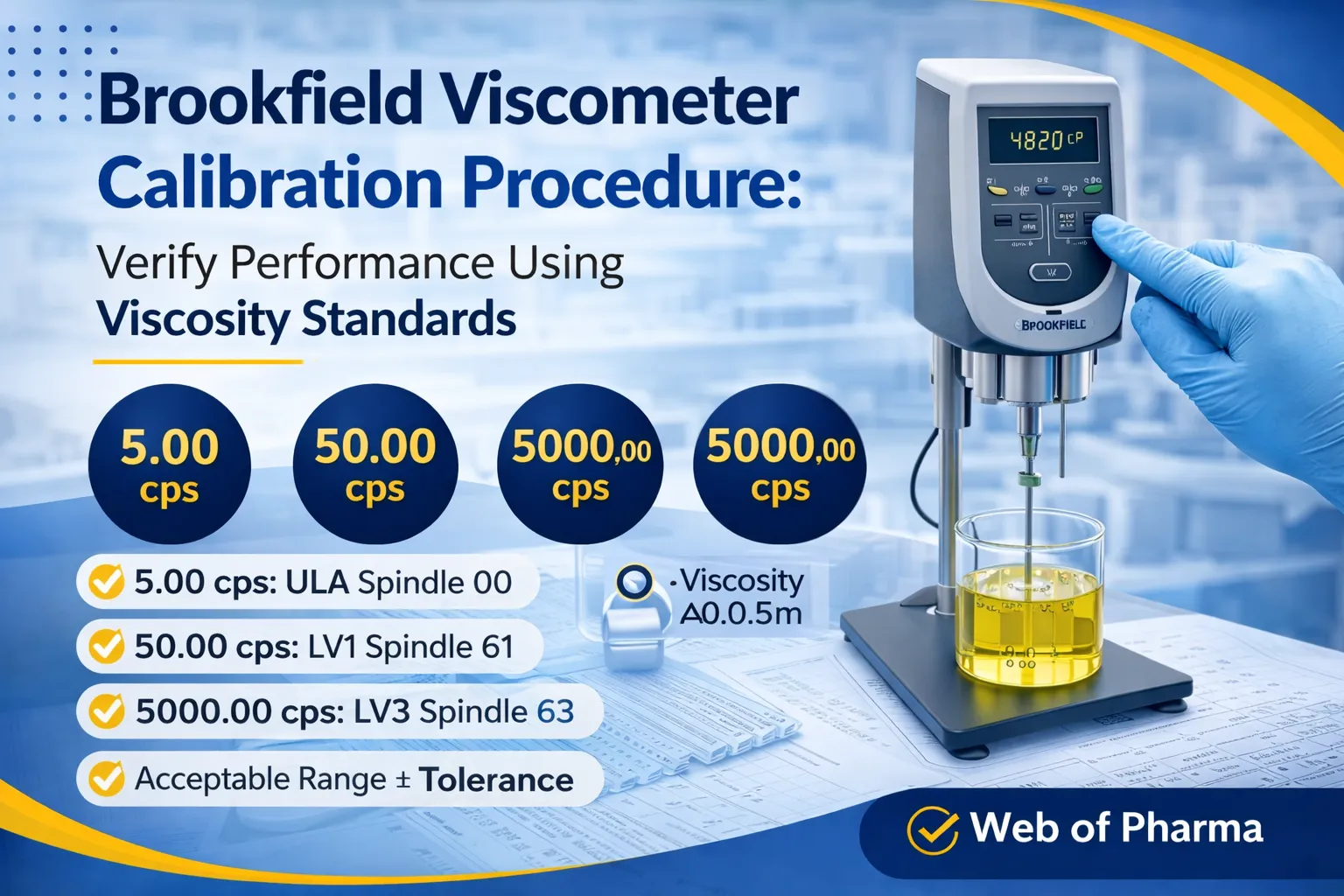

Learn how to verify the performance of Brookfield Viscometer using 5.00 cps, 50.00 cps and 5000.00 cps standards. Step-by-step calibration procedure, tolerance limits, and QA documentation.
In pharmaceutical quality control, viscosity measurement plays a vital role in ensuring product consistency and quality. This guide explains how to verify the performance of Brookfield Viscometer using 5.00 cps, 50.00 cps and 5000.00 cps standards, following a reliable SOP-based approach.
🎯 Purpose of Calibration
Calibration of a Brookfield Viscometer ensures:
- Accurate viscosity measurements
- Compliance with GMP and QA requirements
- Consistency in analytical results
- Detection of instrument deviations
⚙️ Pre-Calibration Checks
Before starting:
- Ensure all instrument connections are proper
- Switch ON the viscometer
- Use clean, contamination-free standard solutions
- Maintain temperature at 25°C
🧾 Calibration Procedure
- Take viscosity standard solutions in a 500 ml beaker.
- Adjust the temperature to 25°C.
- Attach the appropriate spindle.
- Set the required speed (RPM).
- Measure viscosity and record the stable (constant) reading.
📊 Viscosity Standards, Spindles & Acceptance Criteria
| Sr. No. | Std. Viscosity (cps) | Actual (cps) | Spindle | RPM | Acceptable Range (cps) |
|---|---|---|---|---|---|
| 1 | 5.00 | 4.70 | ULA (00) | 60 | 4.55 – 4.85 |
| 2 | 50.00 | 48.40 | LV1 (61) | 60 | 46.9 – 49.9 |
| 3 | 5000.00 | 4820.00 | LV3 (63) | 10 | 4651.83 – 4988.17 |
✅ Acceptance Criteria
- Observed viscosity must fall within the specified tolerance limits
- Results outside limits indicate calibration failure
⚠️ Precautions During Calibration
- Avoid contamination of standard solutions
- Do not return used solution to original container
- Prevent air bubble formation during transfer
- Ensure proper immersion of spindle
📅 Calibration Frequency
- Perform calibration once every 6 months
- Record results as per SOP requirements
📝 Calibration Record Requirements
The calibration report should include:
- Instrument details (Make, Model, Instrument No.)
- Standard viscosity values
- Observed readings
- Tolerance limits
- Remarks (Satisfactory / Not Satisfactory)
- Signatures (Done by / Checked by)
- Next calibration due date
🔧 Out-of-Calibration Handling
- If instrument fails:
- Label as “Out of Calibration”
- Send for servicing/repair
- After repair:
- Recalibrate before use
🧼 Maintenance Tips
- Clean spindles after each use
- Store instrument in dust-free environment
- Handle viscosity standards carefully
- Follow manufacturer’s instructions
✅ Conclusion
Regular calibration ensures that viscosity measurements remain accurate and reliable. Following this SOP to verify the performance of Brookfield Viscometer using 5.00 cps, 50.00 cps and 5000.00 cps standards is essential for maintaining product quality, regulatory compliance, and laboratory efficiency.
❓ Frequently Asked Questions (FAQs)
1. Why is Brookfield Viscometer calibration important?
It ensures accurate viscosity measurements critical for product quality.
2. Which standards are used for calibration?
5.00 cps, 50.00 cps, and 5000.00 cps viscosity standards are used.
3. What temperature is required during calibration?
Calibration should be performed at 25°C.
4. What happens if viscosity is outside limits?
The instrument is considered out of calibration and must be serviced.
5. Why should air bubbles be avoided?
Air bubbles can affect viscosity readings and lead to errors.
6. Can used viscosity standards be reused?
No, they should not be returned to the original container.
7. How often should calibration be performed?
Calibration should be done once every six months.
8. What is the role of spindle selection?
Different spindles are used for different viscosity ranges to ensure accuracy.
9. What is a stable reading?
A constant reading that does not fluctuate significantly over time.
10. Is recalibration required after servicing?
Yes, recalibration is mandatory before reuse.