




Learn the working principle of pH sensor electrode and pH meter used in quality control and manufacturing areas. Understand how pH measurement works, its importance in pharmaceuticals, and how electrodes generate accurate readings.
A pH meter is an essential analytical instrument used to determine the acidity or alkalinity of a solution. In pharmaceutical quality control and manufacturing areas, accurate pH measurement plays a critical role in ensuring product safety, stability, and compliance with regulatory standards.
The working principle of pH sensor electrode and pH meter used in quality control and manufacturing area is based on the measurement of hydrogen ion concentration in a solution.
What is pH?
pH is a measure of hydrogen ion (H⁺) concentration in a solution. It indicates whether a solution is acidic, neutral, or alkaline:
- pH < 7 → Acidic solution
- pH = 7 → Neutral solution (e.g., pure water)
- pH > 7 → Alkaline (basic) solution
The pH scale ranges from 1 to 14:
- pH 1 → Highly acidic
- pH 14 → Highly alkaline
The acidity depends on hydrogen ions (H⁺), while alkalinity depends on hydroxyl ions (OH⁻).
Importance of pH Meter in Pharmaceuticals
In pharmaceutical manufacturing and quality control laboratories, pH meters are widely used because they provide:
- High accuracy compared to pH strips
- Real-time digital readings
- Better reproducibility
- Compliance with GMP requirements
pH measurement is crucial for:
- Drug formulation stability
- Buffer preparation
- Raw material testing
- Finished product quality control
Components of a pH Meter
A pH meter consists of two main parts:
1. pH Probe (Electrode System)
The probe includes:
- Glass (sensor) electrode
- Reference electrode
2. pH Meter Device
- Converts electrical signals into pH values
- Displays the result digitally
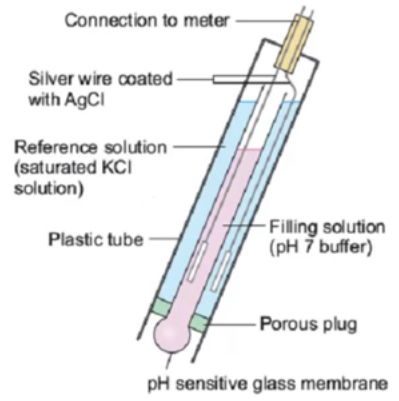
Structure of pH Sensor Electrode
The glass pH probe contains two electrodes enclosed in glass tubes:
Sensor Electrode
- Contains a pH 7 buffer solution
- Has a thin, permeable glass membrane
- Coated with silica and metal salts
- Includes a silver wire coated with silver chloride
Reference Electrode
- Contains saturated potassium chloride (KCl) solution
- Includes a silver/silver chloride wire
- Provides a stable reference potential
Working Principle of pH Sensor Electrode and pH Meter
The working principle of pH sensor electrode and pH meter used in quality control and manufacturing area is based on electrochemical potential difference.
Step-by-Step Working:
- When the pH probe is immersed in a solution, hydrogen ions (H⁺) interact with the glass membrane of the sensor electrode.
- Hydrogen ions accumulate on the outer surface of the glass bulb and replace metal ions present in the membrane.
- This ion exchange generates an electrical potential (voltage).
- The internal solution (pH 7 buffer) maintains a constant potential inside the electrode.
- The reference electrode provides a stable comparison point.
- The pH meter measures the voltage difference between the sensor and reference electrodes.
- This voltage is converted into a pH value and displayed on the meter.
Effect of Acidity and Alkalinity on pH Measurement
- Increase in acidity (more H⁺ ions):
- Increases voltage
- Results in lower pH value
- Increase in alkalinity (more OH⁻ ions):
- Decreases hydrogen ion concentration
- Reduces voltage
- Results in higher pH value
Role of Glass Membrane
The glass membrane is the most critical part of the electrode:
- Allows selective movement of hydrogen ions
- Facilitates ion exchange between sample and internal buffer
- Generates measurable electrical potential
However, with continuous use:
- The membrane becomes less porous
- Sensitivity decreases
- Accuracy may be affected
Proper maintenance and calibration are essential to ensure reliable performance.
Conclusion
The working principle of pH sensor electrode and pH meter used in quality control and manufacturing area relies on the electrochemical interaction between hydrogen ions and a glass membrane, producing a voltage that is converted into pH.
Due to its precision and reliability, the pH meter is an indispensable tool in pharmaceutical environments, ensuring consistent product quality and regulatory compliance.
Frequently Asked Questions (FAQs)
1. What is the working principle of a pH meter?
A pH meter works by measuring the voltage generated from hydrogen ion exchange at the glass electrode and converting it into a pH value.
2. Why is a pH meter more accurate than pH strips?
pH meters provide digital readings based on electrochemical signals, whereas strips rely on color comparison, which can be subjective.
3. What are the main components of a pH electrode?
A pH electrode consists of a glass (sensor) electrode and a reference electrode.
4. What is the role of the reference electrode?
It provides a stable reference potential to accurately measure voltage differences.
5. How does hydrogen ion concentration affect pH?
Higher hydrogen ion concentration lowers pH (acidic), while lower concentration increases pH (alkaline).
6. Why is calibration important for pH meters?
Calibration ensures accuracy by aligning the meter with standard buffer solutions.
7. What happens if the glass membrane becomes damaged?
It reduces sensitivity and accuracy, leading to unreliable pH readings.
8. What is the function of potassium chloride in the electrode?
It maintains a stable ionic environment in the reference electrode.
9. Where are pH meters used in pharmaceuticals?
They are used in formulation, quality control, raw material testing, and stability studies.
10. How does temperature affect pH measurement?
Temperature can influence electrode response and solution chemistry, so compensation is often required.