


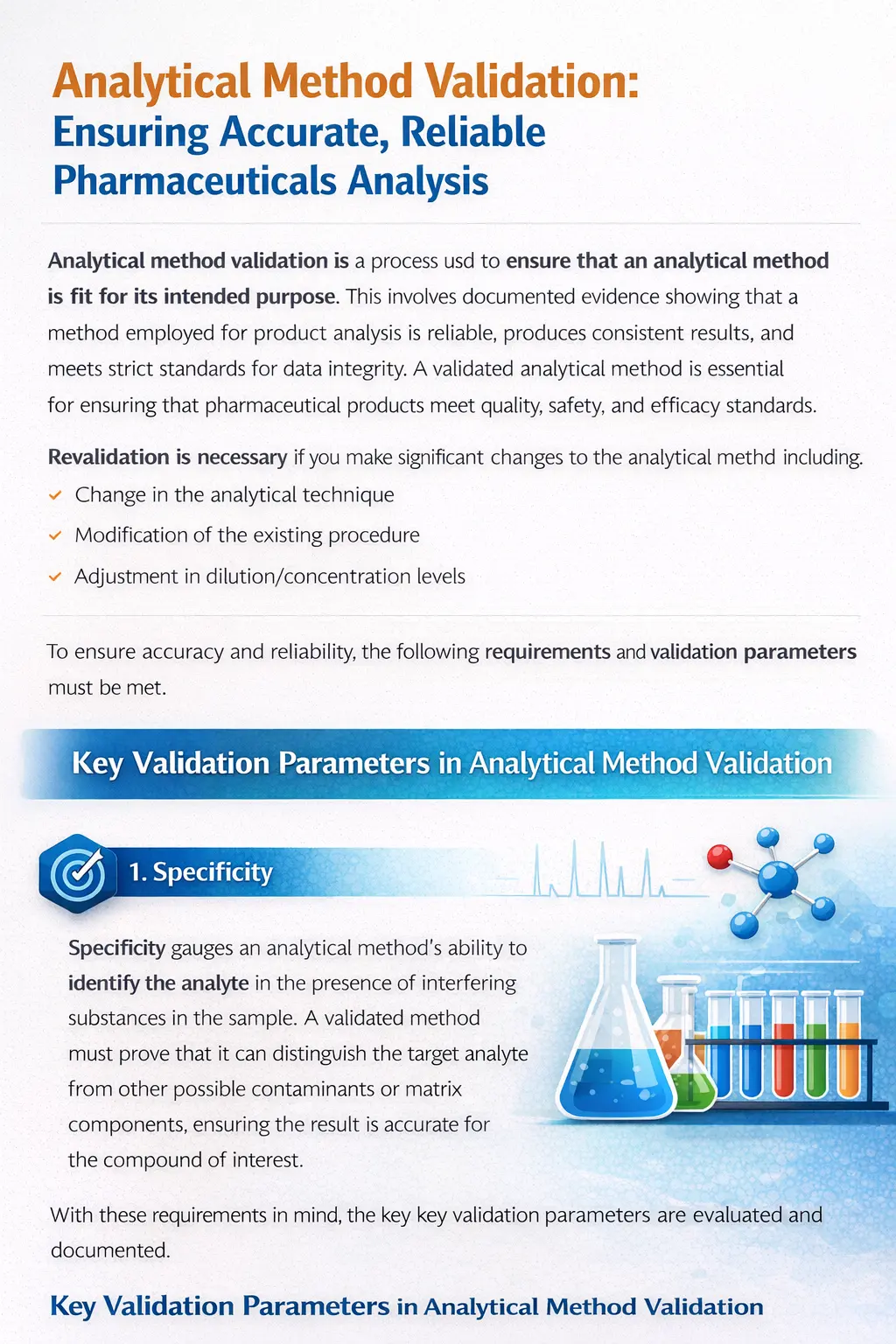

Learn why analytical method validation is a process used to ensure that an analytical method is fit for its intended purpose. Understand validation parameters, regulatory requirements, and benefits for pharmaceutical quality and compliance.
Analytical method validation is a process used to ensure that an analytical method is fit for its intended purpose. It provides documented evidence that any analytical method used for the analysis of pharmaceutical products is suitable, reliable, and capable of producing consistent and accurate results.
In the pharmaceutical industry, validated analytical methods are essential before routine testing of raw materials, intermediates, finished products, and stability samples. A properly validated method ensures data integrity, regulatory compliance, product quality, and patient safety.
Simply put, a validated analytical method produces reliable, reproducible, and scientifically sound results that can be trusted during regulatory inspections and audits.
When is Revalidation of an Analytical Method Required?
Revalidation becomes necessary whenever significant changes occur that may affect method performance. These changes include:
- Change in analytical technique
- Modification in existing procedure
- Change in dilution or concentration
- Change in instrumentation
- Change in formulation or matrix
- Change in sample preparation method
- Transfer of method to another laboratory
Revalidation ensures that the method continues to perform reliably under new conditions.
Requirements of Analytical Method Validation
Before starting analytical method validation, several critical requirements must be defined to ensure accurate and reliable results.
These include:
- Details of components to be detected and quantified
- Expected concentration range of the sample
- Required accuracy and precision
- Analytical technique to be used
- Materials and equipment required
- Sample preparation method
- Acceptance criteria
- Estimated cost of analysis
Proper planning at this stage reduces errors, saves time, and ensures regulatory compliance.
Key Parameters of Analytical Method Validation
Analytical method validation involves evaluating specific performance characteristics to confirm method reliability. These parameters are defined in international regulatory guidelines such as ICH Q2 (R1).
1. Specificity
Specificity is the ability of the analytical method to accurately detect the target analyte in the presence of impurities, degradation products, excipients, or other interfering substances.
This parameter demonstrates that the method measures only the intended compound without interference.
Specificity ensures:
- Accurate identification of analyte
- Reliable impurity detection
- Method selectivity
2. Linearity
Linearity refers to the ability of the analytical method to produce results that are directly proportional to the concentration of the analyte within a given range.
Typically:
- At least 5 concentration levels are tested
- A calibration curve is plotted
- The correlation coefficient (R²) is evaluated
A linear response confirms consistent detector performance across concentration levels.
3. Range
The range is the interval between the highest and lowest concentration levels of the analyte that can be measured accurately and precisely.
The method should:
- Detect very low concentrations
- Measure high concentrations reliably
- Maintain accuracy throughout the range
4. Accuracy
Accuracy represents how close the measured value is to the true or theoretical value of the analyte.
It is typically determined using:
- Percent recovery studies
- Standard reference materials
- Spiked sample analysis
High accuracy indicates reliable analytical performance.
5. Limit of Detection (LOD)
The Limit of Detection (LOD) is the lowest concentration of an analyte that can be detected but not necessarily quantified.
LOD is important for:
- Impurity testing
- Residual solvent analysis
- Trace-level detection
6. Limit of Quantification (LOQ)
The Limit of Quantification (LOQ) is the lowest concentration of an analyte that can be measured quantitatively with acceptable accuracy and precision.
LOQ ensures:
- Reliable quantitative analysis
- Regulatory compliance
- Consistent product quality
7. Robustness
Robustness measures the ability of an analytical method to remain unaffected by small, deliberate variations in method parameters.
Examples of variations tested:
- pH changes
- Flow rate variations
- Temperature fluctuations
- Mobile phase composition
A robust method produces consistent results under routine laboratory conditions.
Factors Affecting Analytical Results in Pharmaceutical Analysis
Several operational and environmental factors can influence analytical performance. Controlling these variables is essential to maintain data reliability.
Common factors include:
- Type of chromatographic column used
- pH value of the sample
- Composition of the mobile phase
- Sample flow rate
- Column oven temperature
- Buffer composition
- Instrument calibration status
- Analyst technique
Understanding these factors helps maintain consistent analytical results.
Why is Analytical Method Validation Required?
Analytical method validation is a regulatory and scientific requirement in pharmaceutical manufacturing. It ensures that analytical data is accurate, reliable, and suitable for decision-making.
1. Regulatory Compliance
Analytical method validation is a mandatory requirement under:
- GMP (Good Manufacturing Practices)
- ICH Guidelines
- FDA Regulations
- WHO Guidelines
- EU GMP
Regulatory authorities require validated methods before approving pharmaceutical products for market release.
2. Increased Operational Efficiency
Validated methods improve laboratory efficiency because:
- Procedures are standardized
- Parameters are predefined
- Troubleshooting is reduced
- Testing time is minimized
This leads to faster analysis and improved productivity.
3. Improved Data Accuracy and Reliability
Validated analytical methods produce:
- Accurate results
- Reproducible data
- Reliable test outcomes
- Consistent quality measurements
Reliable data supports regulatory decisions and product release.
4. Enhanced Customer and Patient Confidence
High-quality analytical testing leads to:
- Safer pharmaceutical products
- Reduced product complaints
- Improved product consistency
- Increased customer satisfaction
Ultimately, method validation protects patient health and company reputation.
Conclusion
Analytical method validation is a critical component of pharmaceutical quality systems. Since analytical method validation is a process used to ensure that an analytical method is fit for its intended purpose, it plays a central role in maintaining product quality, regulatory compliance, and data integrity.
A well-validated method ensures accurate testing, reliable results, and consistent pharmaceutical performance, making it an essential requirement for every pharmaceutical laboratory and manufacturing facility.
Frequently Asked Questions (FAQs)
1. What is analytical method validation?
Analytical method validation is the process of confirming that an analytical method consistently produces accurate, reliable, and reproducible results for its intended use.
2. Why is analytical method validation required in pharmaceuticals?
It is required to ensure product quality, regulatory compliance, data integrity, and patient safety.
3. What guideline is commonly used for analytical method validation?
The most widely used guideline is ICH Q2 (R1) for validation of analytical procedures.
4. When is analytical method revalidation required?
Revalidation is required when there are changes in:
- Analytical method
- Instrumentation
- Formulation
- Sample preparation
- Laboratory location
5. What are the main parameters of analytical method validation?
The main parameters include:
- Specificity
- Linearity
- Accuracy
- Precision
- Range
- LOD
- LOQ
- Robustness
6. What is the difference between LOD and LOQ?
LOD is the lowest concentration that can be detected, while LOQ is the lowest concentration that can be quantified accurately and precisely.
7. What is robustness in analytical method validation?
Robustness measures the reliability of the method when small changes are made to testing conditions.
8. How many concentrations are typically used in linearity studies?
Usually, five concentration levels are used to evaluate linearity in analytical method validation.
9. Who requires analytical method validation?
Regulatory authorities such as:
- FDA
- EMA
- WHO
- National regulatory agencies
require validation before routine product testing.
10. What is the main objective of analytical method validation?
The main objective is to ensure that the analytical method produces accurate, reliable, and consistent results suitable for its intended purpose.