


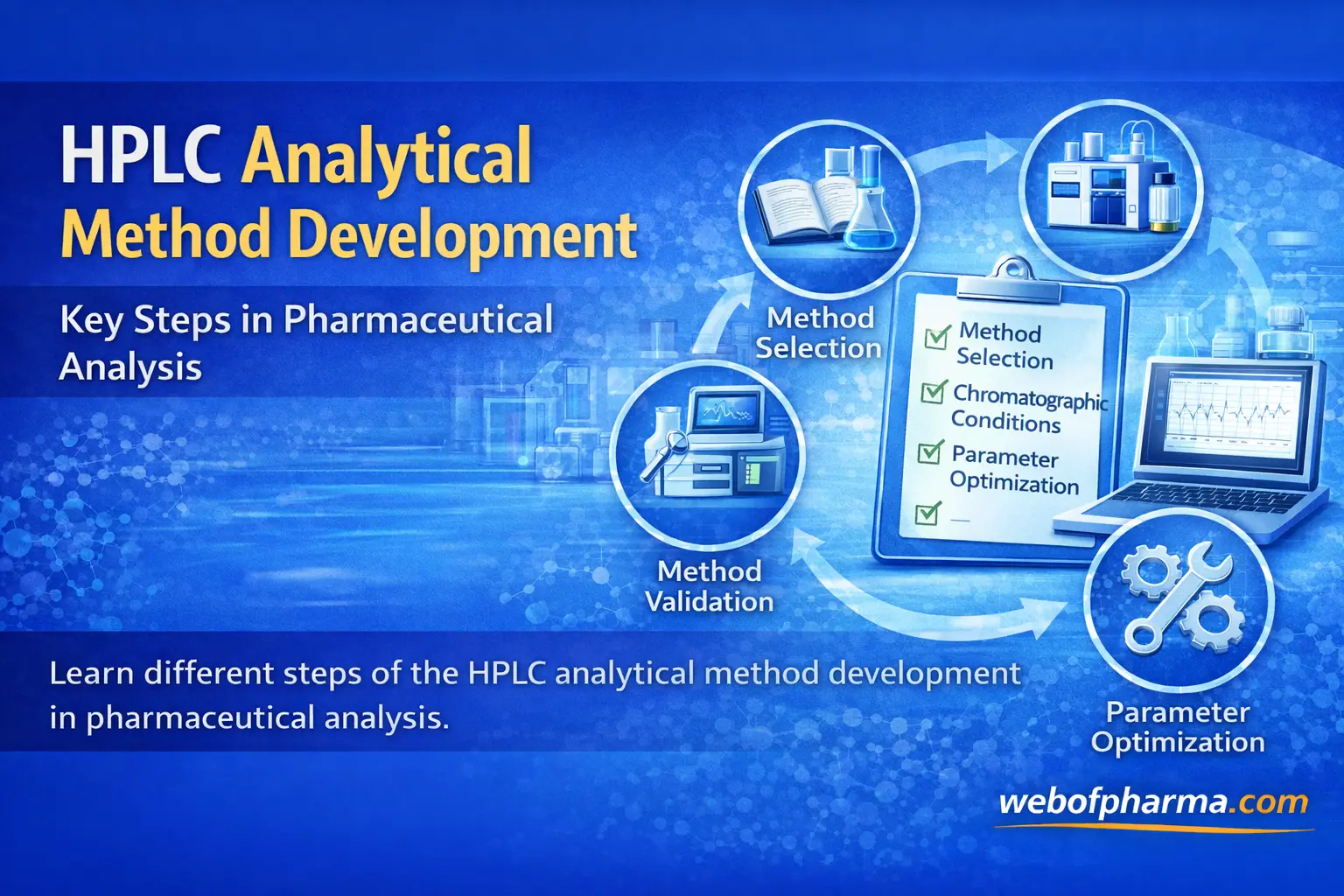

Learn the different steps of the HPLC analytical method development in pharmaceutical analysis. Explore method selection, chromatographic conditions, optimization, and validation for accurate results.
Analytical method development is a critical part of pharmaceutical research and quality control. A well-developed HPLC method ensures accurate, reliable, and reproducible results, which are essential for drug safety and regulatory compliance.
Due to the availability of multiple columns, mobile phase compositions, pH conditions, and operating parameters, method development can be complex. However, by following a structured approach, the different steps of the HPLC analytical method development in pharmaceutical analysis can be carried out efficiently.
Overview of HPLC Method Development Steps
The process of HPLC method development generally involves three key stages:
- Selection of HPLC Analytical Method
- Selection of Chromatographic Conditions
- Parameter Optimization
1. Selection of HPLC Analytical Method
The first step is to understand the physicochemical properties of the analyte by reviewing available literature. This helps in selecting suitable analytical conditions.
A. Sample Preparation
Sample preparation should be based on:
- Solubility of the analyte
- Filtration requirements
- Extraction procedures
- Removal of interfering substances
A clear and stable sample solution is essential for accurate HPLC analysis.
B. Selection of Chromatography Type
Choosing the right chromatographic technique is crucial:
- Reverse Phase (RP-HPLC): Most widely used; ideal for non-polar to moderately polar compounds
- Ion Suppression/Ion Pairing: Used for acidic or basic compounds
- Normal Phase: Suitable for low to medium polarity analytes and isomer separation
- Ion Exchange Chromatography: Best for charged molecules (anions/cations)
- Size Exclusion Chromatography: Used for high molecular weight compounds
Typically, a C18 column is the first choice in pharmaceutical analysis.
C. Gradient vs Isocratic Elution
- Gradient HPLC: Suitable for complex mixtures; provides better resolution and sensitivity
- Isocratic HPLC: Suitable for simple mixtures; uses constant mobile phase composition
D. Column Selection
- Column length: 100–150 mm (commonly used)
- Particle size: 3–5 µm
- Flow rate: 1–1.5 mL/min (initial setting)
Shorter columns reduce run time, while longer columns improve separation for complex samples.
E. Detector Selection
- UV Detector: Most commonly used (preferred choice)
- Fluorescence Detector: For trace-level analysis
- Electrochemical Detector: For specific compounds
- Refractive Index Detector: For high concentration samples
F. Wavelength Selection
- Use λmax of analyte for maximum sensitivity
- Prefer wavelengths above 200 nm to reduce noise
- Avoid lower wavelengths due to baseline instability
2. Selection of Chromatographic Conditions
After selecting the method, chromatographic parameters are optimized to achieve proper separation.
Key Factors:
- Mobile Phase Composition: Controls retention time and resolution
- pH of Mobile Phase: Affects ionization and peak shape
- Ion Pairing Reagents: Used for better separation of ionic compounds
- Flow Rate: Influences analysis time and peak resolution
For complex samples, gradient elution is preferred to avoid long retention times.
3. Parameter Optimization
This step ensures the method delivers the best performance.
Parameters to Optimize:
- Column dimensions
- Particle size
- Flow rate
- Run time
- Mobile phase ratio
The goal is to achieve:
- Sharp and well-resolved peaks
- Short analysis time
- High reproducibility
Method Validation: Final Step
After optimization, the method must be validated according to regulatory guidelines (ICH, FDA, etc.).
Validation ensures:
- Accuracy
- Precision
- Specificity
- Linearity
- Robustness
Analytical method validation is now mandatory in pharmaceutical industries.
Conclusion
Understanding the different steps of the HPLC analytical method development in pharmaceutical analysis is essential for developing robust and reliable analytical procedures. From method selection to optimization and validation, each step plays a vital role in ensuring high-quality pharmaceutical analysis.
A systematic and scientific approach not only improves method efficiency but also ensures regulatory compliance and product safety.
Frequently Asked Questions (FAQs)
1. What is HPLC method development?
It is the process of designing analytical procedures to accurately analyze pharmaceutical compounds.
2. What are the main steps in HPLC method development?
Method selection, chromatographic condition selection, and parameter optimization.
3. Why is sample preparation important?
It ensures accurate and interference-free analysis.
4. What is the most commonly used HPLC method?
Reverse phase HPLC (RP-HPLC).
5. What is the difference between gradient and isocratic HPLC?
Gradient uses varying mobile phase composition, while isocratic uses constant composition.
6. Why is a C18 column widely used?
It provides good separation for a wide range of compounds.
7. How is wavelength selected in HPLC?
Based on λmax of the analyte for maximum sensitivity.
8. What is parameter optimization?
Adjusting conditions to achieve the best resolution and shortest run time.
9. Why is method validation required?
To ensure reliability and compliance with regulatory standards.
10. What factors affect retention time in HPLC?
Mobile phase composition, pH, flow rate, and column properties.