


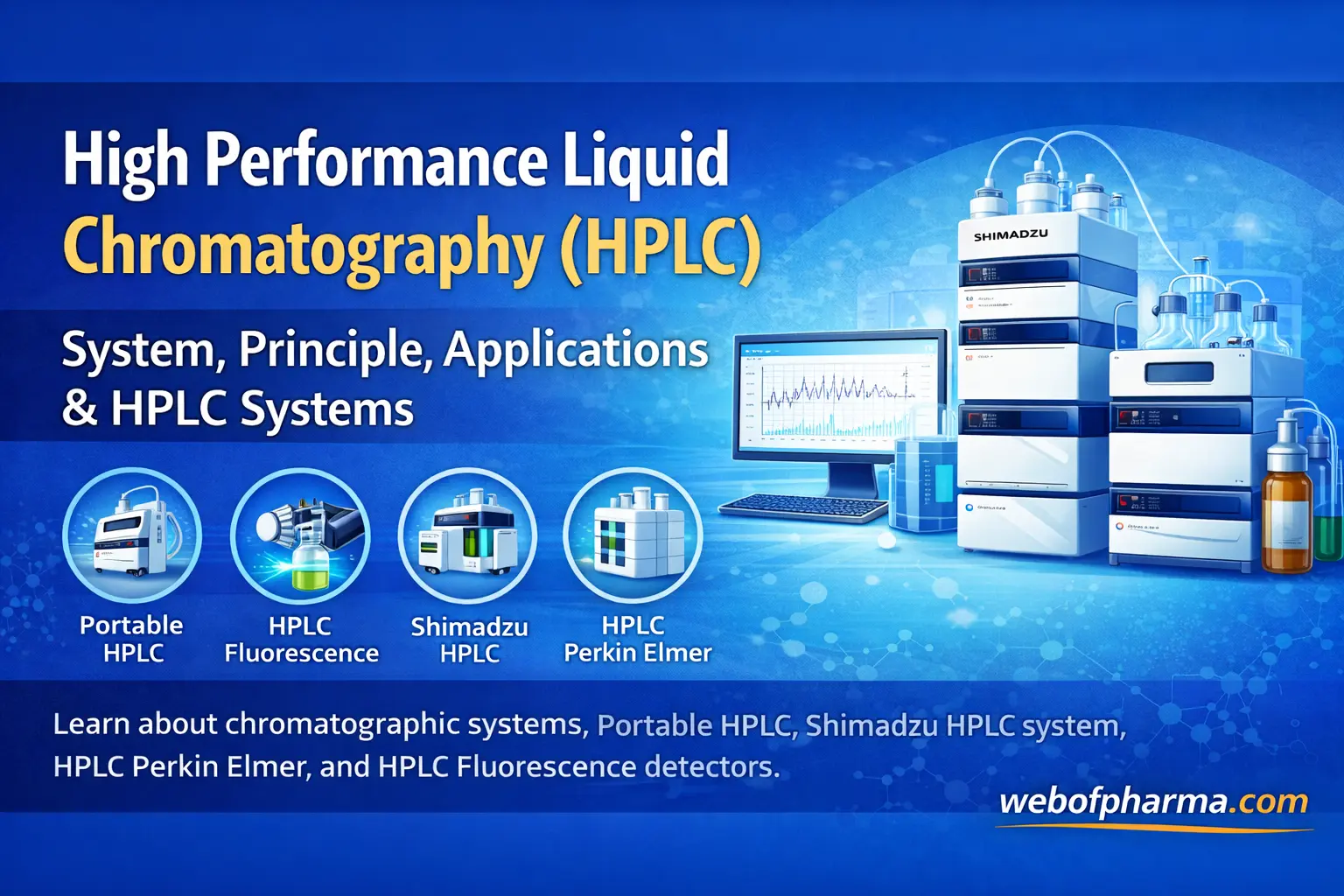

Learn about chromatographic system design, portable HPLC, Shimadzu HPLC system, HPLC Perkin Elmer, and HPLC fluorescence detectors. A complete guide to high performance liquid chromatography system, working, and applications.
High Performance Liquid Chromatography (HPLC) is one of the most powerful analytical techniques used in pharmaceutical, chemical, and food industries. Its ability to separate, identify, and quantify complex mixtures makes it an essential chromatographic system in modern laboratories.
With advancements such as the portable HPLC, Shimadzu HPLC system, and HPLC Perkin Elmer instruments, this technology continues to evolve, offering improved precision, automation, and efficiency.
What is a High Performance Liquid Chromatography System?
A high performance liquid chromatography system is an advanced form of column chromatography that uses high pressure to separate components in a mixture. The sample is passed through a column packed with a stationary phase, where different compounds interact differently and get separated.
Each compound elutes at a specific time, allowing accurate identification and quantification.
Key Components of an HPLC System
A typical chromatographic system consists of the following components:
- Solvent Reservoir: Holds the mobile phase (e.g., water, methanol, acetonitrile)
- Pump: Delivers mobile phase at high pressure
- Injector: Introduces the sample into the system (manual or auto-injector)
- Column: The heart of the system where separation occurs
- Detector: Detects separated compounds (e.g., UV, HPLC fluorescence)
- Data System: Software that records and processes chromatograms
Modern systems like the Shimadzu HPLC system and HPLC Perkin Elmer platforms integrate advanced software for better control and compliance.
Principle of HPLC
The working principle of HPLC is based on the differential interaction of compounds between the mobile phase and stationary phase.
- Compounds with stronger interaction with the stationary phase elute later
- Compounds with weaker interaction elute earlier
Mechanical pumps ensure a constant flow, while detectors measure compound concentration. In advanced setups, HPLC fluorescence detectors provide high sensitivity for trace-level analysis.
Retention Time: The Key Parameter
Retention time is the time a compound takes to pass through the column and reach the detector. It is unique for each compound under fixed conditions and is used for identification and comparison.
Types of HPLC Systems
Different separation mechanisms define various types of HPLC systems:
1. Normal Phase HPLC
- Polar stationary phase (silica)
- Non-polar mobile phase
- Suitable for polar compounds
2. Reverse Phase HPLC
- Non-polar stationary phase (C18, C8)
- Polar mobile phase
- Most widely used in pharmaceuticals
3. Ion Exchange HPLC
- Separates compounds based on charge
- Used for proteins and biomolecules
4. Size Exclusion HPLC
- Separates based on molecular size
- Used for polymers and large biomolecules
Types of HPLC Detectors
Detector selection depends on the nature of the analyte:
- UV-Visible Detector: Most common in pharmaceutical analysis
- Refractive Index Detector: Measures refractive index changes
- Fluorescence Detector (HPLC Fluorescence): Highly sensitive for specific compounds
- Conductivity Detector: Used for ionic species
- Mass Spectrometry Detector: Advanced and highly specific
Applications of HPLC
HPLC is widely used across industries:
1. Pharmaceutical Industry
- Drug assay and content uniformity
- Dissolution and stability studies
- Impurity profiling
2. Environmental Analysis
- Detection of pollutants and pesticides
3. Food and Beverage Industry
- Analysis of additives, preservatives, and nutrients
4. Clinical and Forensic Science
- Drug testing and toxicology analysis
Portable innovations like portable HPLC systems are now enabling on-site testing and faster decision-making.
Advantages of HPLC
- High accuracy and precision
- Excellent sensitivity and resolution
- Automation and reproducibility
- Wide applicability across industries
Limitations of HPLC
- High initial investment (e.g., Shimadzu HPLC system, HPLC Perkin Elmer)
- Requires trained personnel
- Not suitable for highly volatile compounds
- Time-consuming maintenance
Conclusion
The high performance liquid chromatography system remains a cornerstone of analytical science. With continuous advancements such as portable HPLC, HPLC fluorescence detection, and modern platforms like the Shimadzu HPLC system and HPLC Perkin Elmer, laboratories can achieve faster, more reliable, and highly sensitive analysis.
Understanding the principles, components, and applications of this chromatographic system is essential for professionals working in pharmaceuticals and related industries.
Frequently Asked Questions (FAQs)
1. What is HPLC used for?
HPLC is used to separate, identify, and quantify components in complex mixtures.
2. What is a chromatographic system?
It is a system used to separate chemical compounds based on their interactions with stationary and mobile phases.
3. What is the principle of HPLC?
Separation is based on differential interaction of compounds with stationary and mobile phases.
4. What is retention time in HPLC?
It is the time taken by a compound to elute from the column and reach the detector.
5. What is a portable HPLC system?
A compact HPLC system designed for field or on-site analysis.
6. What are common HPLC detectors?
UV, fluorescence, refractive index, conductivity, and mass spectrometry detectors.
7. What is HPLC fluorescence detection?
A sensitive detection method for compounds that emit fluorescence.
8. Which companies manufacture HPLC systems?
Popular systems include Shimadzu HPLC system and HPLC Perkin Elmer instruments.
9. What are common mobile phases in HPLC?
Water, methanol, acetonitrile, and buffer solutions.
10. What are the limitations of HPLC?
High cost, maintenance requirements, and need for skilled operators.