


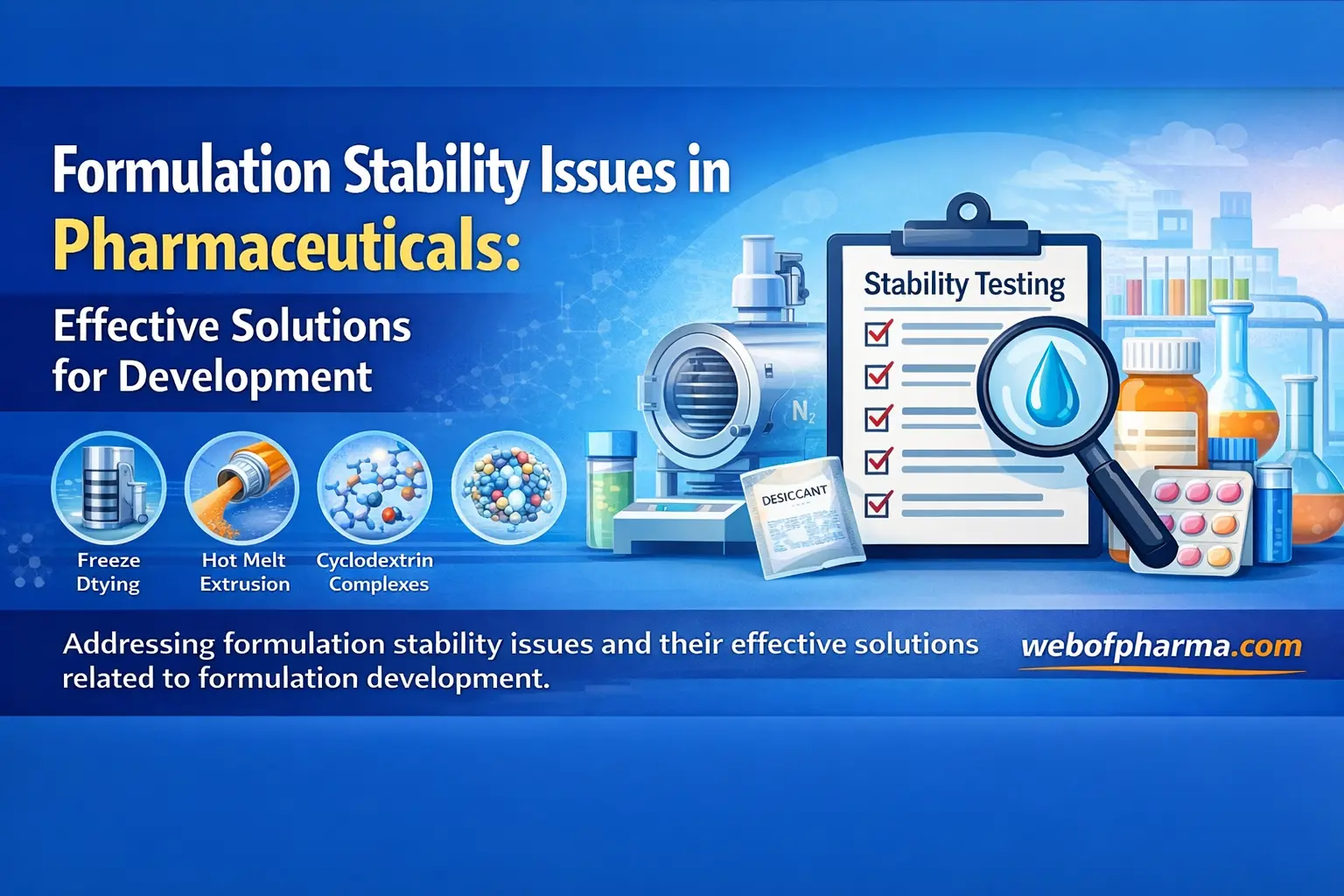

Learn how formulation stability issues and their effective solutions related to formulation development impact drug safety. Explore causes, stability strategies, excipient selection, packaging, and advanced techniques.
The stability of pharmaceutical products is a critical factor that directly impacts drug safety, efficacy, and shelf life. An unstable formulation can degrade over time, producing harmful byproducts that may compromise patient health.
That’s why formulation stability issues and their effective solutions related to formulation development are a major focus throughout the pharmaceutical product lifecycle. From early-stage research to final packaging, stability testing ensures that products remain safe and effective under defined conditions.
Understanding the Root Causes of Formulation Instability
Identifying the root cause of instability is often complex because multiple factors can influence drug degradation. These factors are broadly categorized into environmental and formulation-related causes.
A. Environmental Factors Affecting Stability
- Temperature
Elevated temperatures accelerate chemical reactions, leading to degradation and impurity formation. - Moisture
High humidity can cause hydrolysis, resulting in breakdown products that may be unsafe. - Light
Exposure to light, especially UV radiation, can trigger photolysis and oxidation reactions. - Oxygen
Oxygen present in air reacts with susceptible ingredients, leading to oxidative degradation.
B. Drug and Formulation-Related Factors
- Drug Impurities
Impurities can catalyze degradation reactions, reducing product stability. - Drug–Excipient Interaction
Incompatibility between API and excipients can lead to chemical instability. - Packaging Interaction
Inappropriate packaging may allow moisture or oxygen ingress, accelerating degradation.
Role of Pre-Formulation Studies
During formulation development, pre-formulation studies help identify and mitigate stability risks. These include:
- pH stability studies
- Solubility profiling
- Thermal stability testing
- Photostability studies
- Drug–excipient compatibility testing
These evaluations are essential for addressing formulation stability issues and their effective solutions related to formulation development early in the process.
Formulation Optimization and Excipient Selection
Once instability causes are identified, formulation optimization strategies are applied.
Key Approaches:
- Buffers: Maintain optimal pH (e.g., citrate, acetate, phosphate buffers)
- Chelators (Antioxidants): Prevent oxidation (e.g., EDTA)
- Stabilizers: Improve solubility and stability (e.g., HPMC, PVP)
- Desiccants: Control moisture in packaging
Sometimes, stability improvement requires changing:
- API salt form (e.g., sulfate to acetate)
- Excipient type
- Dosage form
Improving Packaging and Storage Conditions
Packaging plays a crucial role in protecting formulations from environmental stress.
Effective Packaging Strategies:
- Inert Packaging: Nitrogen flushing to prevent oxidation
- Light-Resistant Containers: Amber glass or UV-protected plastics
- Moisture-Proof Packaging: Alu-alu blisters and desiccant-containing bottles
- Single-Dose Packaging: Minimizes repeated environmental exposure
Analytical Techniques for Stability Assessment
Reliable analytical methods are essential to detect degradation and validate stability improvements.
- HPLC: Identifies and quantifies degradation products
- UV Spectrophotometry: Assesses photostability
- Karl Fischer Titration: Measures moisture content
- Thermal Analysis (DSC/TGA): Evaluates thermal stability
Ongoing stability studies are required throughout the product lifecycle to meet regulatory expectations.
Advanced Techniques to Enhance Stability
When conventional methods are insufficient, advanced formulation strategies are used:
- Lyophilization (Freeze Drying): Removes moisture for heat-sensitive drugs
- Microencapsulation: Protects API from environmental exposure
- Hot Melt Extrusion & Solid Dispersion: Enhances solubility and stability
- Cyclodextrin Complexation: Improves stability and reduces degradation
Product Reformulation as a Final Approach
If stability issues persist, reformulation may be necessary. This can involve:
- Modifying the dosage form
- Changing excipients
- Using a more stable API derivative
Such decisions should always be guided by experienced formulation scientists.
Conclusion
Addressing formulation stability issues and their effective solutions related to formulation development is essential for delivering safe and effective pharmaceutical products. A scientific, step-by-step approach—starting from pre-formulation studies to advanced stabilization techniques—ensures long-term product quality.
Ultimately, stability is not just a regulatory requirement; it is a commitment to patient safety and therapeutic effectiveness.
Frequently Asked Questions (FAQs)
1. What are formulation stability issues?
They are problems related to the degradation or instability of pharmaceutical products over time.
2. Why is stability important in pharmaceutical development?
It ensures product safety, efficacy, and shelf life.
3. What are the main causes of drug instability?
Environmental factors (temperature, moisture, light, oxygen) and formulation-related factors.
4. How do excipients affect stability?
They can either stabilize or destabilize the formulation depending on compatibility.
5. What is the role of packaging in stability?
Packaging protects the product from environmental conditions like humidity, light, and oxygen.
6. What analytical techniques are used in stability testing?
HPLC, UV spectrophotometry, Karl Fischer titration, and thermal analysis.
7. What is lyophilization?
A freeze-drying technique used to improve stability of moisture-sensitive drugs.
8. When is reformulation required?
When stability issues cannot be resolved with standard optimization techniques.
9. What is the importance of pre-formulation studies?
They help identify potential stability issues early in development.
10. How can formulation stability be improved?
By optimizing excipients, packaging, storage conditions, and using advanced technologies.