


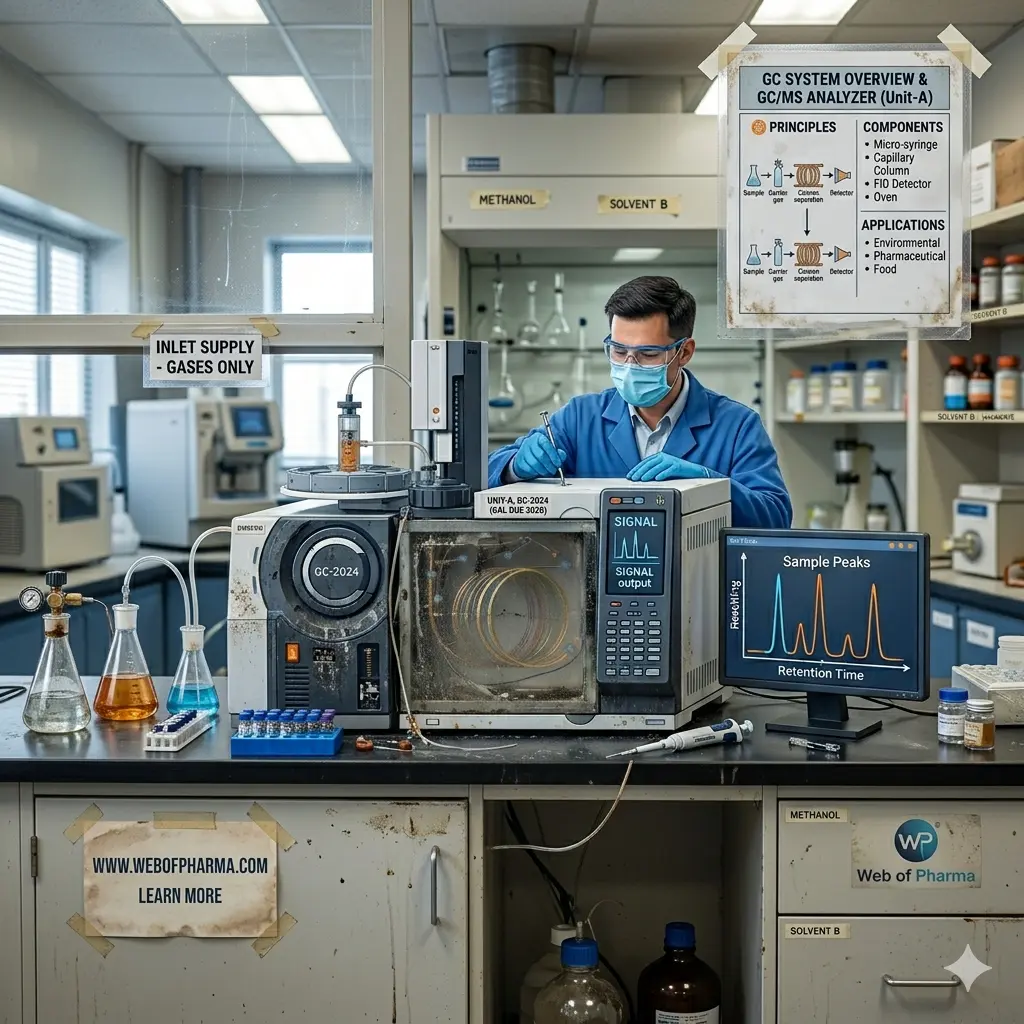

Learn about GC analyzer, gas chromatograph analyzer, chiral GC column, glass chromatography column, gas liquid chromatography, and autosampler gas chromatography. Understand principles, components, working, and applications in pharmaceuticals and chemicals.
Gas chromatography (GC) remains one of the most important analytical techniques in pharmaceutical, chemical, and research laboratories. Its reliability, sensitivity, and accuracy make it ideal for analyzing volatile compounds and ensuring product quality.
In this article, we explore GC analyzer, gas chromatograph analyzer, chiral GC column, glass chromatography column, gas liquid chromatography, and autosampler gas chromatography, including their principles, components, working, advantages, and limitations.
What is Gas Chromatography?
Gas chromatography is a separation technique similar to high-performance liquid chromatography (HPLC). It identifies and quantifies components in mixtures.
- In pharmaceuticals, GC is used to detect volatile substances, impurities, and residual solvents.
- In the chemical industry, it determines the purity of organic compounds.
Principle of Gas Chromatography
The principle of GC is separation based on interaction with a mobile gas phase and stationary polymer phase.
- Carrier Gas (mobile phase): Helium, hydrogen, or nitrogen transports the sample through the column.
- Stationary Phase: A polymer-coated inner surface of the column interacts differently with each compound.
Compounds that interact less with the stationary phase elute faster, while those with stronger interactions take longer. This difference allows separation of individual components.
Components of a Gas Chromatograph Analyzer
Understanding the main parts is essential for efficient GC analysis:
- Carrier Gas: Chemically inert gas that transports the sample through the system.
- Injector Port: Heated area (250–300°C) where the sample is vaporized.
- Column:
- Heart of the GC, either a glass chromatography column or stainless steel.
- Types: Packed columns (older) or capillary columns (modern, efficient).
- Special types: Chiral GC column for enantiomer separation.
- Oven: Maintains column temperature; supports isothermal or temperature-programmed runs.
- Detector: Identifies separated compounds. Common detectors include:
- Flame Ionization Detector (FID): Detects organic compounds based on carbon ionization in a flame.
- Thermal Conductivity Detector (TCD): Detects compounds by measuring changes in thermal conductivity.
- GC-MS: Combines mass spectrometry with GC for compound identification and structure analysis.
Step-by-Step Working of Gas Chromatography
- Sample Injection: Small volumes (5–10 µL) are injected into the heated injector.
- Vaporization & Transportation: Carrier gas moves the vaporized sample into the column.
- Separation: Components interact differently with the stationary phase, separating based on retention time.
- Detection: Detector records signals, producing a chromatogram. Peak size indicates quantity, and retention time identifies compounds.
Advantages of Gas Chromatography
- High sensitivity for trace-level detection.
- Fast analysis with reproducible results.
- Accurate quantitative analysis for volatile compounds.
- Widely used in pharmaceutical, petrochemical, environmental, food, and forensic industries.
Limitations
- Only suitable for volatile compounds.
- Sample and instrument preparation can be time-consuming.
- Not applicable for large molecules like proteins.
FAQs: GC Analyzer & Gas Chromatograph Analyzer
Q1. What is a GC analyzer?
A: A GC analyzer, or gas chromatograph analyzer, is an instrument that separates, identifies, and quantifies volatile compounds in mixtures.
Q2. What is the principle of gas chromatography?
A: Compounds separate based on their interaction between a carrier gas (mobile phase) and a stationary phase inside the column.
Q3. What are chiral GC columns used for?
A: Chiral GC columns separate enantiomers (mirror-image compounds), often critical in pharmaceutical analysis.
Q4. What is a glass chromatography column?
A: A glass column used as the stationary phase container in GC; it is chemically inert and supports separation of volatile compounds.
Q5. What is gas liquid chromatography (GLC)?
A: A type of GC where the stationary phase is a liquid coated on a solid support, allowing separation of volatile substances.
Q6. What is an autosampler in gas chromatography?
A: An autosampler automatically injects samples into the GC, improving reproducibility and reducing manual error.
Q7. What types of detectors are used in GC?
A: Flame Ionization Detector (FID), Thermal Conductivity Detector (TCD), Electron Capture Detector (ECD), and GC-MS.
Q8. What industries use GC routinely?
A: Pharmaceuticals, petrochemical, environmental monitoring, food & beverage, forensic toxicology, and cosmetics.
Q9. What factors affect separation in GC?
A: Column type and length, stationary phase polarity, carrier gas flow, temperature, sample size, and injection technique.
Q10. Why is GC important in pharmaceuticals?
A: GC accurately detects volatile impurities, residual solvents, and ensures the quality, safety, and compliance of pharmaceutical products.