


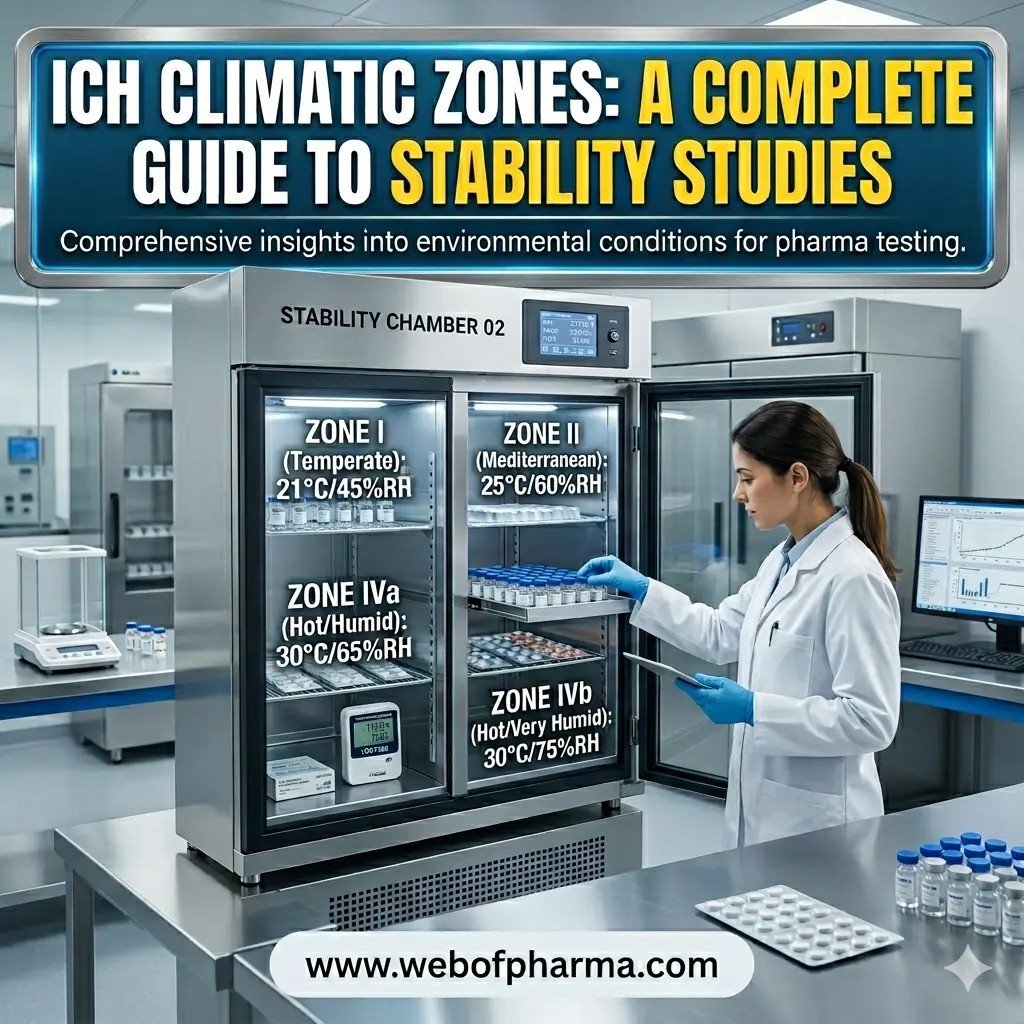

Learn about different climatic zones by ICH for stability conditions including temperate, subtropical, hot dry, hot humid, and high humidity regions with testing guidelines and examples.
Stability studies are a critical part of pharmaceutical product development, ensuring that medicines remain safe, effective, and high-quality throughout their shelf life. Among the many factors affecting drug stability, environmental conditions such as temperature and humidity play a major role.
Since pharmaceutical products are distributed globally, they are exposed to different environmental conditions. To address this, the WHO and ICH have classified the world into climatic zones for standardized stability testing.
Understanding the different climatic zones by ICH in the world for stability conditions including Temperate, Mediterranean / subtropical, Hot dry, Hot humid / tropical and hot & higher humidity zones is essential for regulatory compliance and product quality.
What Are Climatic Zones in Pharmaceuticals?
Climatic zones are geographical regions classified based on average temperature and relative humidity. These conditions directly impact:
- Drug degradation rate
- Shelf life
- Packaging requirements
- Storage conditions
By defining climatic zones, regulatory bodies ensure that stability testing reflects real-world environmental exposure.
Classification of Climatic Zones (WHO & ICH)
Initially, WHO defined four climatic zones, later expanded to five to better represent global conditions.
| Zone | Type of Climate | Long-Term Stability Conditions |
|---|---|---|
| Zone I | Temperate | 21°C ± 2°C / 45% RH ± 5% |
| Zone II | Subtropical / Mediterranean | 25°C ± 2°C / 60% RH ± 5% |
| Zone III | Hot and Dry | 30°C ± 2°C / 35% RH ± 5% |
| Zone IVa | Hot and Humid | 30°C ± 2°C / 65% RH ± 5% |
| Zone IVb | Hot and Very Humid | 30°C ± 2°C / 75% RH ± 5% |
Understanding Each Climatic Zone
Zone I – Temperate Climate
Includes regions like Northern Europe, Canada, and parts of the USA.
- Mild temperatures
- Moderate humidity
- Lower risk of moisture-related degradation
Zone II – Subtropical / Mediterranean
Found in Southern Europe, Japan, and parts of the USA.
- Moderate temperature and humidity
- Requires balanced stability conditions
Zone III – Hot and Dry
Common in Middle East, Africa, and parts of India.
- High temperature
- Low humidity
- Risk of evaporation and degradation of volatile components
Zone IVa – Hot and Humid
Includes South Asia and Southeast Asia.
- High humidity
- Risk of moisture absorption and microbial growth
Zone IVb – Hot and Very Humid
Covers tropical regions like Malaysia, Singapore, and the Philippines.
- Extreme humidity conditions
- Most challenging for stability testing
Importance of Climatic Zones in Stability Studies
1. Regulatory Compliance
Regulatory agencies require stability testing as per ICH Q1A (R2) and WHO guidelines based on target markets.
2. Shelf Life Determination
Stability studies under different climatic conditions help define:
- Expiry date
- Storage instructions
3. Packaging Selection
Climate affects packaging performance. Studies help determine:
- Blister vs bottle
- Moisture barrier properties
4. Global Product Quality
Testing across climatic zones ensures consistent product performance in international markets.
ICH Guidelines for Stability Testing
The ICH Q1A (R2) guideline defines testing requirements for drug substances and products.
Long-Term Stability Conditions
| Zone | Temperature | Humidity | Duration |
|---|---|---|---|
| Zone I | 21°C ± 2°C | 45% RH ± 5% | 12 months |
| Zone II | 25°C ± 2°C | 60% RH ± 5% | 12 months |
| Zone III | 30°C ± 2°C | 35% RH ± 5% | 12 months |
| Zone IVa | 30°C ± 2°C | 65% RH ± 5% | 12 months |
| Zone IVb | 30°C ± 2°C | 75% RH ± 5% | 12 months |
Accelerated & Intermediate Conditions
| Study Type | Temperature | Humidity | Duration |
|---|---|---|---|
| Accelerated | 40°C ± 2°C | 75% RH ± 5% | 6 months |
| Intermediate | 30°C ± 2°C | 65% RH ± 5% | 6 months |
Global Distribution of Climatic Zones
Countries are assigned zones based on their environmental conditions. For example:
- Zone I: Canada, Germany
- Zone II: USA, Europe, Japan
- Zone III: Middle East regions
- Zone IVa: India, Pakistan, Thailand
- Zone IVb: Malaysia, Singapore, Philippines
This classification ensures that pharmaceutical products are tested according to real storage environments.
Why Climatic Zones Matter in Pharmaceuticals
- Ensure drug safety and efficacy
- Support regulatory approvals
- Improve product stability
- Enable global market access
Ignoring climatic conditions can lead to:
- Reduced potency
- Product degradation
- Regulatory rejection
Frequently Asked Questions (FAQs)
1. What are ICH climatic zones?
ICH climatic zones are classifications of global regions based on temperature and humidity for stability testing of pharmaceutical products.
2. How many climatic zones are defined by ICH?
There are five main zones: I, II, III, IVa, and IVb.
3. What is Zone IVb in stability studies?
Zone IVb represents hot and very humid conditions (30°C / 75% RH), typical of tropical climates.
4. Why are climatic zones important in pharmaceuticals?
They help determine appropriate stability testing conditions to ensure drug safety and quality.
5. What is the difference between Zone IVa and IVb?
Zone IVa has 65% humidity, while Zone IVb has higher humidity at 75%.
6. Which countries fall under Zone II?
Countries like the USA, Japan, and Southern Europe fall under Zone II.
7. What are accelerated stability conditions?
Accelerated testing is performed at 40°C and 75% RH for 6 months to predict long-term stability.
8. What is mean kinetic temperature?
It is a calculated temperature that reflects the cumulative effect of temperature fluctuations on drug stability.
9. How do climatic zones affect packaging?
High humidity zones require moisture-resistant packaging like alu-alu blisters.
10. Which guideline covers stability testing?
ICH Q1A (R2) is the primary guideline for stability testing of pharmaceuticals.