


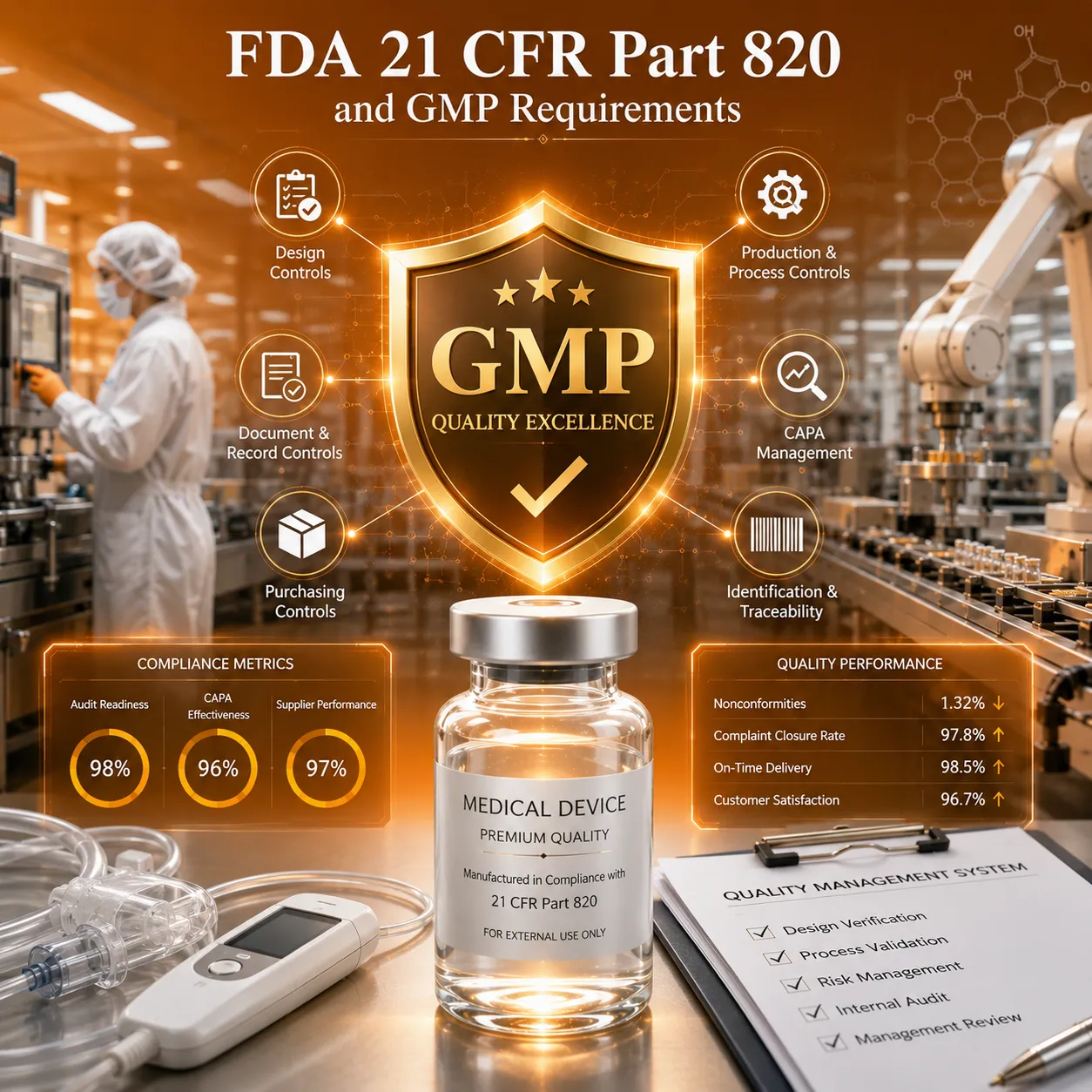

Learn FDA 21 CFR Part 820 and GMP Requirements, QMSR updates, compliance strategies, CAPA, design controls, and medical device quality systems.
What Is FDA 21 CFR Part 820?
FDA 21 CFR Part 820 is the Quality Management System Regulation (QMSR) governing medical device manufacturing in the United States. It establishes Current Good Manufacturing Practice (CGMP) requirements for design controls, supplier management, production processes, CAPA, documentation, and quality systems to ensure medical devices are consistently safe, effective, and compliant with FDA regulations.
Introduction
Medical device manufacturers operate in one of the most heavily regulated industries in the world. Ensuring product safety, effectiveness, and regulatory compliance requires a comprehensive quality management framework capable of controlling every stage of the product lifecycle.
The FDA’s 21 CFR Part 820, commonly known as the Quality Management System Regulation (QMSR), establishes the Current Good Manufacturing Practice (CGMP) requirements for medical devices marketed in the United States.
Recent FDA modernization efforts have aligned Part 820 more closely with ISO 13485:2016, creating greater harmonization between global quality system expectations and U.S. regulatory requirements.
For manufacturers, contract organizations, quality professionals, regulatory affairs teams, and auditors, understanding FDA Part 820 is essential for maintaining compliance, passing inspections, and ensuring patient safety.
Understanding FDA 21 CFR Part 820
FDA 21 CFR Part 820 establishes requirements for designing, manufacturing, packaging, labeling, storing, installing, and servicing medical devices.
The regulation requires manufacturers to implement and maintain a documented Quality Management System (QMS) capable of ensuring products consistently meet regulatory and customer requirements.
Primary Objectives
- Ensure medical device safety and effectiveness
- Establish controlled manufacturing processes
- Minimize quality failures
- Support regulatory compliance
- Improve product traceability
- Facilitate corrective actions and continuous improvement
FDA QMSR and ISO 13485 Harmonization
The FDA’s Quality Management System Regulation (QMSR) aligns many requirements with ISO 13485:2016.
Key Benefits of Harmonization
| Benefit | Impact |
|---|---|
| Reduced Compliance Complexity | Easier alignment with global markets |
| Consistent Quality Systems | Unified procedures across regions |
| Enhanced Risk Management | Improved product safety |
| Streamlined Audits | Better inspection preparedness |
| Global Market Access | Supports international expansion |
Key GMP Requirements Under FDA 21 CFR Part 820
Overview of Core Requirements
| Requirement | Purpose |
|---|---|
| Design Controls | Ensure devices meet intended use |
| Document Controls | Maintain approved records |
| Purchasing Controls | Manage supplier quality |
| Production Controls | Ensure consistent manufacturing |
| CAPA | Correct recurring issues |
| Traceability | Support recalls and investigations |
| Complaint Handling | Address customer concerns |
| Internal Audits | Verify compliance effectiveness |
1. Design Controls
Design controls are among the most critical requirements for Class II and Class III medical devices.
Requirements
Manufacturers must establish procedures for:
- Design planning
- Design input
- Design output
- Design review
- Design verification
- Design validation
- Design transfer
- Design changes
Practical Example
A manufacturer developing an infusion pump documents user requirements, verifies technical specifications, validates clinical usability, and maintains complete design history records before commercial release.
Key Records
| Record | Purpose |
|---|---|
| Design History File (DHF) | Demonstrates design compliance |
| Design Review Reports | Tracks approvals |
| Validation Protocols | Confirms intended use |
| Verification Reports | Confirms specifications |
2. Document and Record Controls
Documentation forms the backbone of FDA compliance.
Requirements
Organizations must control:
- SOPs
- Quality manuals
- Work instructions
- Specifications
- Validation records
- Audit reports
FDA Expectations
Documents must be:
- Reviewed and approved
- Current and accurate
- Easily retrievable
- Protected from unauthorized changes
- Retained for required periods
Record Retention
Records must generally be maintained for:
- Device lifetime, or
- Minimum of two years after release
Whichever period is longer.
3. Purchasing Controls
Supplier quality directly impacts product safety.
Requirements
Manufacturers must:
- Evaluate suppliers
- Approve vendors
- Monitor supplier performance
- Define quality agreements
- Perform supplier audits when necessary
Example
A catheter manufacturer audits a tubing supplier annually and tracks supplier defect rates through quality scorecards.
Supplier Control Metrics
| Metric | Target |
|---|---|
| On-Time Delivery | >95% |
| Defect Rate | <1% |
| Audit Score | ≥90% |
| CAPA Closure | Within 30 Days |
4. Production and Process Controls
Production operations must be controlled to prevent defects and ensure repeatability.
Requirements
- Approved procedures
- Process validation
- Environmental controls
- Equipment maintenance
- Production monitoring
- Change control
Process Validation Areas
| Process | Validation Requirement |
|---|---|
| Sterilization | Mandatory |
| Packaging | Risk-based |
| Software Systems | Required where applicable |
| Automated Inspection | Validation expected |
Example
An implant manufacturer validates sterilization cycles and continuously monitors critical process parameters.
5. Corrective and Preventive Action (CAPA)
CAPA is consistently one of the most scrutinized areas during FDA inspections.
CAPA Process
- Identify issue
- Investigate root cause
- Implement corrective action
- Verify effectiveness
- Prevent recurrence
- Document outcomes
CAPA Sources
- Customer complaints
- Internal audits
- Nonconforming products
- Supplier issues
- Trending data
Example
A recurring packaging defect triggers a root cause investigation, resulting in equipment redesign and operator retraining.
6. Identification and Traceability
Manufacturers must maintain product traceability throughout the device lifecycle.
Traceability Requirements
- Raw materials
- Components
- Work-in-progress
- Finished devices
- Distribution records
Benefits
- Efficient recalls
- Complaint investigations
- Regulatory reporting
- Supply chain visibility
Critical Quality Records Under Part 820
| Record | Purpose |
|---|---|
| Device Master Record (DMR) | Manufacturing specifications |
| Device History Record (DHR) | Batch production evidence |
| Design History File (DHF) | Design documentation |
| Complaint Files | Customer feedback records |
| CAPA Records | Improvement tracking |
| Audit Reports | Compliance assessments |
Step-by-Step Guide to FDA 21 CFR Part 820 Compliance
Step 1: Conduct a Gap Assessment
Compare existing processes against FDA QMSR requirements.
Evaluate
- Documentation
- Design controls
- Supplier management
- Production systems
- CAPA effectiveness
Step 2: Build a Robust Quality Management System
Establish:
- Quality policy
- Quality objectives
- SOP framework
- Training systems
- Change control processes
Step 3: Implement Design Controls
Develop formal procedures covering:
- Design planning
- Verification
- Validation
- Change management
Step 4: Strengthen Supplier Oversight
Create:
- Approved supplier lists
- Qualification criteria
- Performance reviews
- Supplier audit schedules
Step 5: Validate Critical Processes
Validate manufacturing processes where outputs cannot be fully verified through inspection alone.
Step 6: Establish CAPA and Complaint Handling
Implement systems capable of:
- Trend analysis
- Root cause investigation
- Effectiveness checks
Step 7: Conduct Internal Audits
Audit all quality system elements regularly.
Focus Areas
- Documentation
- Production records
- Supplier controls
- CAPA implementation
Step 8: Prepare for FDA Inspections
Maintain inspection readiness through:
- Mock audits
- Training programs
- Quality metrics reviews
- Document accessibility
Practical Example: FDA Part 820 Implementation
Scenario
A startup medical device company is preparing to commercialize a wearable cardiac monitoring device.
Initial Challenges
- Informal documentation
- No CAPA process
- Inconsistent supplier oversight
Actions Taken
| Action | Result |
|---|---|
| Implemented QMS software | Improved document control |
| Developed CAPA procedures | Reduced recurring issues |
| Established supplier qualification | Lower supplier-related defects |
| Performed internal audits | Improved inspection readiness |
Outcome
The company successfully completed an FDA inspection and accelerated product commercialization.
Common FDA Part 820 Inspection Findings
| Observation | Root Cause |
|---|---|
| Weak CAPA Program | Inadequate investigations |
| Poor Documentation | Uncontrolled records |
| Insufficient Validation | Incomplete protocols |
| Supplier Control Failures | Lack of oversight |
| Design Control Gaps | Missing verification evidence |
| Complaint Handling Issues | Inadequate trending |
Conclusion
FDA 21 CFR Part 820 remains the foundation of medical device quality system compliance in the United States. Through comprehensive controls covering design, documentation, supplier management, manufacturing, CAPA, and traceability, organizations can ensure medical devices consistently meet safety and performance expectations.
As FDA continues harmonization efforts with ISO 13485:2016, manufacturers that invest in robust, risk-based quality management systems will gain competitive advantages through stronger compliance, improved operational efficiency, and enhanced patient safety.
FAQs
1. What is FDA 21 CFR Part 820?
FDA 21 CFR Part 820 is the Quality Management System Regulation governing medical device manufacturing and quality systems.
2. Is FDA Part 820 the same as ISO 13485?
No. While closely aligned, FDA Part 820 is a U.S. regulation and ISO 13485 is an international standard.
3. What does QMSR stand for?
QMSR stands for Quality Management System Regulation.
4. Which devices require design controls?
Class II and Class III devices generally require design controls, along with certain Class I devices.
5. What is a Device Master Record (DMR)?
A DMR contains the specifications and instructions needed to manufacture a medical device.
6. What is a Device History Record (DHR)?
A DHR documents the manufacturing history of a specific device batch or lot.
7. Why is CAPA important in FDA compliance?
CAPA helps identify root causes of quality issues and prevents recurrence, making it a key inspection focus.
8. How often should internal audits be conducted?
Most manufacturers conduct audits annually, although higher-risk processes may require more frequent reviews.
9. What are purchasing controls?
Purchasing controls ensure suppliers and outsourced partners consistently meet quality requirements.
10. How can companies prepare for FDA inspections?
By maintaining complete documentation, conducting mock audits, validating processes, and monitoring quality metrics.