


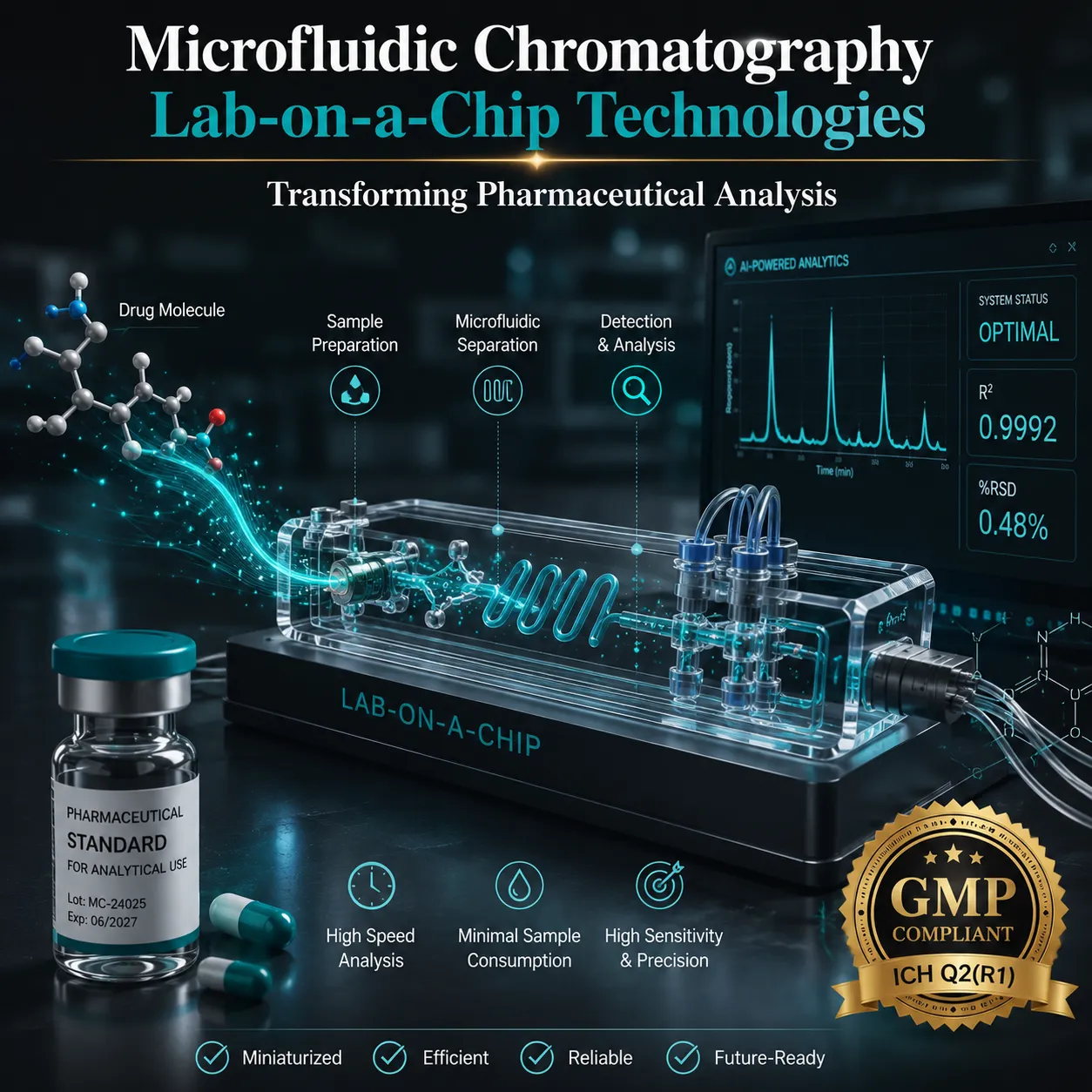

Explore microfluidic chromatography and lab-on-a-chip technologies for drug discovery, diagnostics, and GMP-compliant pharmaceutical analysis.
Definition
Microfluidic chromatography is a miniaturized analytical technique that integrates chromatographic separation, sample preparation, and detection onto a microchip. Combined with Lab-on-a-Chip (LOC) technology, it enables rapid, high-sensitivity analysis using minimal sample and reagent volumes for applications in diagnostics, drug discovery, and pharmaceutical research.
Introduction
The pharmaceutical industry is increasingly focused on faster, more efficient analytical technologies that can reduce costs, accelerate development timelines, and support personalized medicine. Traditional laboratory instruments often require significant sample volumes, extensive preparation, and centralized testing facilities.
Microfluidic Chromatography and Lab-on-a-Chip (LOC) technologies are revolutionizing this landscape by miniaturizing entire laboratory workflows onto compact microchips. These advanced platforms integrate sample preparation, separation, reaction, and detection processes into a single device, enabling high-speed analysis with exceptional sensitivity.
From rapid disease diagnostics to high-throughput drug screening, microfluidic systems are becoming essential tools in modern pharmaceutical research and development.
What Is Microfluidic Chromatography?
Microfluidic chromatography combines chromatographic separation principles with microfluidic technology to perform chemical and biological analyses on microscale devices.
Unlike conventional chromatography systems that rely on large columns and significant solvent consumption, microfluidic platforms use microscopic channels and integrated separation components.
Key Characteristics
| Feature | Traditional Chromatography | Microfluidic Chromatography |
|---|---|---|
| Sample Volume | Milliliters | Nanoliters–Microliters |
| Analysis Time | Minutes–Hours | Seconds–Minutes |
| Reagent Consumption | High | Extremely Low |
| Instrument Size | Bench-top | Portable |
| Throughput | Moderate | High |
How Microfluidic Chromatography Works
Microfluidic devices manipulate tiny fluid volumes through microchannels designed on glass, silicon, or polymer substrates.
1. Microscale Fluid Dynamics
At microscale dimensions, fluids exhibit laminar flow, where streams move smoothly without turbulence.
Benefits
- Precise fluid control
- Predictable analyte movement
- Improved analytical reproducibility
2. Chromatographic Separation
Microchannels contain integrated stationary phases similar to conventional chromatographic columns.
As analytes travel through the microchannel:
- Molecules interact differently with the stationary phase
- Components separate according to chemical properties
- Detection occurs downstream
Separation Mechanisms
| Mechanism | Application |
|---|---|
| Adsorption | Small molecules |
| Partitioning | Drug compounds |
| Size Exclusion | Biomolecules |
| Affinity Chromatography | Proteins and antibodies |
3. On-Chip Detection
Integrated detectors may include:
- Fluorescence detection
- UV detection
- Electrochemical sensors
- Mass spectrometry interfaces
These systems provide real-time analytical results without extensive post-processing.
Lab-on-a-Chip (LOC) Technology Explained
Lab-on-a-Chip technology integrates multiple laboratory functions onto a single microchip.
Typical LOC Workflow
- Sample introduction
- Sample preparation
- Mixing and reaction
- Chromatographic separation
- Detection and quantification
- Data analysis
This “mini-laboratory” approach significantly reduces testing time and operational complexity.
Fabrication of Microfluidic Devices
The performance of LOC platforms depends heavily on fabrication methods.
Common Materials
| Material | Advantages |
|---|---|
| Glass | Chemical resistance |
| Silicon | Precision microfabrication |
| PDMS | Flexible and low-cost |
| Thermoplastics | Scalable manufacturing |
Manufacturing Techniques
Photolithography
Widely used for creating highly precise microchannel structures.
Soft Lithography
Popular for PDMS-based device fabrication due to lower production costs.
Injection Molding
Supports commercial-scale production of disposable chips.
Key Advantages of Microfluidic Chromatography
High Sensitivity and Speed
The high surface-to-volume ratio improves reaction kinetics and separation efficiency.
Benefits
- Faster analysis
- Lower detection limits
- Enhanced analytical performance
Reduced Sample and Reagent Consumption
Microfluidic systems require only tiny sample volumes.
Impact
- Lower operating costs
- Reduced solvent waste
- Sustainable laboratory operations
Portability
Unlike conventional analytical systems, microfluidic devices can be deployed outside centralized laboratories.
Applications
- Point-of-care diagnostics
- Remote healthcare settings
- Field environmental monitoring
Automation and Integration
LOC devices reduce manual intervention and support automated workflows.
Advantages
- Improved reproducibility
- Reduced operator errors
- Faster turnaround times
Pharmaceutical Applications of Microfluidic Chromatography
1. Clinical and Point-of-Care Diagnostics
Rapid diagnostics represent one of the fastest-growing applications of microfluidic technology.
Common Uses
- Infectious disease detection
- DNA/RNA amplification
- Cancer biomarker analysis
- Single-cell studies
Practical Example
Microfluidic PCR chips can detect viral RNA within minutes, enabling rapid patient screening.
2. Drug Discovery and Development
Pharmaceutical companies increasingly utilize microfluidics during early-stage drug development.
Applications
| Function | Benefit |
|---|---|
| High-throughput screening | Faster candidate identification |
| Cell-based assays | Improved predictive data |
| Organ-on-chip models | Reduced animal testing |
| ADME studies | Better pharmacokinetic assessment |
Example
Microfluidic liver-on-chip models help evaluate drug metabolism and toxicity before clinical trials.
3. Biopharmaceutical Analysis
Microfluidic chromatography supports characterization of:
- Monoclonal antibodies
- Proteins
- Peptides
- Gene therapy products
The technology enables rapid quality assessment with minimal sample requirements.
4. Environmental and Water Monitoring
Microfluidic platforms support real-time contaminant analysis.
Detection Targets
- Heavy metals
- Pesticides
- Industrial pollutants
- Pharmaceutical residues
Step-by-Step Workflow of a Lab-on-a-Chip System
Step 1: Sample Collection
Obtain biological, pharmaceutical, or environmental samples.
Step 2: Sample Introduction
Load minute sample volumes into the microchip.
Step 3: On-Chip Sample Preparation
Perform filtration, dilution, or extraction automatically.
Step 4: Chromatographic Separation
Separate target compounds using integrated micro-columns.
Step 5: Detection
Analyze compounds using integrated sensors.
Step 6: Data Processing
Convert analytical signals into actionable results.
Step 7: Reporting
Generate results for quality control, diagnostics, or regulatory review.
Current Challenges and Limitations
Despite rapid advancements, several barriers remain.
Manufacturing Scalability
Large-scale commercial production remains technically challenging.
Development Costs
Advanced fabrication and validation processes can be expensive.
Complex Sample Handling
Whole blood and highly viscous biological samples require sophisticated preparation methods.
Regulatory Acceptance
Many applications still require broader regulatory validation before widespread adoption.
GMP and Regulatory Considerations
Pharmaceutical implementation of microfluidic technologies must align with regulatory expectations.
Relevant Guidelines
| Regulation | Relevance |
|---|---|
| FDA 21 CFR Part 11 | Electronic records compliance |
| ICH Q2(R2) | Analytical method validation |
| ICH Q14 | Analytical procedure development |
| EU GMP Annex 11 | Computerized systems |
| USP <1225> | Validation of compendial methods |
| ISO 13485 | Medical device quality systems |
Conclusion
Microfluidic Chromatography and Lab-on-a-Chip technologies are redefining analytical science by delivering rapid, sensitive, and cost-effective testing within compact platforms. Their applications span diagnostics, drug discovery, biopharmaceutical characterization, and environmental monitoring.
As manufacturing processes mature and regulatory frameworks evolve, microfluidic systems are expected to become integral components of pharmaceutical research, quality control, and precision medicine, driving the next wave of innovation in analytical technologies.
FAQs
1. What is microfluidic chromatography?
Microfluidic chromatography is a miniaturized separation technique that performs chromatographic analysis on microchip-based platforms.
2. What is Lab-on-a-Chip technology?
Lab-on-a-Chip technology integrates multiple laboratory functions onto a single microdevice for rapid analysis.
3. How does microfluidic chromatography work?
It separates analytes within microchannels containing stationary phases while manipulating very small fluid volumes.
4. What are the advantages of microfluidic systems?
They offer faster analysis, reduced reagent use, portability, and enhanced automation.
5. What materials are used in microfluidic devices?
Common materials include glass, silicon, PDMS, and thermoplastics.
6. How is microfluidics used in drug discovery?
It supports high-throughput screening, toxicity testing, and organ-on-chip models.
7. Can microfluidic devices be used for point-of-care testing?
Yes. Their compact size and rapid results make them ideal for point-of-care diagnostics.
8. What are the challenges of Lab-on-a-Chip technologies?
Manufacturing scalability, regulatory validation, and complex sample preparation remain key challenges.
9. Are microfluidic systems GMP compliant?
They can be GMP compliant when properly validated and operated within regulated quality systems.
10. What is the future of microfluidic chromatography?
AI integration, digital microfluidics, wearable diagnostics, and real-time monitoring are driving future growth.