


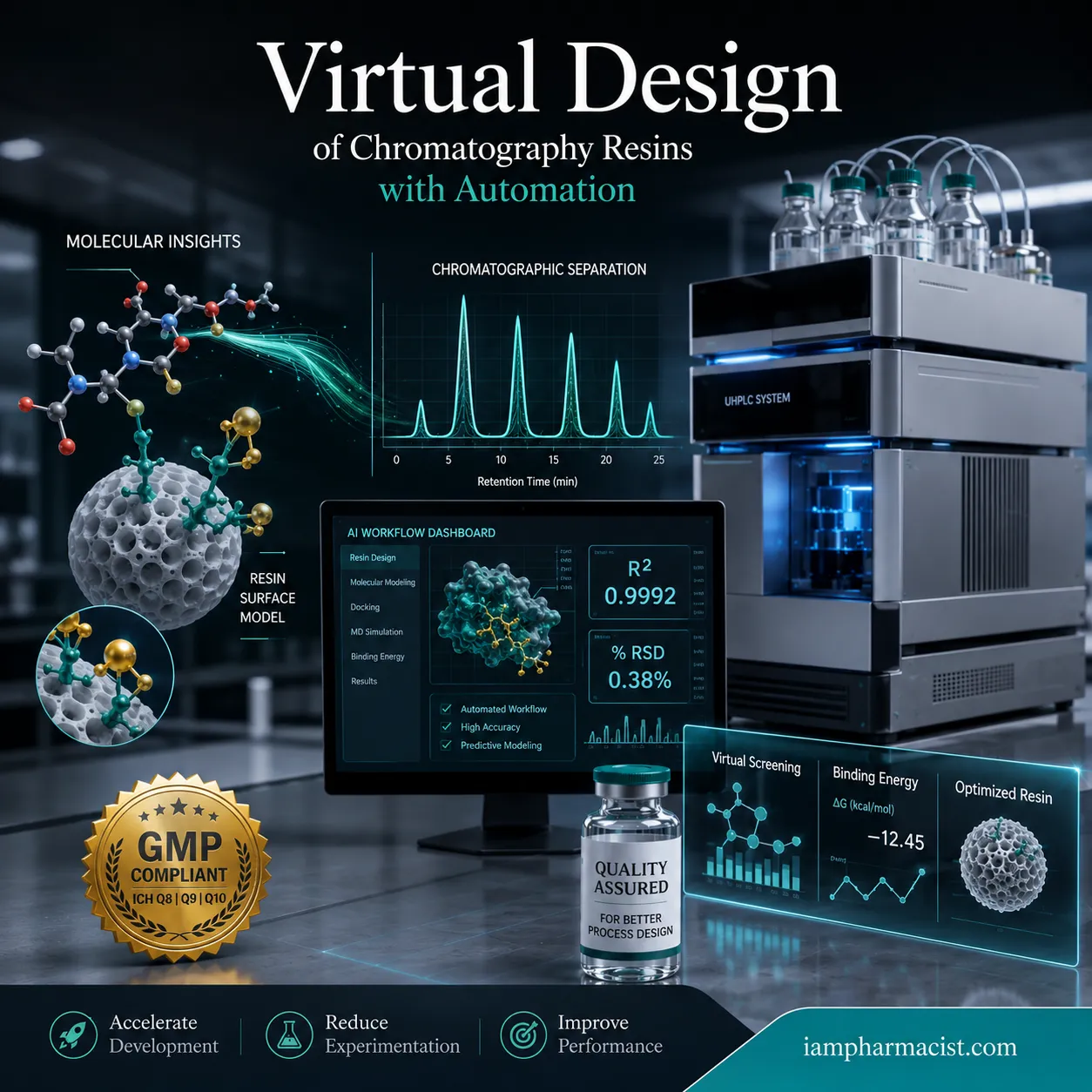

Discover automated workflows for Virtual Design of Chromatography Resins, molecular simulations, peptide binding prediction, and GMP-ready process optimization.
Definition
Virtual chromatography resin design is a computational approach that uses molecular simulations and automated workflows to create, optimize, and evaluate chromatography resins before physical development. By combining all-atom modeling, molecular dynamics, docking, and binding energy calculations, researchers can predict biomolecule–resin interactions, accelerate resin development, and reduce experimental workload.
Introduction
Chromatography remains one of the most critical technologies in pharmaceutical manufacturing, biotechnology, vaccine production, and biomolecule purification. Despite decades of advancement in resin chemistry, chromatography media development often relies heavily on empirical experimentation, requiring significant time, resources, and laboratory screening.
Recent advances in computational chemistry, molecular simulations, and workflow automation are transforming this paradigm. Researchers can now virtually design chromatography resins, model molecular interactions at atomic resolution, and predict adsorption behavior before synthesizing materials in the laboratory. These capabilities enable more efficient process development, improved resin performance, and reduced development costs.
Automated workflow management systems such as SimStack and KNIME further simplify complex simulation processes, making molecular modeling accessible to chromatography scientists without extensive computational expertise.
Why Molecular Modeling Matters in Chromatography
Traditional resin development faces several challenges:
- High experimental costs
- Lengthy screening campaigns
- Limited molecular-level understanding
- Difficulty predicting adsorption behavior
- Complex biomolecule–surface interactions
Molecular simulations overcome these barriers by providing atomic-scale insights into:
| Application | Benefit |
|---|---|
| Ligand design | Improved selectivity |
| Resin optimization | Enhanced binding capacity |
| Process development | Reduced experimental workload |
| Peptide purification | Better adsorption prediction |
| Media screening | Faster candidate selection |
According to recent research, molecular simulations can accurately predict biomolecule interactions with chromatography surfaces and support rational resin design.
What Are Workflow Management Systems (WMS)?
Workflow Management Systems automate computational tasks, simulation pipelines, and data processing.
Advantages of WMS in Chromatography
- Reduced technical barriers
- Reproducible simulations
- High-throughput screening
- Faster model generation
- User-friendly interfaces
- Improved data management
Two key platforms highlighted in recent chromatography research include:
| Platform | Primary Function |
|---|---|
| SimStack | Resin structure generation |
| KNIME | Binding energy calculations |
| Schrödinger | Molecular docking |
| LAMMPS | Molecular dynamics |
| GFN2-xTB | Energy calculations |
These systems enable “one-click” execution of complex molecular modeling workflows.
Virtual Design of Methacrylate-Based Chromatography Resins
Overview
The automated workflow generates detailed all-atom models of chromatography resins using a multiscale modeling strategy.
The process combines:
- Coarse-grained simulations
- All-atom molecular modeling
- Polymerization simulations
- Molecular dynamics relaxation
- Automated topology generation
This methodology enables realistic representation of methacrylate-based chromatography materials.
Key Building Blocks in Resin Design
Available Components
| Category | Examples |
|---|---|
| Monomers | HEMA, DHPMA |
| Crosslinkers | EGDMA |
| Ligands | Trp, Sulfonic Acid, Q Ligands |
| Spacers | Linear Alkyl Chains |
Users can customize:
- Ligand density
- Spacer length
- Monomer composition
- Crosslinking levels
- Surface architecture
These variables directly influence adsorption behavior and chromatographic performance.
Automated Workflow Architecture
Step 1: Define Resin Building Blocks
Researchers specify:
- Monomer type
- Crosslinker concentration
- Ligand chemistry
- Spacer configuration
- Simulation dimensions
Example Inputs
| Parameter | Example |
|---|---|
| Monomer | DHPMA |
| Crosslinker | EGDMA |
| Ligand | Tetramethylammonium |
| Spacer | C4 Butane |
| Box Size | 15 × 15 × 20 nm |
Step 2: Coarse-Grained Polymerization
The workflow simulates:
- Radical polymerization
- Network formation
- Ligand attachment
- Porogen removal
Outputs are stored as coarse-grained polymer networks.
Step 3: Convert to All-Atom Representation
The system automatically:
- Places molecular fragments
- Generates topology
- Assigns force-field parameters
- Creates atomistic resin structures
Benefits include:
- Higher structural accuracy
- Realistic molecular interactions
- Improved adsorption predictions
Step 4: Molecular Dynamics Relaxation
The generated resin undergoes:
- Energy minimization
- Structural relaxation
- Dynamic equilibration
This produces a physically realistic chromatography surface model.
Step 5: Export for Docking Simulations
Final outputs include:
- LAMMPS files
- MOL2 structures
- Docking-ready surfaces
These files integrate directly with downstream molecular screening workflows.
Automated Peptide Binding Energy Workflow
After resin generation, a second workflow predicts adsorption behavior.
Key Steps
1. Ligand Preparation
Input:
- Peptide sequences
- SMILES structures
2. Docking Simulations
Using Schrödinger Glide:
- Binding pose generation
- Surface interaction prediction
3. Energy Minimization
Refinement of docked complexes.
4. MM-GBSA Calculations
Binding free energy estimation.
5. GFN2-xTB Validation
Identification of false-positive binding poses.
6. Automated Reporting
Results exported directly into Excel format.
Practical Applications in Biopharmaceutical Development
Resin Screening
Virtual screening enables rapid comparison of resin candidates before synthesis.
Benefits
- Reduced development costs
- Faster decision-making
- Higher success rates
Peptide Purification Optimization
Researchers can predict:
- Langmuir constants
- Adsorption strengths
- Elution behavior
This supports chromatography process development and scale-up.
Rational Resin Design
The workflow supports optimization of:
| Variable | Impact |
|---|---|
| Ligand density | Capacity |
| Spacer length | Accessibility |
| Backbone chemistry | Selectivity |
| Surface morphology | Binding behavior |
Machine Learning Integration
Future applications may combine:
- AI-driven optimization
- Genetic algorithms
- Predictive analytics
- Automated resin discovery
The resulting systems could dramatically accelerate chromatography innovation.
GMP and Regulatory Considerations
Although molecular simulations do not replace experimental validation, they support Quality by Design (QbD) initiatives by:
- Enhancing process understanding
- Supporting risk assessments
- Accelerating method development
- Reducing development variability
Relevant Regulatory Frameworks
- ICH Q8 Pharmaceutical Development
- ICH Q9 Quality Risk Management
- ICH Q10 Pharmaceutical Quality System
- GMP Process Validation Guidance
- FDA Process Analytical Technology (PAT)
Simulation-driven development aligns well with modern regulatory expectations for scientific process understanding.
Benefits of Automated Chromatography Modeling
| Benefit | Impact |
|---|---|
| Reduced experimentation | Lower cost |
| High-throughput screening | Faster development |
| Molecular-level understanding | Better decisions |
| Automated workflows | Improved productivity |
| Reproducibility | Higher confidence |
| Scalability | Broader adoption |
Future Directions
Emerging innovations include:
- AI-guided resin design
- Automated chromatographic process optimization
- Digital twins for chromatography systems
- Machine learning-assisted ligand selection
- Cloud-based molecular screening platforms
- Real-time adsorption prediction
As computational power continues to increase, virtual chromatography design is expected to become a standard component of process development.
FAQs
1. What is virtual chromatography resin design?
It is the use of molecular simulations and computational workflows to design chromatography resins before physical manufacturing.
2. Why are molecular simulations important in chromatography?
They provide atomic-level insights into biomolecule–resin interactions and reduce experimental screening.
3. What is SimStack?
SimStack is a workflow management system used to automate molecular simulations and resin model generation.
4. What is KNIME used for in chromatography?
KNIME automates docking studies, binding energy calculations, and chromatography data workflows.
5. What are all-atom resin models?
They are detailed molecular representations of chromatography surfaces containing complete atomic information.
6. Can virtual design reduce chromatography development costs?
Yes, by reducing laboratory experimentation and improving candidate selection.
7. What types of resins are modeled in these workflows?
Methacrylate-based chromatography resins.
8. How are peptide binding energies calculated?
Using molecular docking, MM-GBSA calculations, and GFN2-xTB energy validation.
9. Is virtual chromatography design GMP compliant?
It can support GMP process development but requires experimental verification and validation.
10. What is the future of computational chromatography?
AI-driven resin design, digital twins, predictive analytics, and fully automated process optimization.