


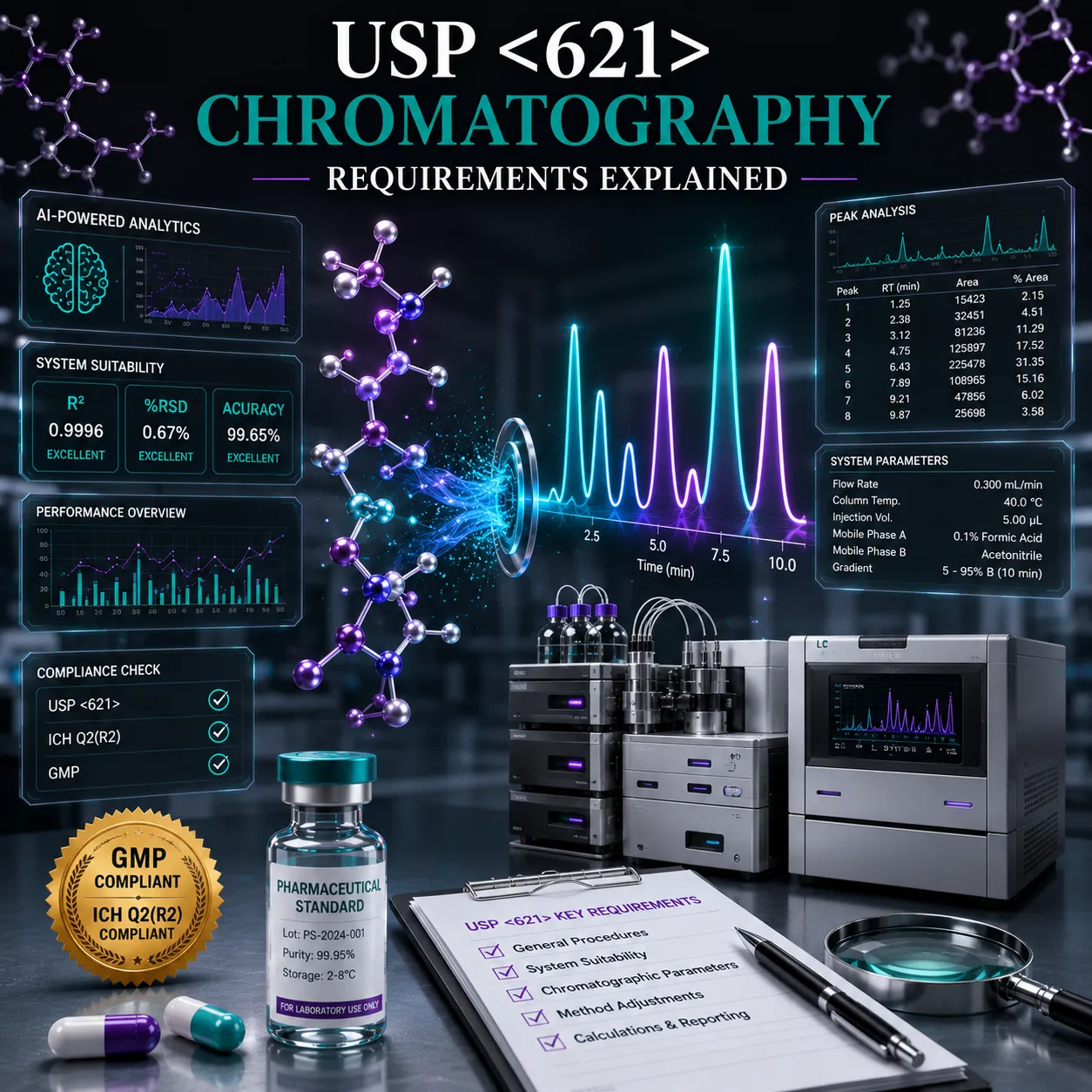

Learn USP <621> chromatography requirements, system suitability, method adjustments, column changes, and GMP compliance for pharmaceutical analysis.
Definition
USP <621> is the United States Pharmacopeia general chapter that establishes requirements for chromatographic procedures, system suitability testing, performance parameters, and allowable method adjustments in pharmaceutical analysis. It ensures chromatographic methods remain accurate, reliable, and compliant with regulatory expectations while maintaining analytical integrity.
Chromatography remains one of the most critical analytical techniques in pharmaceutical quality control, stability testing, impurity profiling, and regulatory submissions. To ensure consistency across laboratories worldwide, the United States Pharmacopeia (USP) developed General Chapter <621> Chromatography, which provides standardized requirements for chromatographic procedures and system suitability testing.
Understanding USP <621> is essential for QC analysts, method development scientists, validation specialists, and GMP auditors because it governs how chromatographic methods are executed, adjusted, and verified without compromising analytical performance.
This guide explains USP <621> in simple terms while highlighting key GMP implications and practical laboratory applications.
What Is USP <621>?
USP <621> is a general chapter that defines:
- Chromatographic principles
- System suitability requirements
- Performance calculations
- Acceptable method adjustments
- Column replacement criteria
- HPLC and GC operating flexibility
- Quantitation approaches
The chapter applies to:
| Chromatography Type | Covered by USP <621> |
|---|---|
| HPLC/LC | Yes |
| UPLC | Yes |
| Gas Chromatography (GC) | Yes |
| Thin-Layer Chromatography (TLC) | Yes |
| Paper Chromatography | Yes |
| Column Chromatography | Yes |
Why USP <621> Matters
USP <621> ensures analytical methods produce reliable and reproducible results regardless of:
- Laboratory location
- Instrument manufacturer
- Column supplier
- Analyst performing the test
Without standardized criteria, chromatographic results could vary significantly between laboratories.
Key Benefits
✅ Improved method consistency
✅ Regulatory compliance
✅ Reduced OOS investigations
✅ Better method transfer success
✅ Global harmonization
Core Components of USP <621>
USP <621> focuses on four major areas:
| Component | Purpose |
|---|---|
| General Procedures | Defines chromatographic techniques |
| System Suitability | Verifies system performance |
| Adjustment of Conditions | Specifies allowable method changes |
| Quantitation | Describes calculation approaches |
Understanding System Suitability Requirements
System suitability is the most frequently cited section during inspections and audits.
USP states that:
No sample analysis is acceptable unless system suitability has been demonstrated.
Before sample testing, laboratories must verify that the chromatographic system is functioning properly.
Common System Suitability Parameters
| Parameter | Purpose |
|---|---|
| Resolution (Rs) | Peak separation |
| Tailing Factor (As) | Peak symmetry |
| Plate Count (N) | Column efficiency |
| %RSD | Injection repeatability |
| Signal-to-Noise Ratio | Sensitivity |
| Retention Factor (k) | Peak retention behavior |
Key Chromatographic Calculations Explained
1. Resolution (Rs)
Measures separation between two adjacent peaks.
Interpretation
| Resolution | Meaning |
|---|---|
| <1.5 | Inadequate separation |
| ≥1.5 | Baseline separation |
| ≥2.0 | Excellent separation |
Example
If an impurity peak overlaps with the API peak, the method may fail system suitability requirements.
2. Tailing Factor (As)
Evaluates peak symmetry.
USP Acceptance
| Value | Interpretation |
|---|---|
| 1.0 | Perfect symmetry |
| 0.8–1.8 | Acceptable |
| >1.8 | Excessive tailing |
Common Causes of Peak Tailing
- Column deterioration
- Dead volume
- pH mismatch
- Secondary interactions
3. Plate Number (N)
Indicates column efficiency.
Higher plate count = better separation.
Typical Expectations
| Column Type | Typical N |
|---|---|
| Standard HPLC | >2000 |
| Modern HPLC | >5000 |
| UPLC | >10000 |
4. System Repeatability (%RSD)
Determines injection precision.
General Expectations
| Test Type | Typical Limit |
|---|---|
| Assay | ≤2.0% |
| Related Substances | Monograph-specific |
Allowable USP <621> Method Adjustments
One of the most valuable aspects of USP <621> is its flexibility.
Laboratories often need to:
- Replace columns
- Change flow rates
- Adjust pH
- Modify mobile phase composition
USP specifies which changes can be made without revalidation.
HPLC Method Adjustment Limits
Mobile Phase pH
| Parameter | Allowable Change |
|---|---|
| Buffer pH | ±0.2 pH units |
Buffer Concentration
| Parameter | Allowable Change |
|---|---|
| Salt concentration | ±10% |
Column Temperature
| Method Type | Allowable Change |
|---|---|
| Isocratic LC | ±10°C |
| Gradient LC | ±5°C |
Flow Rate
| Parameter | Allowable Change |
|---|---|
| Flow Rate | ±50% |
Column Replacement Rules Under USP <621>
Column replacement is common when vendors discontinue products or supply chains change.
USP allows replacement provided:
The New Column Maintains
- Same bonded phase
- Similar chemistry
- Comparable selectivity
- Acceptable system suitability
Example
Allowed:
✅ C18 → Different C18 supplier
Not Allowed:
❌ C18 → C8
without proper validation.
Dwell Volume Considerations
Modern HPLC systems have different dwell volumes.
Differences can affect:
- Gradient start point
- Retention times
- Resolution
- Peak elution order
GMP Risk
Failure to evaluate dwell volume differences during method transfer is a common inspection finding.
Step-by-Step USP <621> Compliance Checklist
Step 1: Review the Monograph
Verify:
- Column type
- Mobile phase
- Detector wavelength
- System suitability criteria
Step 2: Prepare Chromatographic System
Ensure:
- Instrument calibration status
- Detector qualification
- Pump performance verification
Step 3: Perform System Suitability
Evaluate:
- Resolution
- Tailing factor
- Plate count
- %RSD
Step 4: Verify Acceptance Criteria
Confirm all criteria meet monograph requirements.
Step 5: Assess Any Method Changes
Check whether proposed modifications fall within USP <621> allowable ranges.
Step 6: Document Results
Maintain:
- Chromatograms
- Calculations
- Audit trail records
- System suitability reports
Practical Example
Scenario
A USP assay method specifies:
- Column: 250 mm × 4.6 mm, 5 µm C18
- Flow Rate: 1.0 mL/min
Laboratory wishes to use:
- 150 mm × 4.6 mm, 3 µm C18
Can This Be Done?
Yes.
USP <621> permits adjustments provided:
- L/dp ratio remains acceptable
- Flow rate is appropriately adjusted
- System suitability passes
- Peak selectivity remains equivalent
GMP and Regulatory Insights
FDA and global inspectors routinely review chromatographic practices.
Common observations include:
Frequent Compliance Issues
❌ Unjustified column changes
❌ Failure to perform system suitability
❌ Inadequate documentation of adjustments
❌ Unsupported flow rate modifications
❌ Poor method transfer assessments
Best Practices
✅ Document every adjustment
✅ Perform risk assessments
✅ Maintain change control records
✅ Verify system suitability before every sequence
USP <621> and Data Integrity
USP <621> aligns closely with:
- FDA Data Integrity Guidance
- EU GMP Annex 11
- PIC/S Data Integrity Guidance
- ALCOA+ Principles
Analysts should ensure:
- Audit trails remain enabled
- Electronic records are secure
- Chromatograms are retained
- Integration events are justified
Frequently Asked Questions
1. What is USP <621>?
USP <621> is a general chapter that defines chromatographic procedures, system suitability requirements, and allowable method adjustments.
2. Does USP <621> apply to HPLC?
Yes. USP <621> extensively covers liquid chromatography (HPLC/LC).
3. What is system suitability in USP <621>?
System suitability verifies that a chromatographic system performs adequately before sample analysis.
4. What is the acceptable tailing factor in USP <621>?
Unless otherwise specified, peak symmetry should generally be between 0.8 and 1.8.
5. Can flow rate be adjusted under USP <621>?
Yes. Flow rate adjustments up to ±50% are generally permitted under defined conditions.
6. Can I replace a USP column with another brand?
Yes, provided the stationary phase chemistry and chromatographic performance remain equivalent.
7. What is dwell volume in chromatography?
Dwell volume is the volume between solvent mixing and the column inlet, affecting gradient performance.
8. Is revalidation always required after method changes?
No. Adjustments permitted by USP <621> typically do not require full revalidation.
9. Why is resolution important?
Resolution ensures proper separation of analytes and impurities.
10. How does USP <621> support GMP compliance?
It standardizes chromatographic practices, ensuring reliable and reproducible analytical results.