


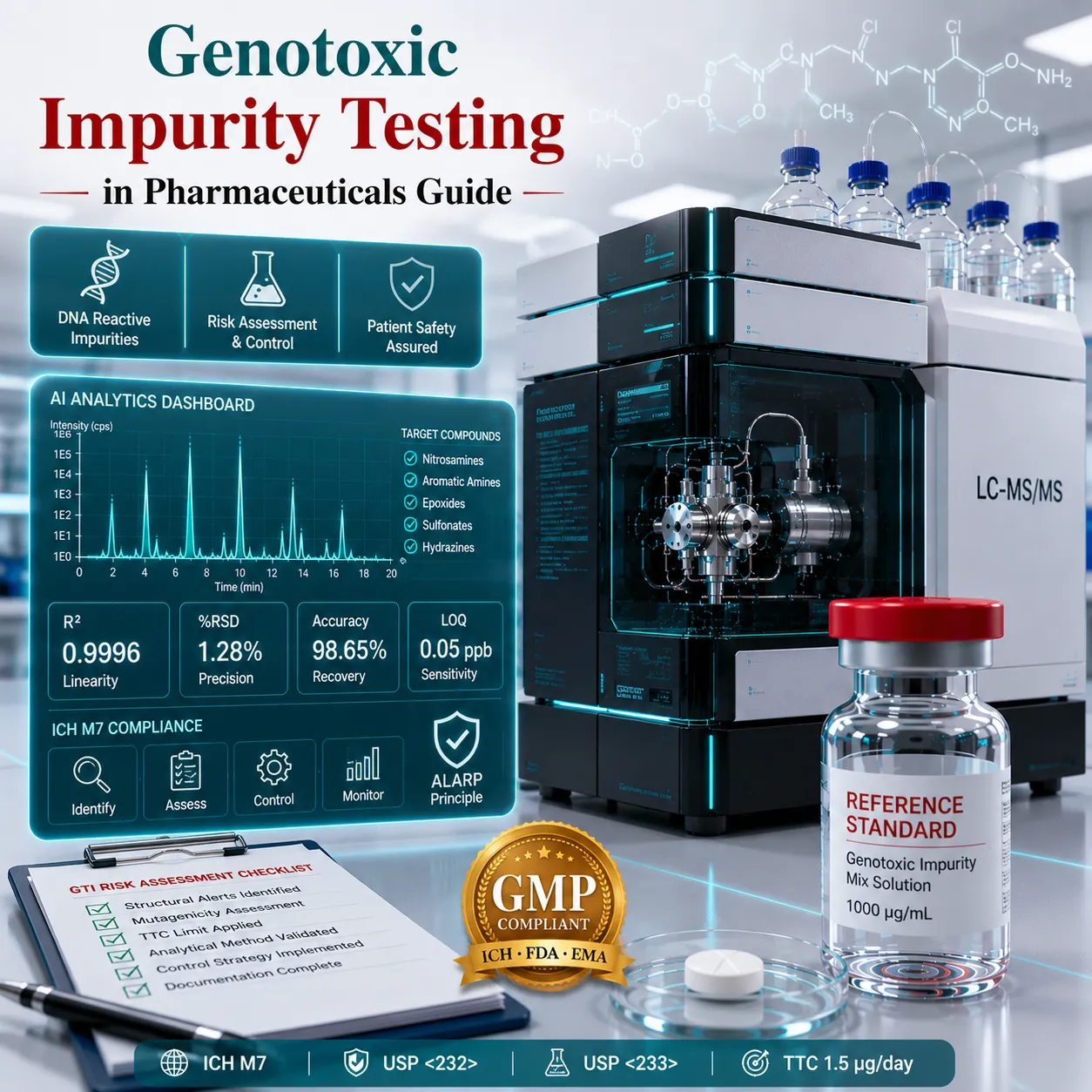

Learn regulatory expectations, ICH M7 requirements, TTC limits, analytical methods, and GMP strategies for genotoxic impurity testing in pharmaceuticals.
Definition
Genotoxic impurity testing in pharmaceuticals involves identifying, assessing, controlling, and monitoring DNA-reactive impurities that may cause mutations or cancer. Regulatory expectations under ICH M7 require a risk-based approach using toxicological assessment, process controls, TTC limits, and highly sensitive analytical techniques such as LC-MS/MS, GC-MS, and UHPLC.
Introduction
Genotoxic impurities (GTIs), also known as Potential Genotoxic Impurities (PGIs), have become one of the most closely scrutinized areas in pharmaceutical development. These impurities are capable of interacting with DNA and may increase the risk of mutations, chromosomal damage, and carcinogenesis even at extremely low concentrations.
As pharmaceutical synthesis becomes increasingly complex, manufacturers frequently utilize highly reactive starting materials, catalysts, reagents, and intermediates that can generate trace-level genotoxic impurities.
Because these compounds may present significant patient safety concerns, global regulatory agencies including the FDA, EMA, PMDA, and ICH have established stringent requirements for their identification, assessment, control, and analytical determination.
The current regulatory framework centers around ICH M7, which replaced earlier FDA and EMA guidance and introduced a science-based risk management approach for controlling DNA-reactive impurities. The need for highly sensitive analytical methods capable of detecting impurities at parts-per-million (ppm) or lower levels has transformed pharmaceutical analytical chemistry.
What Are Genotoxic Impurities?
Genotoxic impurities are chemical substances capable of directly or indirectly damaging genetic material.
Potential Consequences
- DNA mutations
- Chromosomal abnormalities
- Genetic instability
- Increased cancer risk
- Long-term patient safety concerns
Common Sources of GTIs
| Source | Examples |
|---|---|
| Starting Materials | Aromatic amines, alkyl halides |
| Reagents | Sulfonates, hydrazines |
| Intermediates | Reactive synthetic compounds |
| Byproducts | Process-related impurities |
| Degradation Products | Stability-induced impurities |
| Residual Solvents | Certain Class 1 solvents |
Why GTIs Are Different from Conventional Impurities
Traditional impurity guidelines such as:
- ICH Q3A
- ICH Q3B
- ICH Q3C
- ICH Q3D
focus on toxicological qualification thresholds.
However, genotoxic impurities may pose risks at much lower concentrations than ordinary process impurities. Therefore, dedicated risk-based control strategies are required.
Regulatory Expectations for Genotoxic Impurities
ICH M7: Current Global Standard
ICH M7 provides guidance on:
- Assessment of DNA-reactive impurities
- Mutagenicity evaluation
- Risk management strategies
- Control limits
- Analytical testing requirements
Key Objective
Limit patient exposure to mutagenic impurities that may increase carcinogenic risk.
FDA Expectations
FDA guidance emphasizes:
Prevention
Prevent formation of genotoxic impurities whenever possible.
Reduction
Reduce impurity levels to acceptable limits.
Characterization
Assess carcinogenic and mutagenic potential.
Control Strategy
Develop scientifically justified specifications and monitoring programs.
EMA Expectations
The European Medicines Agency introduced the concept of:
ALARP Principle
As Low As Reasonably Practicable
Manufacturers should minimize genotoxic impurities whenever feasible.
TTC Concept
The EMA strongly supports application of the:
Threshold of Toxicological Concern (TTC)
for impurities lacking compound-specific toxicity data.
Understanding the TTC Concept
Threshold of Toxicological Concern
The TTC establishes a generic exposure level below which carcinogenic risk is considered negligible.
Standard TTC Limit
1.5 µg/day
This exposure level is generally considered to correspond to an acceptable theoretical lifetime cancer risk.
Calculation Example
| Parameter | Value |
|---|---|
| TTC | 1.5 µg/day |
| Daily Dose | 500 mg/day |
| Acceptable GTI Level | 3 ppm |
Classification of Genotoxic Impurities
The Pharmaceutical Research and Manufacturers of America (PhRMA) framework categorizes impurities according to risk.
Class 1
Known mutagenic and carcinogenic impurities.
Examples
- Nitrosamines
- Certain alkylating agents
Regulatory Approach
Prefer elimination.
Class 2
Known mutagenic compounds with uncertain carcinogenicity.
Control Strategy
Apply TTC-based limits.
Class 3
Structural alerts present but mutagenicity unknown.
Requirement
Additional testing required.
Class 4
Structural alerts related to API structure.
Assessment
Case-by-case evaluation.
Class 5
No structural alerts.
Control
Managed as conventional impurities.
Structural Alerts Frequently Associated with GTIs
Aromatic and Nitrogen-Based Alerts
- Aromatic amines
- N-hydroxyaryls
- Aza-aryl N-oxides
Reactive Functional Groups
| Functional Group | Genotoxic Concern |
|---|---|
| Nitrosamines | Strong carcinogenicity |
| Hydrazines | DNA reactivity |
| Epoxides | Alkylation potential |
| Aziridines | Mutagenicity |
| Aldehydes | DNA interaction |
| Alkyl Halides | Genotoxic potential |
Risk Assessment Workflow for GTIs
Step 1: Review Synthetic Route
Evaluate:
- Starting materials
- Reagents
- Intermediates
- Catalysts
- Byproducts
Step 2: Identify Structural Alerts
Use:
- DEREK Nexus
- Leadscope
- CASE Ultra
- QSAR models
Step 3: Conduct Mutagenicity Assessment
Ames Test
The bacterial reverse mutation assay remains the gold standard.
Outcomes
| Result | Classification |
|---|---|
| Negative | Class 5 |
| Positive | Class 2 |
Step 4: Evaluate Process Purge
Assess removal during:
- Crystallization
- Extraction
- Distillation
- Filtration
Step 5: Establish Control Strategy
Options include:
- Process controls
- Specifications
- Routine monitoring
- Analytical testing
Analytical Challenges in GTI Testing
GTIs are often present at:
Typical Levels
1–5 ppm
or lower.
This creates significant analytical challenges.
Key Analytical Requirements
| Parameter | Requirement |
|---|---|
| Sensitivity | Very high |
| Specificity | Excellent |
| Accuracy | ICH compliant |
| Precision | Reliable |
| Stability | Demonstrated |
Analytical Techniques for GTI Determination
HPLC-UV
Advantages
- Widely available
- Simple operation
Limitations
- Limited sensitivity for trace GTIs
UHPLC
Benefits
- Higher resolution
- Faster analysis
- Improved sensitivity
Suitable for many GTI applications.
LC-MS/MS
Industry Standard
Most commonly used technique for non-volatile GTIs.
Advantages
✓ Extremely sensitive
✓ Highly selective
✓ Excellent quantitation
✓ Low ppm detection
GC-MS
Ideal for:
- Volatile impurities
- Residual reagents
- Low molecular weight GTIs
Examples
- Alkyl halides
- Volatile nitrosamines
Headspace GC-MS
Preferred for:
- Volatile compounds
- Reactive solvents
- Residual process impurities
Selecting the Right Analytical Technique
| GTI Type | Preferred Technique |
|---|---|
| Volatile | HS-GC-MS |
| Semi-Volatile | GC-MS |
| Non-Volatile | LC-MS/MS |
| UV Active | HPLC/UHPLC |
| Trace-Level | LC-MS/MS or QTOF-MS |
Method Validation Considerations
According to ICH Q2(R2), validation should include:
Parameters
- Specificity
- Accuracy
- Precision
- Linearity
- Detection Limit
- Quantitation Limit
- Solution Stability
Because GTIs are controlled at extremely low levels, LOQ requirements are often significantly lower than conventional impurity methods.
Practical Example
Sulfonate Ester Genotoxic Impurity
Scenario
An API manufacturing process utilizes methanesulfonic acid.
Risk
Formation of:
- Methyl methanesulfonate (MMS)
- Ethyl methanesulfonate (EMS)
Both compounds possess genotoxic potential.
Control Strategy
- Process optimization
- Purge studies
- LC-MS/MS testing
- Specification limits based on TTC
Outcome
Impurity consistently maintained below TTC thresholds.
GMP and Regulatory Inspection Insights
FDA and EMA inspectors commonly review:
Risk Assessment Documentation
- Structural alert evaluations
- QSAR assessments
- Ames data
Analytical Method Validation
- Sensitivity
- Specificity
- Method suitability
Process Understanding
- Impurity formation pathways
- Purge capability
Control Strategy
- Specifications
- Trending data
- Change management
Step-by-Step Guide to GTI Compliance
Step 1
Map the synthetic process.
Step 2
Identify potential genotoxic impurities.
Step 3
Perform structural alert assessment.
Step 4
Conduct Ames testing when necessary.
Step 5
Apply TTC-based risk evaluation.
Step 6
Develop suitable analytical methods.
Step 7
Validate analytical procedures.
Step 8
Implement ongoing GMP monitoring.
Best Practices Checklist
✅ Review every synthetic route
✅ Evaluate structural alerts
✅ Perform toxicological assessments
✅ Establish TTC-based limits
✅ Use highly sensitive analytical techniques
✅ Validate methods per ICH Q2(R2)
✅ Document purge studies
✅ Maintain GMP data integrity
✅ Review trends regularly
✅ Update risk assessments after process changes
FAQs
1. What are genotoxic impurities in pharmaceuticals?
Genotoxic impurities are compounds capable of damaging DNA and potentially increasing cancer risk.
2. Which guideline governs genotoxic impurity control?
ICH M7 is the primary global guideline for assessment and control of DNA-reactive impurities.
3. What is the TTC limit for genotoxic impurities?
The standard TTC is 1.5 µg/day unless compound-specific data support alternative limits.
4. What is a structural alert?
A chemical feature associated with potential mutagenicity or DNA reactivity.
5. What is the Ames test?
A bacterial mutagenicity assay used to evaluate genotoxic potential.
6. Why are GTIs controlled at ppm levels?
Even trace exposure may present carcinogenic risks over a lifetime.
7. Which analytical technique is preferred for GTIs?
LC-MS/MS is often preferred due to its sensitivity and specificity.
8. Can HPLC-UV be used for GTI testing?
Yes, but sensitivity limitations often require LC-MS/MS confirmation.
9. What is ALARP?
As Low As Reasonably Practicable—a principle used to minimize genotoxic impurity exposure.
10. What do regulators inspect during GTI audits?
Risk assessments, analytical methods, impurity controls, toxicology evaluations, and GMP documentation.