


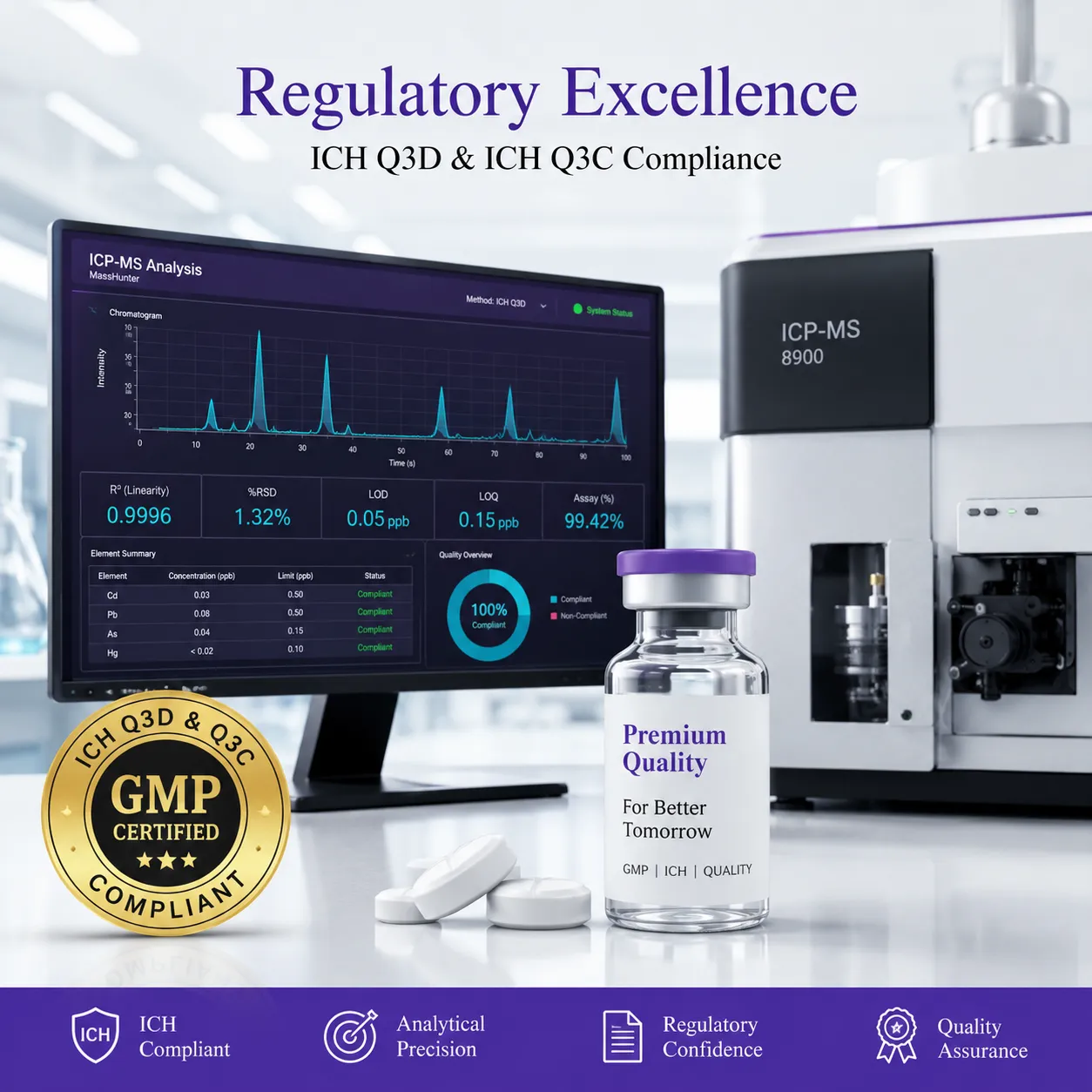

Learn ICH Q3D and ICH Q3C compliance requirements, risk assessments, PDE calculations, testing strategies, GMP expectations, and regulatory best practices.
Definition
ICH Q3C and ICH Q3D are international pharmaceutical guidelines that establish risk-based limits for residual solvents and elemental impurities in drug products. They require manufacturers to perform toxicological risk assessments, establish Permitted Daily Exposure (PDE) limits, and implement suitable analytical controls to ensure patient safety and regulatory compliance.
Modern pharmaceutical regulations increasingly focus on patient safety through scientific, risk-based quality controls. Two of the most important International Council for Harmonisation (ICH) guidelines supporting this objective are ICH Q3C (Residual Solvents) and ICH Q3D (Elemental Impurities).
These guidelines transformed pharmaceutical quality systems by replacing broad contaminant testing with toxicology-driven risk assessments. Regulatory agencies including the FDA, EMA, MHRA, PMDA, Health Canada, and WHO expect manufacturers to demonstrate compliance through documented risk evaluations, validated analytical methods, and effective control strategies.
This guide explains the practical implementation of both guidelines, including impurity classification, risk assessment methodologies, analytical testing requirements, GMP expectations, and inspection readiness.
Understanding ICH Q3C: Residual Solvents
What is ICH Q3C?
ICH Q3C provides guidance on controlling residual solvents, which are organic volatile chemicals used during:
- API synthesis
- Purification processes
- Crystallization
- Extraction
- Equipment cleaning
- Drug product manufacturing
Residual solvents may remain in final products and pose toxicological risks if not adequately controlled.
The guideline establishes limits using Permitted Daily Exposure (PDE) values.
ICH Q3C Solvent Classification
| Solvent Class | Risk Level | Regulatory Expectation | Examples |
|---|---|---|---|
| Class 1 | High Toxicity | Avoid use whenever possible | Benzene, Carbon Tetrachloride |
| Class 2 | Limited Use | Control below PDE limits | Methanol, Toluene, Acetonitrile |
| Class 3 | Low Toxicity | Generally acceptable up to 50 mg/day | Ethanol, Acetic Acid, Isopropanol |
Common Class 2 Solvent PDE Examples
| Solvent | PDE (mg/day) |
|---|---|
| Methanol | 30 |
| Acetonitrile | 4.1 |
| Toluene | 8.9 |
| Hexane | 2.9 |
| Pyridine | 2.0 |
Always verify current values against the latest ICH Q3C revision.
Practical ICH Q3C Compliance Strategy
Option 1: Cumulative Calculation Approach
Manufacturers calculate theoretical solvent contributions from:
- API
- Excipients
- Processing aids
If cumulative levels remain below PDE limits, finished product testing may not be necessary.
Example
A tablet contains:
| Component | Methanol Contribution |
|---|---|
| API | 10 ppm |
| Excipient A | 5 ppm |
| Excipient B | 3 ppm |
| Total | 18 ppm |
If the calculated daily exposure remains below the methanol PDE, risk is considered controlled.
Option 2: Direct Analytical Testing
When calculations indicate potential exceedance, testing is required.
Recommended Techniques
| Technique | Application |
|---|---|
| GC-FID | Routine residual solvent analysis |
| GC-MS | Confirmation and trace analysis |
| Headspace GC | Most common regulatory method |
Understanding ICH Q3D: Elemental Impurities
What is ICH Q3D?
ICH Q3D establishes limits for elemental impurities (trace metals) that may originate from:
- Raw materials
- Catalysts
- Manufacturing equipment
- Process water
- Container closure systems
- Environmental contamination
Unlike solvents, metals do not evaporate or degrade and may accumulate over time.
ICH Q3D Element Classification
Class 1 Elements
These require evaluation for all products due to high toxicity.
| Element | Symbol |
|---|---|
| Arsenic | As |
| Cadmium | Cd |
| Mercury | Hg |
| Lead | Pb |
Class 2A Elements
High probability of occurrence.
| Element |
|---|
| Cobalt |
| Nickel |
| Vanadium |
Class 2B Elements
Evaluated only when intentionally introduced.
| Element |
|---|
| Palladium |
| Platinum |
| Gold |
| Silver |
| Iridium |
| Rhodium |
| Ruthenium |
Class 3 Elements
Route-dependent toxicity.
| Element |
|---|
| Copper |
| Chromium |
| Lithium |
| Molybdenum |
| Tin |
| Antimony |
Route of Administration Impact
One of the most significant aspects of ICH Q3D is route-specific PDE values.
| Route | Risk Level |
|---|---|
| Oral | Lowest concern |
| Parenteral | Higher concern |
| Inhalation | Highest concern |
| Cutaneous/Topical | Product-specific assessment |
A concentration acceptable for an oral tablet may exceed limits for an inhalation product.
ICH Q3D Risk Assessment Process
Step 1: Identify Potential Sources
Evaluate:
- APIs
- Excipients
- Water systems
- Manufacturing equipment
- Catalysts
- Packaging materials
Example
A stainless-steel reactor may contribute:
- Nickel
- Chromium
- Iron
through equipment wear and corrosion.
Step 2: Estimate Potential Exposure
Calculate theoretical elemental contribution from each source.
| Source | Nickel Contribution |
|---|---|
| API | 10% PDE |
| Excipient | 8% PDE |
| Equipment | 6% PDE |
| Total | 24% PDE |
Step 3: Apply Control Threshold
A commonly accepted industry practice is:
- Below 30% PDE → Low risk
- Minimal additional controls
- No routine testing typically required
Risk justification should remain documented.
Step 4: Confirm Through Analytical Testing
When risk exceeds thresholds, testing becomes necessary.
Recommended Techniques
| Method | Suitability |
|---|---|
| ICP-MS | Ultra-trace detection |
| ICP-OES | Multi-element analysis |
| AAS | Limited applications |
Step-by-Step Compliance Implementation Guide
Step 1
Create a comprehensive impurity inventory.
Step 2
Identify all potential solvent and elemental impurity sources.
Step 3
Perform toxicological risk assessment.
Step 4
Calculate PDE-based exposure levels.
Step 5
Establish scientifically justified control strategies.
Step 6
Develop and validate analytical methods.
Step 7
Document risk assessments.
Step 8
Implement routine monitoring where necessary.
Step 9
Integrate controls into Pharmaceutical Quality Systems (PQS).
Step 10
Maintain inspection readiness through periodic reviews.
ICH Q3C vs ICH Q3D: Strategic Comparison
| Compliance Parameter | ICH Q3C | ICH Q3D |
|---|---|---|
| Primary Objective | Control residual solvents | Control elemental impurities |
| Source | Process chemicals | Metals and catalysts |
| Risk Basis | Toxicological PDE | Toxicological PDE |
| Route Impact | Limited | Significant |
| Typical Methods | GC-FID, GC-MS | ICP-MS, ICP-OES |
| Stability Impact | Can decrease over time | Does not degrade |
| Regulatory Focus | Manufacturing processes | Raw materials and equipment |
GMP and Regulatory Expectations
Regulatory inspectors frequently evaluate:
Risk Assessments
- Scientific justification
- Complete source evaluation
- PDE calculations
Analytical Controls
- Method validation
- Detection capability
- Trending programs
Documentation
- Risk assessment reports
- Change controls
- CAPA records
- Supplier qualification files
Data Integrity
- ALCOA+ compliance
- Audit trails
- Electronic records controls
Common Inspection Findings
| Observation | Root Cause |
|---|---|
| Missing elemental risk assessment | Incomplete implementation |
| Unsupported PDE calculations | Poor documentation |
| Inadequate supplier qualification | Weak quality agreements |
| Outdated solvent assessments | Change control failures |
| Insufficient analytical validation | Method lifecycle gaps |
Best Practices for Sustainable Compliance
✅ Maintain current risk assessments
✅ Qualify raw material suppliers
✅ Trend analytical data
✅ Monitor equipment wear
✅ Validate analytical methods regularly
✅ Review packaging interactions
✅ Align with USP <232> and USP <233>
✅ Integrate impurity controls into Quality Risk Management (QRM)
Regulatory References
- ICH Q3C: Residual Solvents
- ICH Q3D: Elemental Impurities
- ICH Q9: Quality Risk Management
- ICH Q10: Pharmaceutical Quality System
- USP <232> Elemental Impurities—Limits
- USP <233> Elemental Impurities—Procedures
- EU GMP Guidelines
- FDA Guidance Documents
Conclusion
ICH Q3C and ICH Q3D compliance have become foundational components of pharmaceutical quality systems. By adopting risk-based assessments, PDE-driven limits, validated analytical methods, and robust GMP controls, manufacturers can effectively manage residual solvents and elemental impurities while meeting global regulatory expectations.
Organizations that integrate these requirements into their Pharmaceutical Quality Systems not only improve inspection readiness but also strengthen patient safety, product quality, and market approval success.
FAQs
1. What is the difference between ICH Q3C and ICH Q3D?
ICH Q3C controls residual solvents, while ICH Q3D controls elemental impurities such as heavy metals and catalyst residues.
2. What does PDE mean in pharmaceutical regulations?
PDE stands for Permitted Daily Exposure and represents the maximum acceptable daily intake of an impurity.
3. Which solvents are classified as Class 1 in ICH Q3C?
Examples include Benzene and Carbon Tetrachloride due to their high toxicity and carcinogenic potential.
4. Which elements must always be assessed under ICH Q3D?
Arsenic, Cadmium, Mercury, and Lead must be evaluated for all products.
5. Is ICP-MS required for ICH Q3D compliance?
ICP-MS is not mandatory but is the preferred technique because of its high sensitivity and multi-element capability.
6. What analytical method is commonly used for residual solvents?
Headspace Gas Chromatography with FID or MS detection is widely used.
7. How often should risk assessments be reviewed?
Assessments should be reviewed during product changes, supplier changes, process modifications, and periodic quality reviews.
8. Do elemental impurity limits differ by administration route?
Yes. Oral, parenteral, and inhalation products have different PDE limits.
9. Can supplier data support compliance?
Yes. Qualified supplier information can support risk assessments when scientifically justified.
10. Which GMP systems support ICH Q3C and Q3D compliance?
Quality Risk Management, Change Control, Supplier Qualification, Method Validation, and CAPA systems are essential.